JTF (just the facts): A retrospective exhibititon consisting of a total of 27 photographs and 5 video installations, hung against white walls and displayed in darkened rooms in a series of galleries on the left side of the museum. (Installation shots and film stills below.) The show was curated by Lauren Cornell.
The following works are included in the show:
Photographs
- 6 inkjet prints mounted on Dibond aluminum (from the series “Nootka Sound”), 1996
- 4 digital chromogenic prints mounted on Dibond aluminum (from the series “Crowds and Riots”), 2008, 2017
- 3 digital fiber prints mounted on Dibond aluminum (from the series “Midcentury Studio”), 2010
- 4 digital chromogenic prints mounted on Dibond aluminum (from the series “Disco Angola”), 2012
- 1 digital chromogenic print mounted on Dibond aluminum, 2014
- 3 digital chromogenic prints mounted on Dibond aluminum (from the series “Scenes from the Blackout”), 2017
- 2 lacquered UV ink on gessoed panel (from the series “DCT”), 2017
- 3 digital chromogenic prints mounted on Dibond aluminum (from the series “2011 ≠ 1848”), 2021
- 1 inkjet print mounted on Dibond aluminum, 2024
Films/Videos
- 1 two-channel video installation (black-and-white, sound, 13 minutes 20 seconds), 1992
- 1 two-channel 16mm film projection, two-channel manipulated optical soundtrack (black-and-white, sound, 9 minutes 50 seconds), 1995
- 1 video projection (color, sound, 6 minutes 50 seconds), 1996
- 1 single-channel video projection (color, sound, 6 hours 1 minute), 2013
- 1 five-channel video installation (black-and-white and color, sound, 13 minutes 20 seconds), 2025
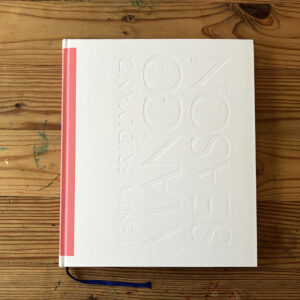
A catalog of the exhibition has been co-published by CCS Bard and the Kemper Museum of Contemporary Art, and is available from the museum (here). (Cover shot below.)


Comments/Context: The excellent Stan Douglas retrospective now on view at CCS Bard ought to be getting much more attention than it is. It’s a tightly edited survey of four decades of impressively smart art making, with very little filler, punctuated by a knockout new video installation worth the trip up to the bucolic college campus all on its own. Liberally mixing photography and video, in an almost back and forth rhythm, the show makes abundantly clear just how conceptually incisive and technically innovative Douglas has been since the early 1990s. As a step-wise argument for his enduring artistic importance, it’s altogether persuasive.
Douglas is a native of Vancouver, Canada, where he still lives and works, so it makes sense that this sampler first locates us in that formative location. Early projects consider the impact of settler colonialism on the island and its surroundings, photographically documenting pulp mills and outposts along the coastline, deep mining scars and graffiti on ancient rocks, and Indigenous totems housed in a Christian church. His 1996 video “Nu•tka•” makes this historical tension even more visible, with sweeping natural views of the bays and mountainsides split into two alternating feeds that are spliced together, raster line by raster line, creating shifting layers and unstable overlaps that are matched by two stacked voiceovers, representing the thoughts of two English and Spanish explorers/colonial agents; the resulting landscape feels intentionally conflicted and unresolved, with competing forces seeking to exploit the territory for their own purposes.
By the mid 2000s, Douglas had begun to refine a sophisticated approach to the increasingly available powers of digital photography, creating large scale staged tableaux constructed from painstakingly assembled combinations of studio-based setups and source imagery. Many of the moments captured in his “Crowds and Riots” series from 2008 feel poised at the edge of breakdown or upheaval, each incident recreated with intense attention to historical accuracy, steeping these “memories” in hyper-real detail. His choices jump around from decade to decade, including a 1912 protest against bans against public assembly (at the Powell Street Grounds), a 1955 crowd in the bleachers at the Hastings Park horse racing track, and a 1977 clash between police and hippies at a “smoke-in” (known as the Gastown Riot), each moment in Vancouver history testing his ability to seamlessly merge small multiple narratives and personalities into one compellingly coherent scene. The 1970s-era night riot scene is particularly impressive in that it locates half a dozen encounters under the street lights at the corner of Abbott and Cordova, from police on horseback and in riot helmets dealing with running protestors to curious bystanders, crowds, and bored kids.
In Douglas’s next two projects, he pushed this meticulous staging approach further and further, not just continually improving the apparent authenticity of his craft but turning the projects into performative impersonations, where the artist himself is taking on a particular role and making pictures in that style. In “Midcentury Studio” (previously reviewed here), Douglas becomes a Weegee-like 1940s-era black-and-white press photographer, capturing a dark sunglassed crime boss in the back of a police car and a group of men shooting dice in a stairwell. And a few years later, in “Disco Angola” (previously reviewed here), he casts himself as a 1970s-era photojournalist straddling the disco scene in New York and the war for independence in Angola, making images of both, intermingling party goers in silk suits and jock straps with revolutionaries and refugees. Both of these bodies of work feature standout images that walk a deliberately muddy line between truth and fiction, with the artist actively inhabiting someone else.
The overarching concept of performative recreation is given more freedom in two of Douglas’s video works, where the idea of musical improvisation is central to the staging and “documentation”. In his 1992 video “Hors-champs”, Douglas presents two versions of a free jazz session where a group of four musicians (bass, saxophone, trombone, and drums) performs Albert Ayler’s “Spirits Rejoice” from 1965. One side of the screen follows the line of the performance, from one improvisational hand off to the next, almost like a TV production, while the other side generally looks away from the playing, watching the idle musicians as they wait, listen, and anticipate, as in outtakes; moving back and forth between watching one side or the other is a fascinating visual exercise in inclusion/exclusion, of identifying what is to be seen and what is to be overlooked in any one moment in a collaborative artistic activity.
More than twenty years later, Douglas returned to this idea of extended improvisation with his video “Luanda-Kinshasa” from 2013 (previously reviewed here). Here the band is bigger, the style is more ’70s jazz funk (with another look back to the cultural interaction of the US and Africa), and the process is much longer, taking shape as some six hours of hypnotic improvisational evolution. Douglas is once again elegantly precise in his costuming, staging, and recreation, but instead of an examination of editing, he gives us the raw material of a longer duration experience, where the music continually shifts and wanders, with one musician taking over from another in a flow state. What’s unexpectedly exciting about such a lengthy jam session is that it places our attention on what might happen, with each moment surprisingly unstable, with the potential to go one way or another. Many of Douglas’s earlier staged photographs have this same frozen tension or potential, but “Luanda-Kinshasa” roots us in that trance-like uncertainty more deeply, seemingly always waiting for a change to occur.
In the following years, Douglas came back to the reconstruction of single moment scenes. His 2014 image of Hogan’s Alley in Vancouver, a historically black community demolished in the 1930s, is a knockout recreation, capturing an elevated nocturnal view of textural wooden houses and outbuildings intermittently lit by streetlights and glowing windows; here Douglas’s complex exploration of the truth of documentary photography becomes an understated effort in wholesale re-imagining, breathing life back into a history long overlooked. His “Scenes from the Blackout” project from 2017 (previously reviewed here) resets the geographical focus to New York City, once again using the darkness of night as a catalyst for friction and uncertainty, finding a balance between the solitary waiting of being caught in an elevator and the communal experience of gathering on the post office steps, with the lawless danger of a burning trash can, scattered mannequin limbs, and a police horse without a rider offering a wary sense of implied suspense. Douglas also re-embraced protests and riots as resonant subject matter, in his series “2011 ≠ 1848” from 2021, which adds an Occupy Wall Street protest on the Brooklyn Bridge, a peaceful twilight moment in Tunis during the Arab Spring, and the burning car shouting and mayhem of the Vancouver hockey crowd after the Canucks lost in the Stanley Cup finals to his parade of singular moments when order is on the edge of breaking down.
While race has always been a key part of Douglas’s work, in his most recent projects, he has turned to literary and cinematic sources as inspiration, re-inventing them with altered racial awareness. His 2024 project “The Enemy of All Mankind” (not on view here, previously reviewed here) used an 18th century comic opera as the basis for a series of reconstructions that amplify the racial (as well as gender and class) complexities in the satirical story. And this retrospective survey culminates in a new five-channel video work that offers a shot-by-shot recreation of an extended scene from D.W. Griffith’s 1915 film “The Birth of a Nation”. More than a century after its making, Griffith’s epic film remains a polarizing cultural relic, mixing bold innovation in early filmmaking with undeniably overt racism. Douglas has chosen a pivotal set of scenes in the film when Gus (a free former slave, played by a crazed looking white man in blackface) pursues a young white woman through the nearby forest; she ultimately falls to her death from a rocky cliff, and the man is chased down and summarily lynched by the Ku Klux Klan. Douglas sets up a powerful comparison, placing the original film in the center, and four simultaneous recreations around the outside, creating a reverberating story that shifts back and forth between the original and the new interpretations. Douglas also tweaks the details of the narrative, removing Gus and replacing him with two other actors playing black freedmen who get caught up in the confusion; he also adds uncertainty to the story, changing the woman’s apparent jump, or push, to a slip, thereby altering the apparent truth (and responsibility) of the situation. The result is an uneasy (and unresolved) tale of mistaken identity, which ends not only with a lynching, but with a breaking of the fourth cinematic wall, where Douglas switches to color, shows us the stage set where the lynching has been set up, and ends with a horse in KKK garb slowly wandering through the sound stage. It’s a powerfully engaging work, offering plenty of opportunities for wrestling with and rethinking American cultural and racial history.
Curatorially, the show both begins and ends with a recent 2024 image of the now-closed Los Angeles Theater, the darkly cavernous space lit by a single bulb on the stage. Its title “Ghostlight” (and the title of the show) refers both to this literal light source and the superstitions of former theater workers, who traditionally leave a light on so that the ghosts can perform. It’s an apt visual metaphor for Douglas and his artistic practice, and his collaborative efforts to help historical ghosts to re-enact their various scenes. This show is Douglas’s first survey in the United States in over twenty years, but we deserve to see his work celebrated more often and more broadly. Not only has he been adept at making works that are richly media and technology aware, he has consistently located us in places where “history could go one way or the other”, offering us chances to reinterpret moments of doubt, upheaval, and even violence. It’s at these rupture points that we see ourselves laid bare, Douglas’s artworks forcing us to confront these many ghosts and to consider how they might actually reflect our present.
Collector’s POV: Since this is a museum exhibition, there are of course no posted prices. Stan Douglas is represented by David Zwirner in New York (here) and Victoria Miro in London (here). Douglas’s photographic work has been available at auction only intermittently in recent years, with very few of his more recent large-scale images coming up for sale. Recent prices have ranged between roughly $10000 and $69000, but this data may not be entirely representative of his entire body of work, including his videos.