JTF (just the facts): A total of 66 photographs by Robert Rauschenberg, as well as other artworks and ephemera by the artist and others, generally framed in black and matted, and hung against light grey walls in a series of divided spaces on the second floor of the museum. The exhibit was curated by Sean Corcoran. (Installation shots below.)
The following works are included in the show:
Entry Area (images of Rauschenberg)
- 7 gelatin silver print reproductions, 1961 (by Fred McDarrah), c1962 (self-portrait), c1964 (possibly by Hans Namuth), 1972 (by Gianfranco Gorgoni), 1980 (self-portrait), 1981 (unattributed), 1982 (possibly by Babelle)
Early Photographs
- 13 gelatin silver prints, 1951, c1951, 1953, c1953, 1954, 1955, 1958, c1962
In + Out City Limits
- 53 gelatin silver prints, 1980, 1981, 1983
Pictures at Work
- 1 oil and silkscreen ink on canvas, 1963
- 1 gelatin silver prints mounted on aluminum, 1981
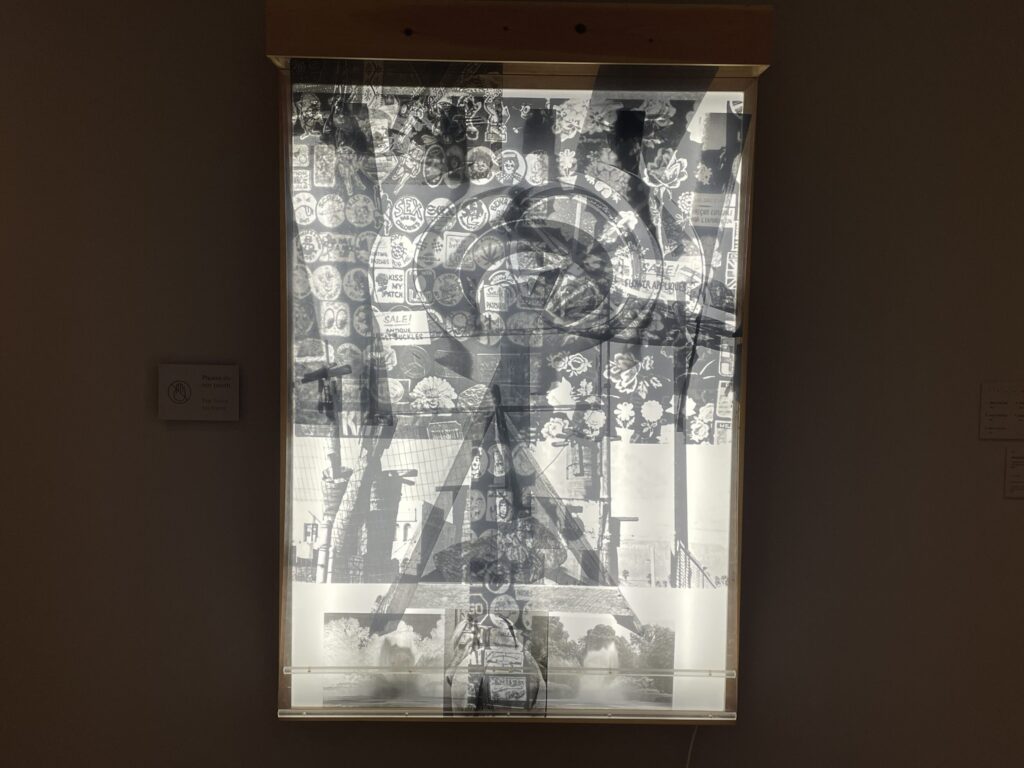
- 1 lightbox assemblage with lithography and screen printing, 1985
- 1 photogravure, 1988-1990
- 1 silkscreen ink and acrylic on anodized mirror aluminum, 1991
- 1 silkscreen ink and acrylic on mirrored aluminum, 1992
- 1 silkscreen ink and acrylic on aluminum, 1994
Ephemera
- 1 poster, 1982
- 1 magazine spread 1951
- 1 hand-written statement, 1961
- 1 gelatin silver print (installation), 1951
- 5 gelatin silver prints, early 1950s, 1950s, 1952, 1954-1955, undated
- 2 gelatin silver print contact sheets, 1980, 1981
- 1 handwritten statement, 2001
- 1 gelatin silver print (by Emil Fray), 1981
- 1 video excerpt (WCBS-TV), 8 minutes 37 seconds, 1967
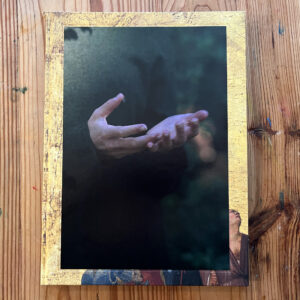
A catalog of the exhibition has been co-published by GILES and the museum (here). (Cover shot below.)




Comments/Context: One of the things to appreciate about the Museum of the City of New York is that its fundamental mandate – to celebrate and interpret this great city – gives it a very particular subject matter centric vantage point for engaging with artists. Almost regardless of what an artist may have done in his or her larger career, and where (or even why) he or she may have done it, what the MCNY is essentially solely interested in is how the artist engaged with the glorious complexity of New York city. As a filter for what’s in and what’s out, it’s refreshingly clear, and over the years within its consistently robust photography program, the museum has presented a broad range of image-making perspectives and approaches as applied to the people and places of the city.
This year marks the centennial of Robert Rauschenberg’s birth (1925–2008), and a dizzying array of Rauschenberg exhibits and activities have been planned for the coming year, including no less than seven museum exhibitions, covering different bodies of work from different periods and different geographies, as well as investigations of his lesser known approaches to materials (including fabrics, costumes, and sound), and another twenty-plus centennial grants provided by the Rauschenberg foundation to mount permanent collection installations at various institutions. For the next year, the “Rauschenberg 100” is going to saturate the art world landscape, bringing the artist back into the contemporary conversation again and again from alternate angles.
Rauschenberg’s relationship with photography is complicated, and undeniably worth a deeper scholarly examination. Even the most casual Rauschenberg fan understands that many of his artworks leverage photographic imagery in one way or another, that he has variously collaged, transferred, or silkscreened into complex juxtapositions. And while many of those images were appropriated from mass media sources like newspapers and magazines, at different times in his career, Rauschenberg did pick up a camera himself, making both stand alone photographic works and photographs that became the visual raw material for still other artworks. Conceptually, this show comes at Rauschenberg through two separate filters: first, exploring some of the valences of his efforts as a photographer, and second, narrowing that focus down even further, within the context of the MCNY, to example images that he made in New York city.
For an artist born in west Texas, New York city plays a surprisingly central role in Rauschenberg’s artistic life. After a turn through the US Navy during WWII and art studies in Paris afterward, Rauschenberg moved to New York to follow his path as a young painter. Starting in 1948, he attended Black Mountain College in North Carolina, where he was exposed to a range of different artistic practices, including photography. His first real forays into the medium came in those college summers back in the city, when he experimented with expressively large scale cyanotypes (some with nude figures) with his new wife, Susan Weil. By the early 1950s, Rauschenberg had become more engaged with photography, using a Rolleicord camera to make his own square format black-and-white portraits and observations, experimenting with light, shadow, blur, and flattened space. Several of these works (that were made in New York) are featured in a small selection of early photographic efforts that opens this show, including a darkly isolated light bulb, a cropped view of Cy Twombly’s hairy chest at the beach, and an unbalanced portrait of David Tudor in Merce Cunningham’s empty studio. Observant portraits of Cunningham and Jasper Johns soon followed, as did an image of the storefront window of a Chinese laundry, which not only features a young girl unexpectedly sitting in the window, but shows hints of Rauschenberg’s future interests in framing, division, layering, and structural vision. (A few of these images would become part of an early portfolio of 12 photographs published by Sonnabend Gallery in 1980.)
It was around this same time that Rauschenberg started to work on his first combines, scavenging found objects and materials (most discovered on the streets of the city) and remixing them into what would become his most influential body of work, merging painting, sculpture, and assemblage, and bringing the “real world” into his art. Some of these works incorporated collaged vernacular imagery and family photos, but during these years (through the 1950s and into the 1960s), Rauschenberg drifted away from his own photography for mundanely practical reasons – his cheap cold water flats and workspaces couldn’t accommodate a darkroom (the chemicals froze all winter), and later (in 1967) his one camera was stolen. Throughout the next decade, Rauschenberg consistently leveraged mass media and found imagery, incorporating the pictures into his compositions via various direct transfer methods and silkscreening (as seen in a short video clip from 1967, with Rauschenberg working on his “Revolvers” with his studio assistant Brice Marden). But it wasn’t until 1979 when the choreographer Trisha Brown asked him to develop the set, costumes, and lighting design for a new dance work (ultimately titled Glacial Decoy) that Rauschenberg really returned to photography; for that project, he made a four screen slideshow backdrop with changing photographic imagery (consisting of more than six hundred black-and-white images made near his second home in Captiva, FL), which put a camera back in his hands and launched him back into making his own pictures.
Back in his days at Black Mountain College, Rauschenberg had come up with the audaciously ambitious (and impractical) idea to photograph the whole of the United States “inch by inch”, and in a sense, he returned to this fantastical idea (in somewhat more abbreviated scope) in the following years. The project “In + Out City Limits” took him to six cities (Baltimore, Boston, Charleston, Fort Myers, Los Angeles, and New York) over the course of a few years (1979-1981), and this show brings together more than fifty of the images he made in New York city during this time, providing a New York-centric snapshot of the larger effort.
The history of photography in New York is of course filled with street photographers of different kinds, who have captured the momentary arrangement of pedestrians, architecture, signage, and other elements found in the chaotic fabric of the city. Rauschenberg was similarly seduced by “this constant irrational juxtaposition of things” (as he described it in a 1966 interview), and while his images don’t always neatly fit into the street photography genre, they certainly take an active interest in how the eye of the camera can be used to frame fleeting observations and combinations of visual elements. Often, he seems to be learning the lessons many camera students teach themselves about photographic seeing, but with a particular emphasis on how disparate things can overlap, interrupt, interact, and fit together (ideas he had explored with sophistication in his combines), where structural elements create order (and even alignment) out of passing movement.
Rauschenberg is by no means the first photographer to look up at the buildings and skylines of the city and see flattened geometric patterns in the mix of old and new, where brick and iron meet glass and steel, creating jagged overlaps, stair steps, skewed angles, reflections, and other sliced and layered possibilities. He successfully arranges views like these at various points around town, incorporating the World Trade Center towers into one composition and the jumping pegasus of a Mobil sign into another. One densely layered image brings together a man sitting on the angle of a ladder set on a sidewalk while fire escapes, street signs, and a passing truck further interrupt the usual cacophony of building forms. Another picture pushes the flattening effect to near trompe l’oeil in a setup framing the dome of a church located in a curtained hotel window, the patterns inside and outside seeming to match.
If there is one motif that runs through Rauschenberg’s photographs most often, it is windows. He consistently notices pairs and sets of windows and the surrounding architectural details of moldings, brickwork, arches, and other surface decorations, with criss cross grating, painted stripes, and the possibilities of open and closed blinds of different kinds changing the way the rectangles function in space. Several of these images recall similarly ordered works by Aaron Siskind, who Rauschenberg knew from Black Mountain College and who shared a sense for how photography could be used to transform the raw material of the world into art. Other window works by Rauschenberg aim their attention at storefronts, particularly windows filled with dancing figurines, neon signs, patterned rolls of flooring, and the interrupting and abstracting force of glass reflection.
Some of these storefronts have a compositional picture-within-a-picture sensibility, where arrangements of patches and belt buckles or silhouettes superheroes are isolated and re-imagined. Rauschenberg then branches out to commercial signage and other graphic elements that catch his eye, from the Wong Wong store to the Jones Diner, with Perfect TRAVEL (with a flowered van in front), a water droplet on a delivery truck, graffiti skeletons, a neon pencil, and wheatpasted dollar bills adding symbolic energy to the flow of the city. His instinct for juxtaposition also kicks in with these kinds of bold visual discoveries, the combination of a man carrying a tray of burgers up an escalator under the watchful eyes of the Statue of Liberty arranged into neat blocks.
Many of the other images on view here might be gathered together under the broad heading of “urban incidents and observations”, where the eccentric serendipity of the city meets the light and dark contrasts of monochrome photography. Rauschenberg finds an off kilter street sign, a tire left around a fire hydrant, a twist of hose draped over a bubbled stairway, a set of four houseplants, and two men straining to turn a bolt, each scene with its own puzzling “what’s happening here” energy. Other images are all about the visual properties of photographic white and black, including a white bird on black water, a man in a white t-shirt holding a large white Styrofoam cup, a white bicycle left on the street, a dark stack of nearly unreadable shadowed signs, a crusty fire hydrant tucked into the shadow of a plywood shell, and a darkly silhouetted man standing between two posts.
The last section of the show offers a handful of examples of works in other mediums (made between the early 1980s and the mid 1990s) that actually leverage the specific photographs on view nearby, creating a clear echo of source material reuse, re-presentation, and recontextualization. A 1981 work from Rauschenberg’s “Photem” series reimagines mounted images in a totem-like tower, with patterns and structures linking the pictures together. A few years later, a 1985 work from the “Sling Shots Lit” series places some of the NY images on hanging sheets in front of a lightbox, creating dense thickets of overlapped imagery. In 1988-1990, Rauschenberg merged images from New York with images from the USSR, creating a juxtaposed Soviet/American arrangement in photogravure. And into the early 1990s, he started to experiment with printing on mirrored aluminum, first reusing his city photographs in ghostly tones (in the 1991 “Phantom” series), and then adding colors (in the 1992 “Shiner” series), ultimately moving back to silkscreened colors on white canvas in a 1994 work (from his “Urban Bourbon” series). Seeing the photographs jump from one iteration (and medium) to the next emphasizes just how much of a magpie collector Rauschenberg was, his own photographs becoming a visual archive (not subject to the whims of copyright and appropriation law) that he could redeploy at will, even many years later.
Rauschenberg’s photography deserves more singular thought and attention, not necessarily because he was a master photographer, but because throughout his career, he was at the forefront of using photography in improvisationally malleable ways. His last gallery show of photography in NY was in 2013 (reviewed here) and this show marks his first museum exhibit in the city to focus solely on his camera work. There is a certain logic to having it take place at the MCNY, given Rauschenberg’s major impact on the postwar art world around town, and by narrowing the curatorial span of this show down to just his New York pictures, the result is a tightly controlled investigation where we can follow the artistic breadcrumbs from one photographic idea to the next. From our contemporary vantage point of near constant photographic recirculation, Rauschenberg feels like a risk-taking cross-disciplinary pioneer, using his camera to make visual notes that then flowed through his art like swirling reusable fragments of the ever-changing and metastasizing world around him.
Collector’s POV: Since this is a museum exhibition, there are of course no posted prices. Robert Rauschenberg is represented by Pace Gallery in New York (here). His photographic works have been intermittently available in the secondary markets in the past decade, as both single prints and as portfolios, with prices ranging from roughly $1000 to $56000. Larger multi image constructions, photocollages, and combined works that are photography-centric (typically found in contemporary art sales) have ranged between roughly $20000 and $350000.