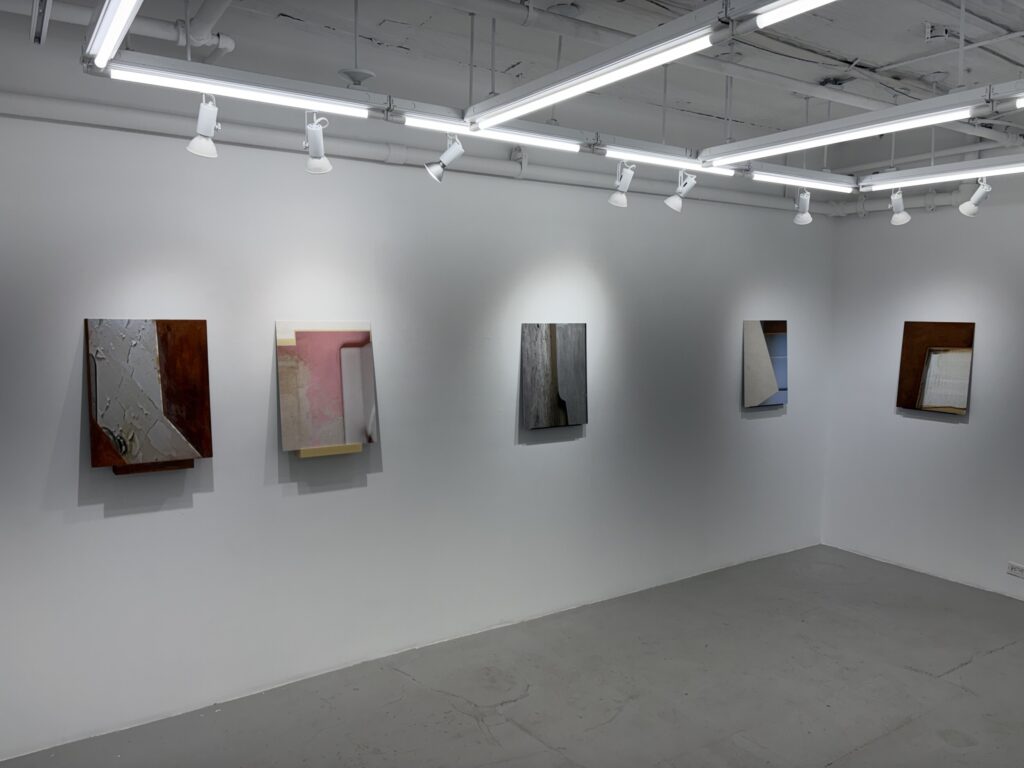
JTF (just the facts): A total of 12 works, installed on custom pedestals against white walls in the downstairs project room. (Installation shots below.)
The following works are included in the show:
“Constitum”
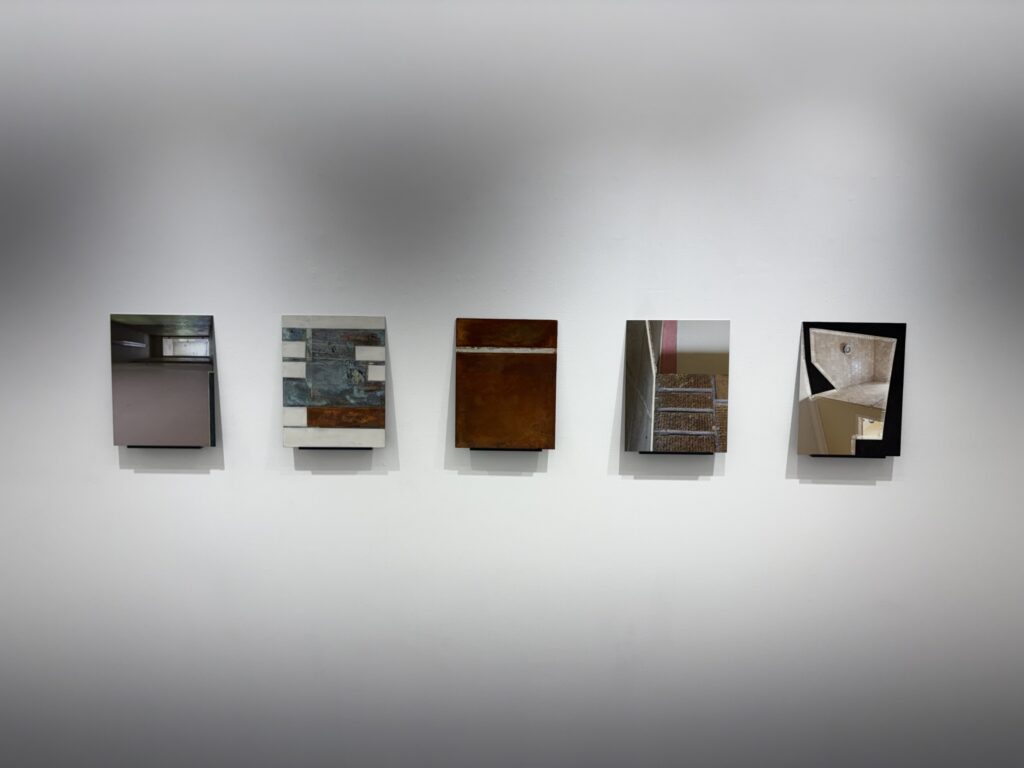
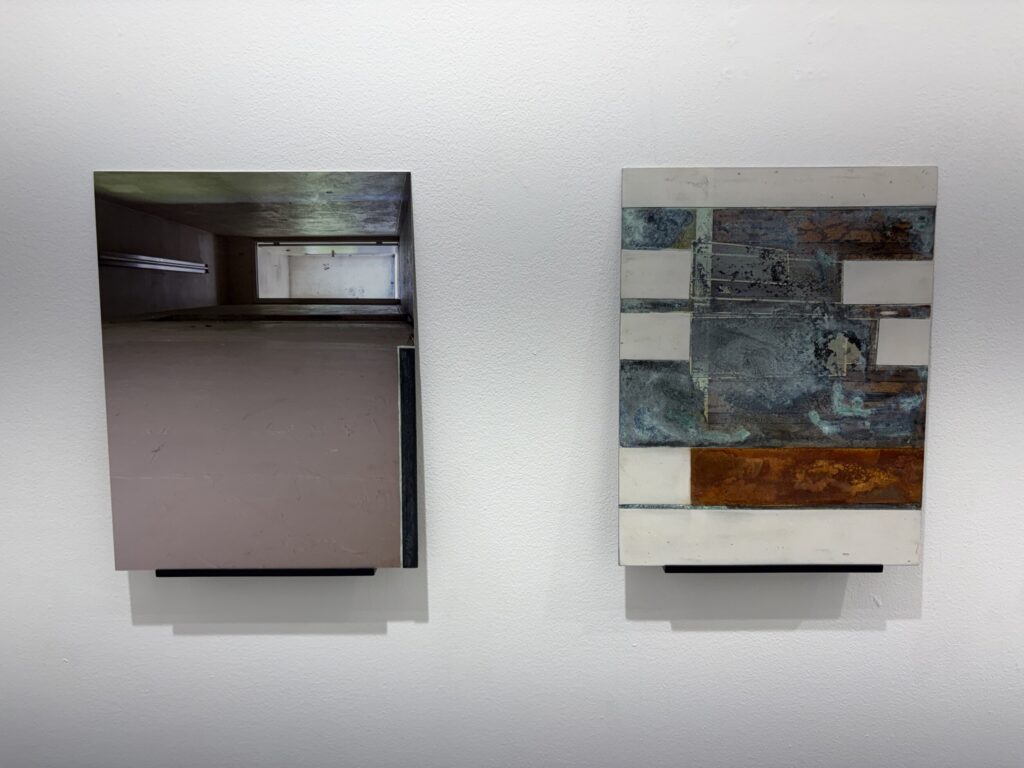
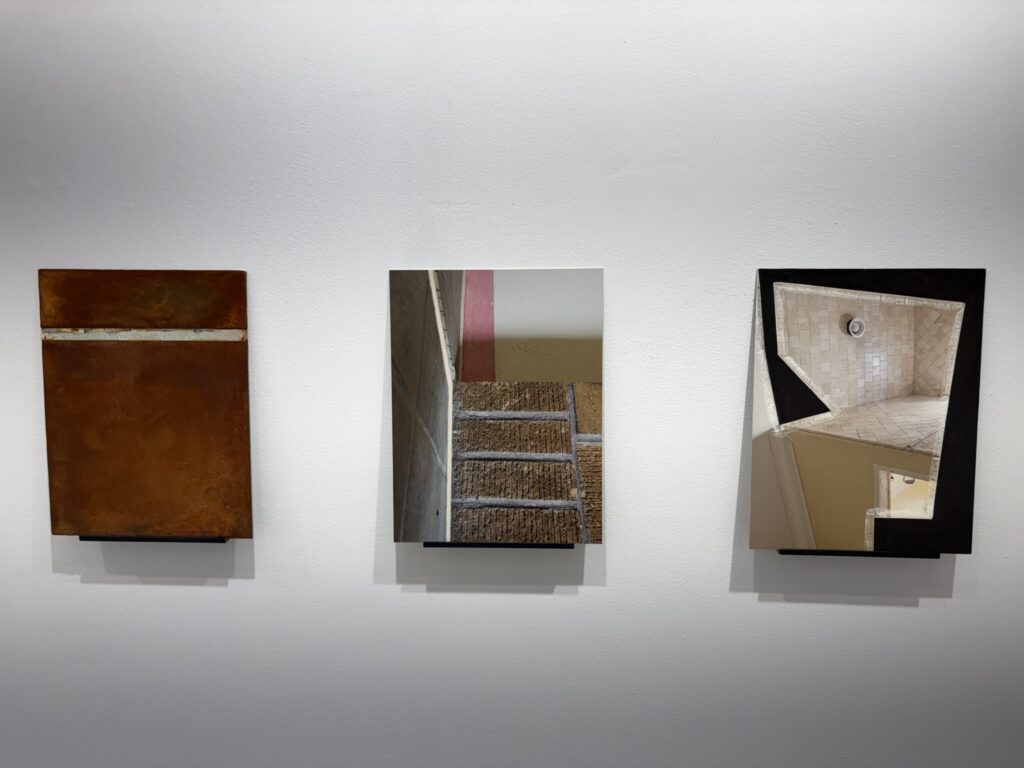
- 1 pigment print mounted on aluminum, aqua resin, bronze paint, bronze powder, acrylic binder, wood, 2016, sized roughly 11×9 inches (plus shelf), unique
- 1 pigment print mounted on aluminum, silica powder, mica powder, pumice, whiting, steel powder, bronze powder, acrylic binder, wood, 2016, sized roughly 11×9 inches (plus shelf), unique
- 1 pigment print mounted on aluminum, whiting, mica, iron paint, steel powder, glass powder, acrylic binder, wood, 2016, sized roughly 11×9 inches (plus shelf), unique
- 1 pigment print mounted on aluminum, silica powder, pink mica powder, pumice, whiting, acrylic binder, wood, 2016, sized roughly 11×9 inches (plus shelf), unique
- 1 pigment print mounted on aluminum, mica powder, bronze powder, acrylic binder, wood, 2016, sized roughly 11×9 inches (plus shelf), unique
“Geometria Concretus”
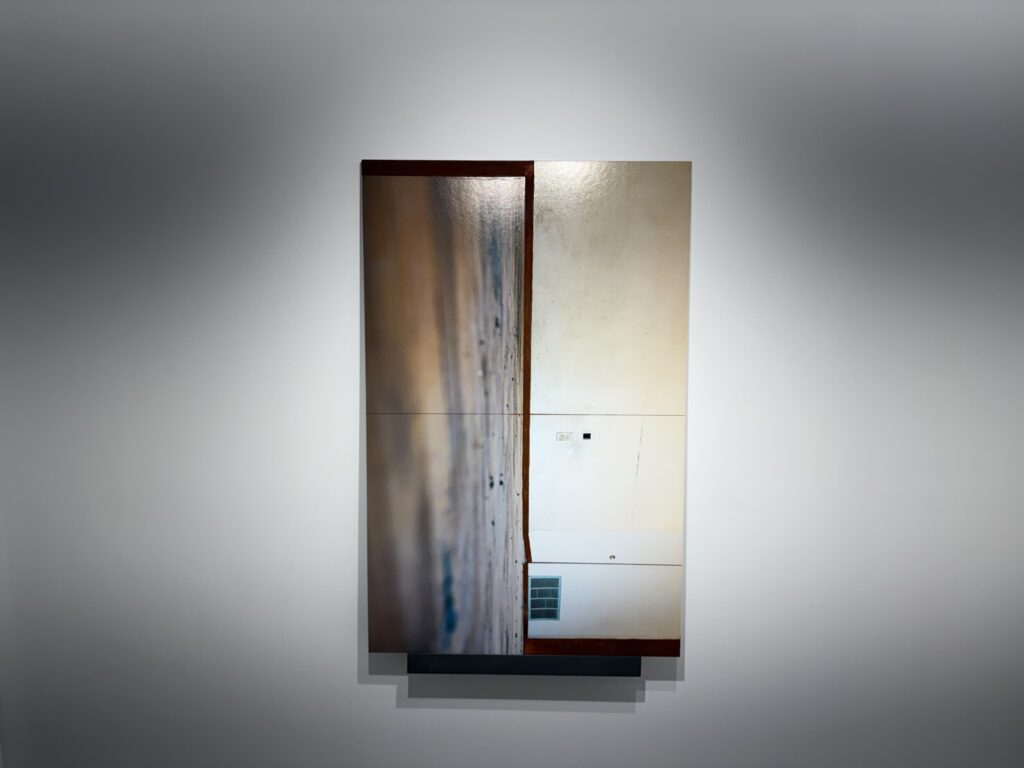
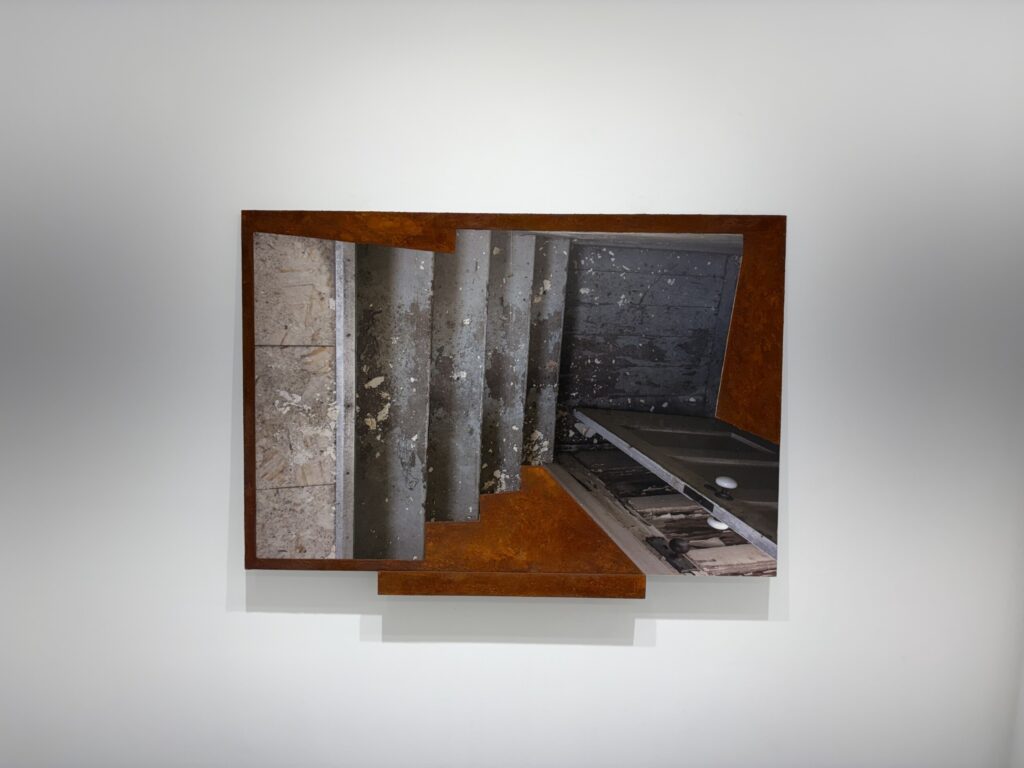
- 1 pigment print mounted on Dibond, steel powder, acrylic binder, cast polyurethane, hardware, 2012, sized roughly 34×22 (plus shelf), unique
- 1 pigment print mounted on Dibond, steel powder, acrylic binder, iron paint, glass flake, cast polyurethane, hardware, 2014, sized roughly 22×34 (plus shelf), unique
- 1 pigment print mounted on aluminum, steel powder, acrylic binder, cast polyurethane, hardware, 2012, sized roughly 22×17 (plus shelf), unique
- 1 pigment print mounted on aluminum, marble dust, acrylic binder, cast polyurethane, hardware, 2014, sized roughly 22×17 (plus shelf), unique
- 1 pigment print mounted on aluminum, steel paint, aluminum paint, glass powder, mica powder, acrylic binder, wood, 2015, sized roughly 22×17 (plus shelf), unique
- 1 pigment print mounted on aluminum, mica powder, rabbit skin glue, wood, 2016, sized roughly 22×17 (plus shelf), unique
- 1 pigment print mounted on aluminum, steel paint, steel powder, glass powder, mica powder, acrylic binder, wood, 2015, sized roughly 22×17 (plus shelf), unique
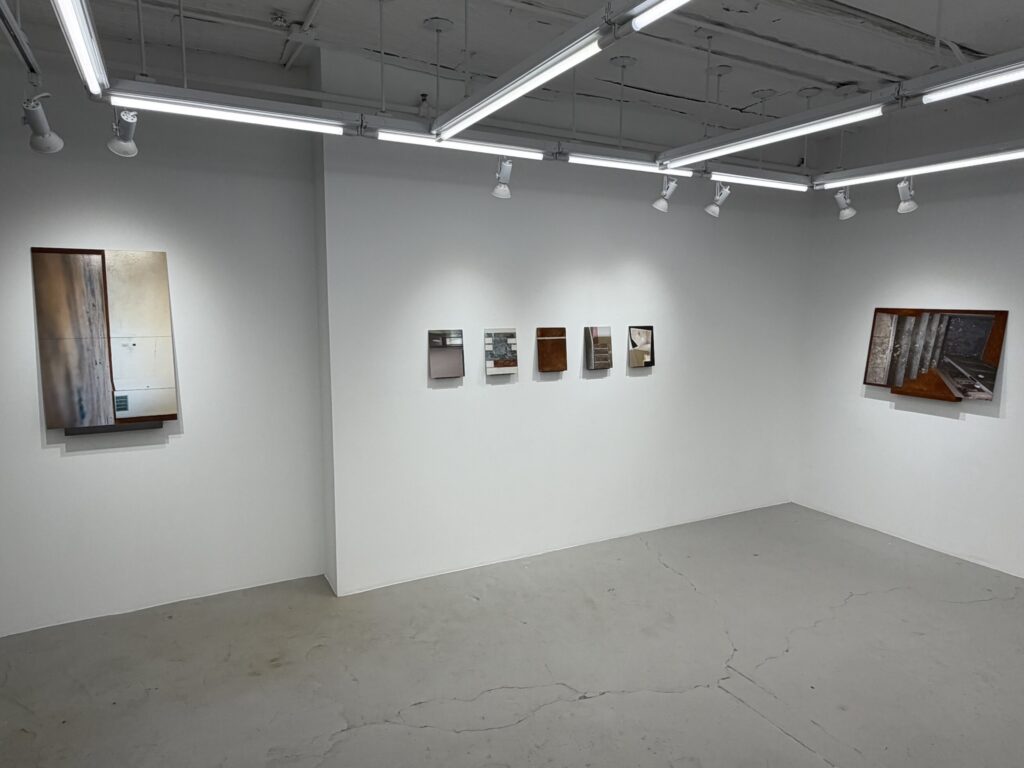
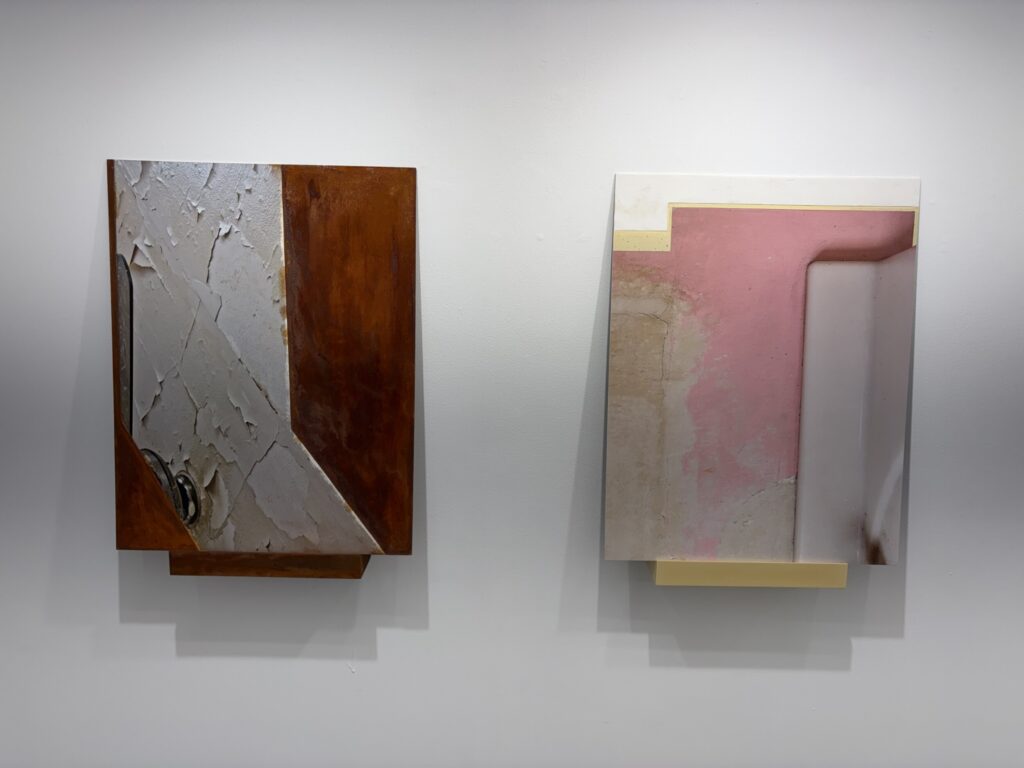
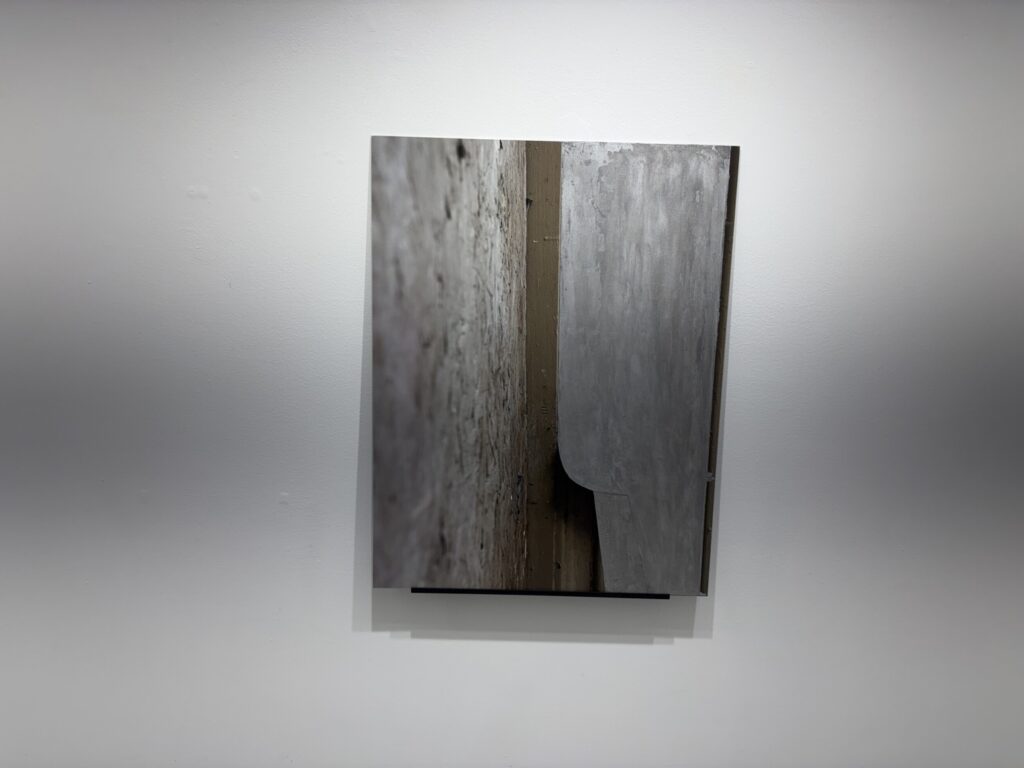
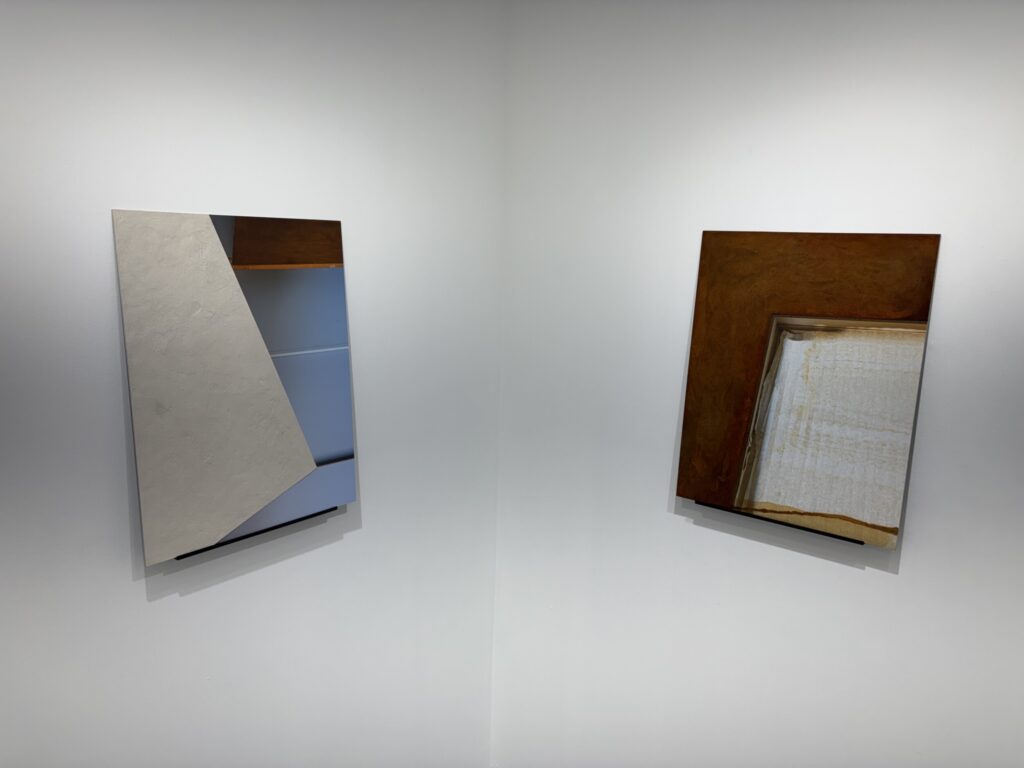
Comments/Context: When a sculptor crosses over into the realm of photography, there is an inherent friction in his or her conceptual vantage point between three dimensions and two. In a simplistic sense, the spatial dynamics of the two artistic mediums are different – sculpture (regardless of whether it is made via addition, subtraction, casting, or assemblage) operates in the context of the space around it, while a photograph flattens whatever is in front of the lens (including the surrounding space) into a single visual plane.
What’s intriguing about Lucy Puls’s photographic works is that they turn the conceptual crank between sculpture and photography yet another notch or two. Many of the artist’s earlier works and projects have considered how discarded objects could be reimagined and repurposed in a variety of ways. But back in 2009, in the aftermath of the 2008 financial crisis, Puls started make photographs of the interior spaces of empty foreclosed homes, seeing what remained when people were forced to leave and thinking about how those vacated decaying locations functioned sculpturally (in a parallel way) as “discarded spaces”.
Her images from that time are often disorientingly angled – looking up from the floor, down from the top a flight of stairs, or up close at various architectural details – creating fragmented views punctuated by strict geometries, rough textures, and blocked colors. In some cases, Puls has then rotated or flipped the images, making their resulting perspectives all the more deliberately confusing, with ceiling light fixtures on side walls, windows upside down, moldings poised at unexpected angles, and floors tumbled over like the fight scene in Inception. Her photographic vision of these empty spaces transforms “nothing” into something, the leftovers becoming the main attraction and the flattening effect of the camera defining new spatial relationships and possibilities.
Photographically, this road has been traveled before, with numerous photographers across this history of the medium turning decayed rooms with peeling paint and dusty corners into stage sets for spatial abstractions and up-close observations. Where Puls steps away from the pack is her unexpected return to sculptural physicality, in the way her photographic objects are further interrupted, embellished, and presented.
As the title of this show implies, Puls has thought of her interventions and alterations as a kind of “righting” or correction, a way of repairing the displacement situation implied by the emptiness of the rooms. In each work, Puls masks or alters certain sections of the underlying photographs (generally with geometric precision), using a range of physical materials that offer different texture, surface, and color options. Each photograph is mounted to aluminum or Dibond, giving it a thick object quality, and the modified prints are then displayed on different kinds of wall-mounted pedestals, some carefully matched to the materials used in the interventions. Her results turn each of the photographs into a kind of visual framework or template that is then actively reconsidered using her sculptural processes and techniques.
The two largest works in this small show use rusty steel powder coatings to rebalance the dynamics of the spaces. In one work, Puls’s intervention changes the relationship between floor and wall in a rotated composition, like two hands of a scale; in the other, the mottled rusty areas further disorient our perception of a view down some stairs to an open doorway, erasing the usual cues of depth and distance. In both cases, we have a sculptor deliberately altering the balance of the spatial weights (as captured in the photograph), moving away from documentation and toward interpretive re-vision.
A selection of smaller works seems to function like a set of experiments or maquettes, as if Puls was testing out ideas in a lower stakes manner before enlarging the works to full scale (and cost). One of the artistic questions she seems to be wrestling with in these small works is how much downstream intervention is necessary or effective. A couple of the works opt for minimal rework, following and amplifying lines found the rotated views. Another pair go the other way, covering nearly all of the underlying images with strips and blocks of textural coatings, in essence hijacking our perception and leaving less identifiable clues behind to orient our interpretation. And one more work experiments with erasure/removal, with a jagged strip border around a tiled bathroom ceiling seemingly lifted up like tape, leaving behind only part of the original emulsion underneath.
The mid-sized works have a more refined touch, with Puls often choosing bolder blocks of sculptural intervention. Again, the intention seems to be toward spatial rebalancing, polygons of rust changing the relationship of a peeling wall to a nearby fixture, and an edging of polyurethane playing against the shiny porcelain of what looks like the bottom of a toilet. In other works, the geometric color blocking gets even more forceful, with masked areas of texture that tussle with the lines, windows, floors, and other visual elements in the photographs, particularly when they are rotated off kilter.
By reintroducing three dimensions back into a framework of two, it’s like Puls is extracting new balance points from the elements in the pictures, making the once three-dimensional scenes sculptural once again after an interlude in flatland. Puls isn’t the first artist to try to bring an element of three dimensionality to photography (particularly through layering, collage, and image construction techniques), but her approach feels rooted somewhere else – in materials, surfaces, and hand-crafted forms. She takes overly easy embellishment (like overpainting) and pushes it into a more extreme range, where her tactile interventions fundamentally reorient our experience of the space we see. Conceptually, that’s a line of thinking (with its own fulcrums of pulling and pushing) that feels richly complex and worth more investigation.
Collector’s POV: The works in this show are priced at $6500, $12000, or $18000, based on size. Puls’s photographic works have little secondary market history at this point, so gallery retail likely remains the best option for those collectors interested in following up.