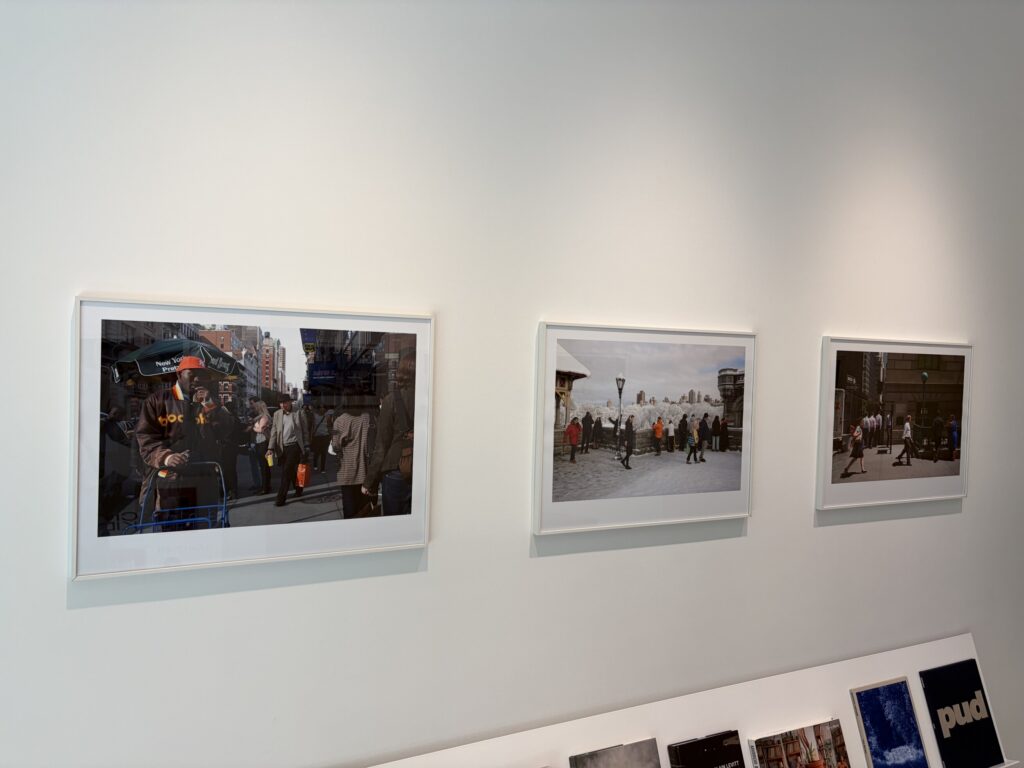
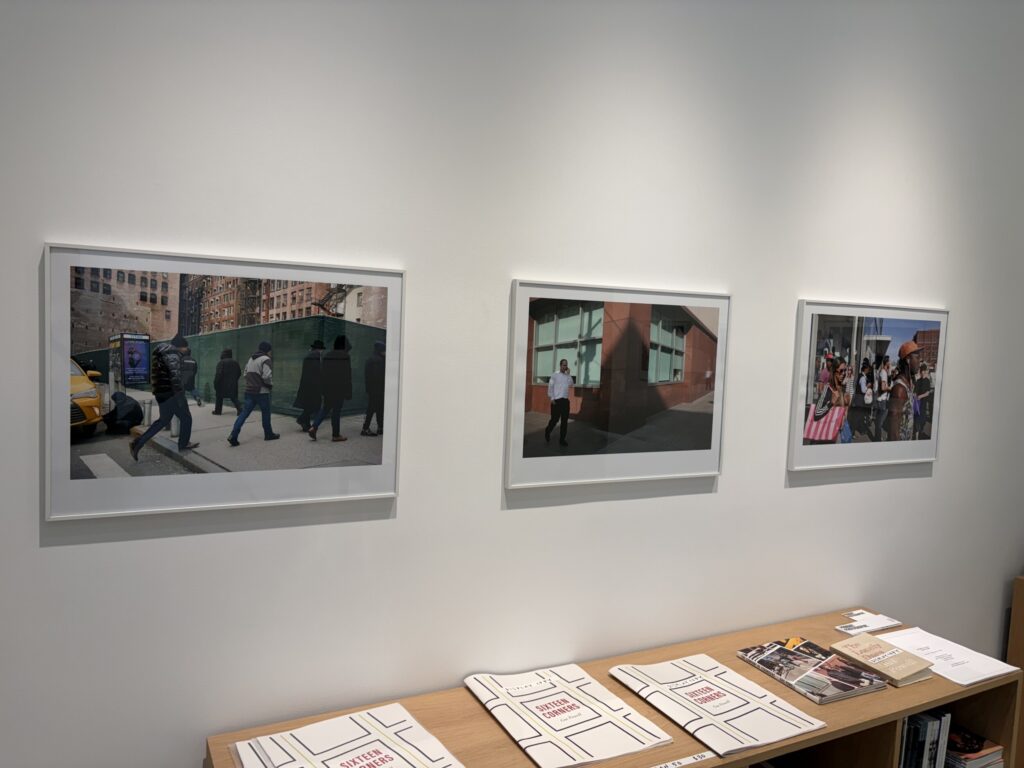
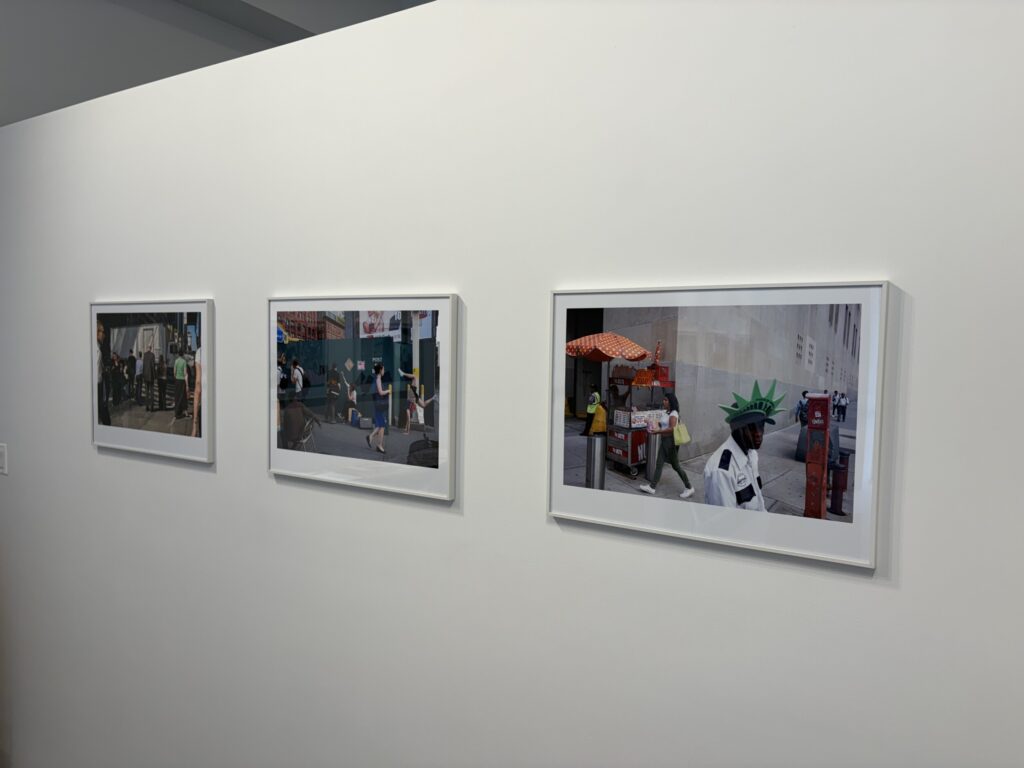
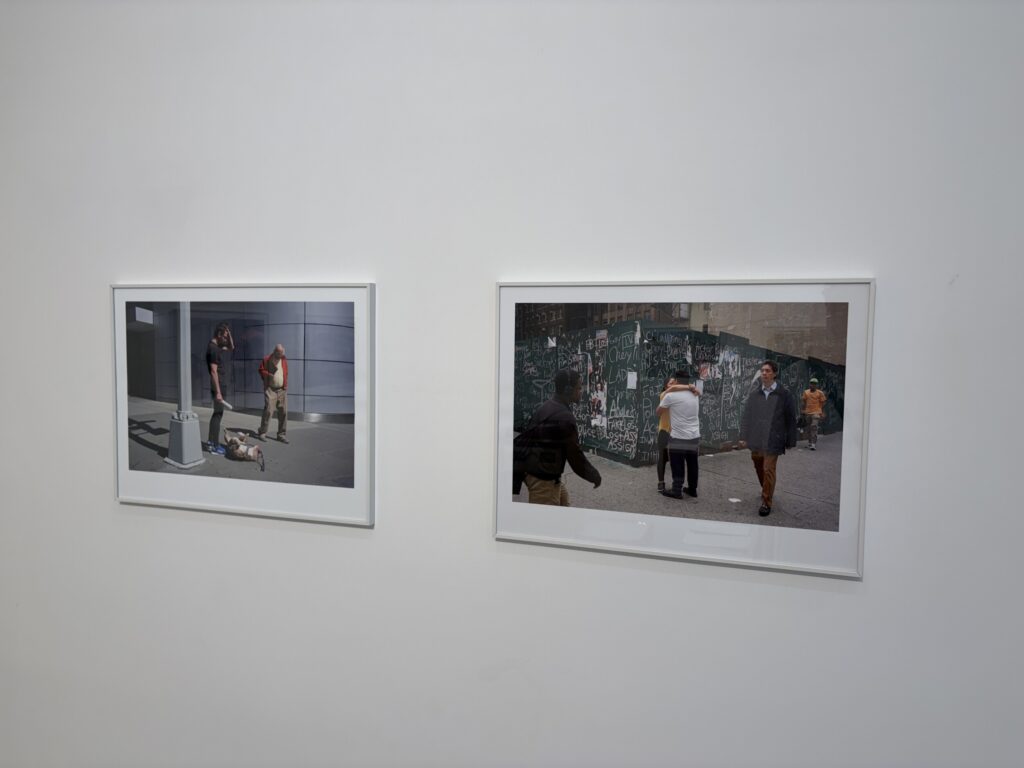
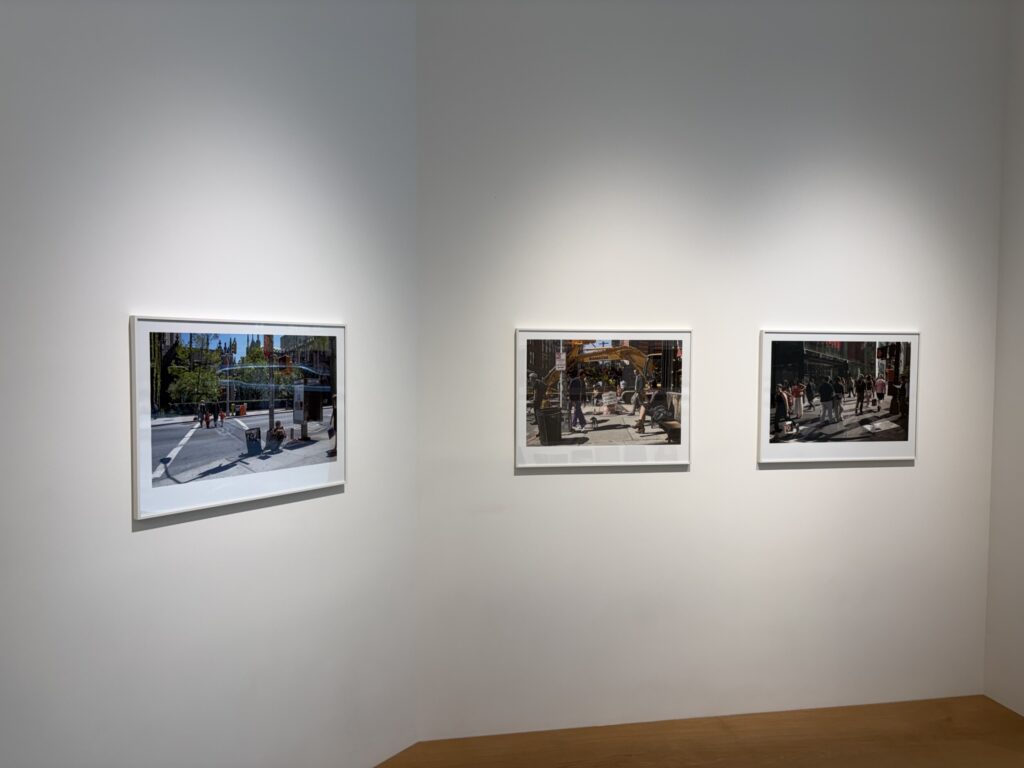
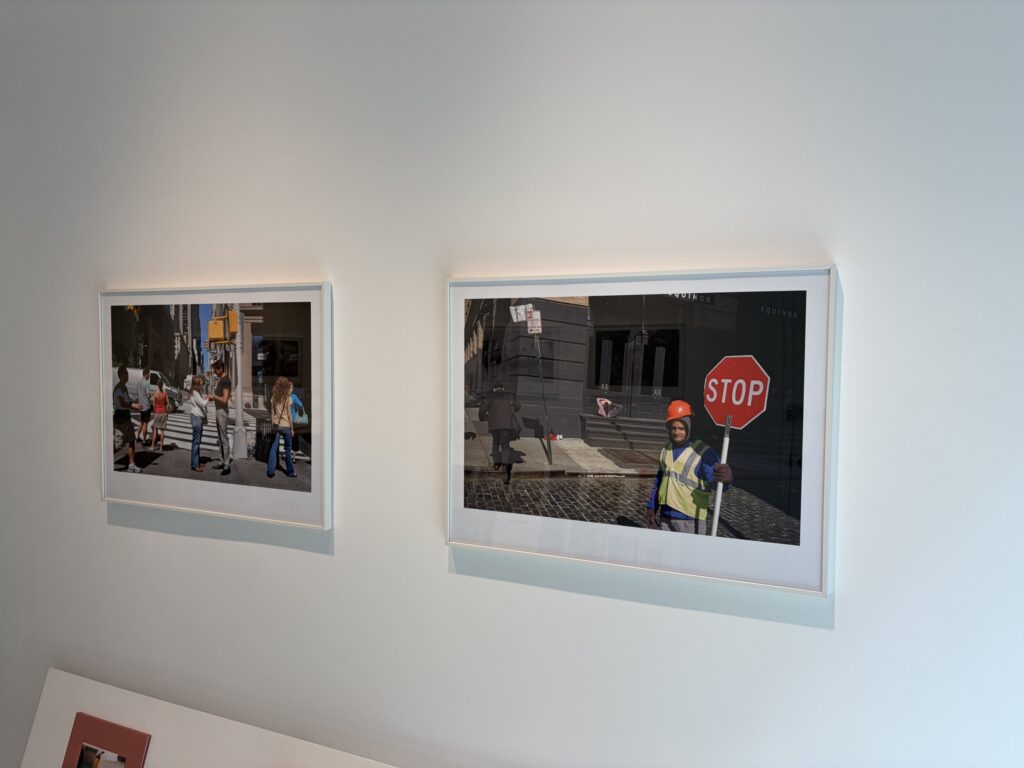
JTF (just the facts): A total of 16 color photographs, framed in white and unmatted, and hung against white walls in the single room gallery space. All of the works are archival pigment prints on Cranson satin premium paper, made in 2009, 2011, 2012, 2013, 2016, 2017, 2018, 2019, 2024, and 2026. The prints are each sized 18×24 inches, and are available in editions of 6. (Installation shots below.)
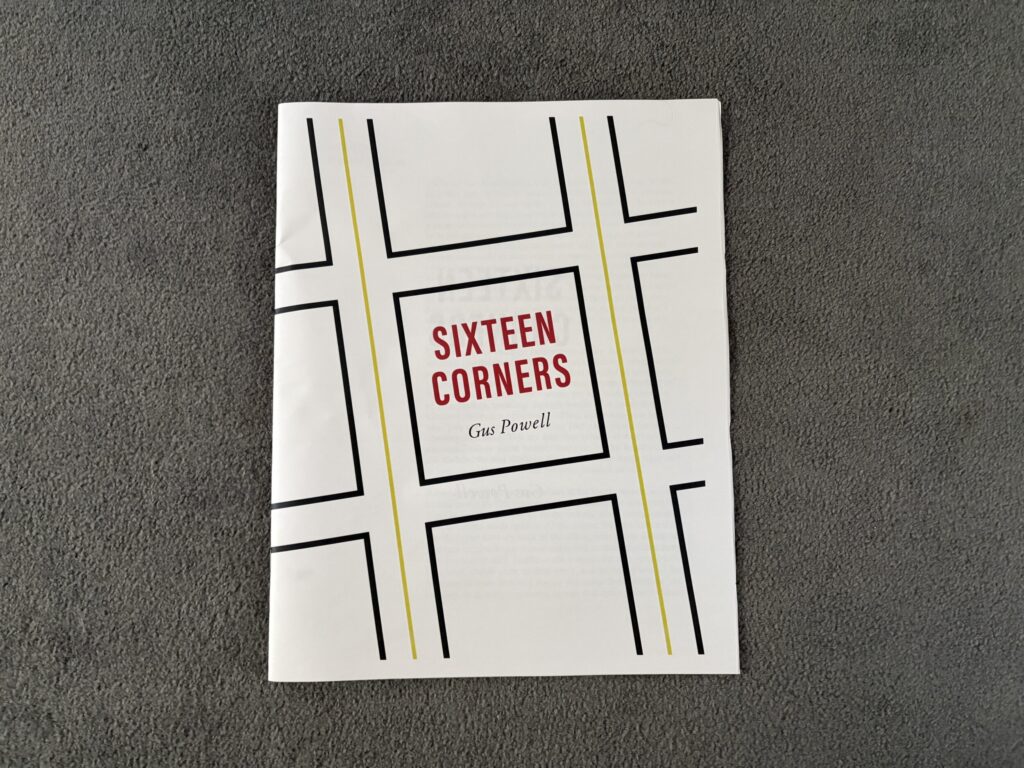
A self-published zine has been been printed in conjunction with the exhibition (here). Newspaper, sized 11.5 x 14.5 inches, 36 pages, with 16 color reproductions. Includes an essay by Robert Sullivan. Design by the artist. In an edition of 50 copies. (Cover shot below.) Note: the sixteen images in the newspaper are not exactly the same as the ones on view in the gallery show. There are seven photographs in the zine that do not appear in the show (and vice versa.)
Comments/Context: In my nearly two decades of writing about photography, I’ve seen artistic deaths declared prematurely surprisingly often. The death of the landscape, the death of the floral still life, the death of the female nude, pick nearly any standard subject matter genre and someone somewhere has authoritatively decided that it is now dead and we should never again take it seriously. But even before we can finish our grieving for these tried and true companions, these very same genres generally seem to rise from the grave once again, their predictable visual clichés and obvious features somehow enlivened and refreshed by new perspectives and contemporary approaches. Instead of definitive starts and stops, these classic subjects seem to exist in regenerative cycles of favor (and disfavor), with old and new constantly informing each other.
Perhaps the most reliably zombie-like photographic subject is street photography – someone is always trying to discount it, downplay it, or undermine it (even the street photographers themselves it seems), but it never gives up, never grows old. And while those anchored around conceptual or theoretical strategies of photography are quick to bury street work, the reason it is enduringly vibrant is that, at its core, it is built on the essential match between the transient serendipity of urban life and the split second vision of photography as a medium. Over time, literally everything changes – the cities change, the streets change, the pedestrians change, the fashions change, the buildings change, the storefronts change, the signage changes, the advertising changes, the traffic changes, the cars change, even the light or weather might change, but the fundamental photographic activity of glimpsing a snippet of uncanny alignment in an endless flow of hustle and bustle never ever goes away. These visual harmonies are always there for those who want to search for and identify them, and when contemporary street photography is done with flair and insight, right now, even in our 21st century age, it’s still very much a consistent delight.
Gus Powell’s project “Sixteen Corners”, as both a gallery show and an accompanying self-published newspaper, is disarmingly literal. It’s an arrangement of sixteen color photographs, all the same size and orientation, and you guessed it, each image captures a fleeting moment at or near a street corner, presumably in New York City. Made across nearly two decades, the included pictures have the conceptual bluntness of a straightforward self-imposed assignment or creative directive – just stand near a busy corner or two and wait for the magic to happen. Easier said than done, of course, as the ratio of photographic winners to passing years of effort quietly attests.
It’s been a number of years since we last caught up with Powell. What’s intriguing is that neither his 2015 photobook The Lonely Ones (reviewed as a 2016 gallery show here) nor his 2019 photobook Family Car Trouble (reviewed here), both of which received much acclaim in the broader photo community, are really street photography in the strictest sense. Aesthetically, “Sixteen Corners” is much more in line with his 2019 folder-as-photobook Brooklyn BRIEF, and his earlier 2003 photobook The Company of Strangers, each project featuring essentially traditional street photographs, with images taken on city sidewalks that capture the clever momentary arrangement of pedestrians and surroundings.
A corner provides a particular nexus point of action for a street photographer – by definition, foot traffic intersects from two opposing directions, creating unexpectedly complex layers of potential movement and alignment. Depending on where the photographer is standing, a corner can be seen head on or from the side, can offer a view across a crosswalk or through passing traffic, or can simply be inundated with people, either waiting or walking. The options for visual chaos are nearly limitless in a crowded place like New York, and the possibilities for concealment and anonymity on the part of the photographer are many, thereby making a well chosen corner an excellent location for tossing in a visual fishing line and seeing what bites.
It’s clear from his photographs that Powell has been playing the street photography game for quite a while now, as he understands that it’s not just one unexpected or resonant detail fortuitously uncovered in the swirl of the streets that makes a street photograph function – it’s the complicated jigsaw effect of how that singular eye-catching detail is then fit into synchronized relation with other nearby objects, movements, and compositional effects. The strongest of Powell’s street photographs offer us a quirky visual anchor point, but then expand out from that point of recognition to fill the frame edge to edge with other action that somehow all adjusts into uncanny alignment, creating a frieze of urban activity that feels stage managed.
In its precise collection of disparate narratives, “Pretzel” (from 2016) is quietly astonishing. The titular salty bread twist hangs at the very far left edge of the composition, puzzlingly weighed down by two crushed Red Bull cans and hung as part of a food cart, which is largely out of the frame. The green plywood wall of a construction site provides the backdrop for a series of small stories – a seated man with a microphone (likely a DJ or busker of some sort, given his mixer and speaker setup on an overturned bucket) talks with another man who has stopped momentarily, an outstretched arm perhaps caught mid hand slap or high five. Nearby another performer (with a sign that may identify her as “Hila the Killa”) has just begun a handstand on the sidewalk, her upturned legs bent into opposing angles. In between these two, one backpacked man talks on his phone, another woman in a blue dress moves in the opposite direction, and the guy from the food cart sits on a metal chair and watches the handstand, all three physically spaced out at measured intervals. Seen together, there is lyrical flow to the whole scene, the everyday movement of the city turned into a visual symphony.
Part of the joy of street photography comes in moments of found visual humor, and many of Powell’s images document sketches of subtle urban comedy. There are the three finance bros in dress shirts and dark pants striding in perfect synchronization (with their right arms all back at the same instant) like dancers. There’s the seen-it-all bored look of the construction guy holding a stop sign to control traffic, with a woman doing a folded yoga pose on the steps of the Equinox in the background. There’s the urban commiseration of dog people, with one man lamenting the silliness of his dog lying on its back on the sidewalk chewing on its leash, while another passing man looks on with amused sympathy. And there’s an unexpected confluence of stripes in a crowd, with one eager woman (in a striped dress) waving to a friend, surrounded by the chance assemblage of a striped bag, a striped track suit, a striped tie, and a striped polo shirt.
Powell makes these kinds of compositional juxtapositions look effortless. “Back Lot Snow Day” is another marvel of collapsed narratives, with half a dozen stories, including a snowball throw, a carried sled, a selfie, a woman in headphones listening to music, a shiny golden parka, and a smiling posed photo, all set against the white frosted trees in the distance. “Pyramid” is more elemental, but somehow spookier, with a man on his phone walking near a corner where a cast shadow is creating a perfectly aligned pyramid shape; what’s weirder is the reflection in the polished marble down the way a bit of a similar man also talking on his phone, making them look like the same person, which of course they aren’t. And still other pictures turn on the unlikely presence of a pair of purple pants (and a chihuahua), a green foam Statue of Liberty crown (and a “Coconuts Today” sign), and a burning cardboard box (and a man squatting down to photograph it), each scene oscillating from the mundane to the surreal.
Maybe it’s time for critics (like myself) to stop prematurely pontificating about the death of one genre or another, and instead, to do a better job of forcing ourselves to search out the fresh take, the risky twist, and the bold rethinking of something we think we already know. Powell hasn’t reinvented the street photography wheel here, but he’s brought a satisfying splash of contagious curiosity to the eccentric coincidences of the streets once again. In this way, his show feels altogether alive, engaged, and contemporary, and left me with a smile on my face as I headed back out on those very same sidewalks.
Collector’s POV: The prints in this show are priced at $2500 each. Powell’s work has little secondary market history at this point, so gallery retail likely remains the best option for those collectors interested in following up.