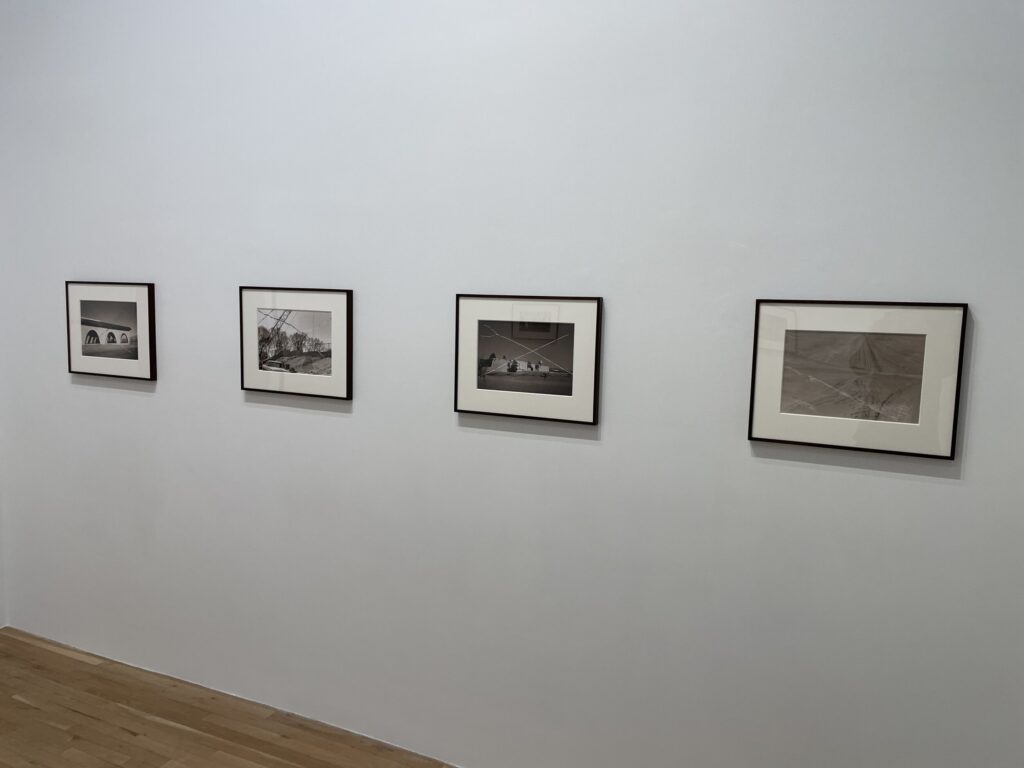
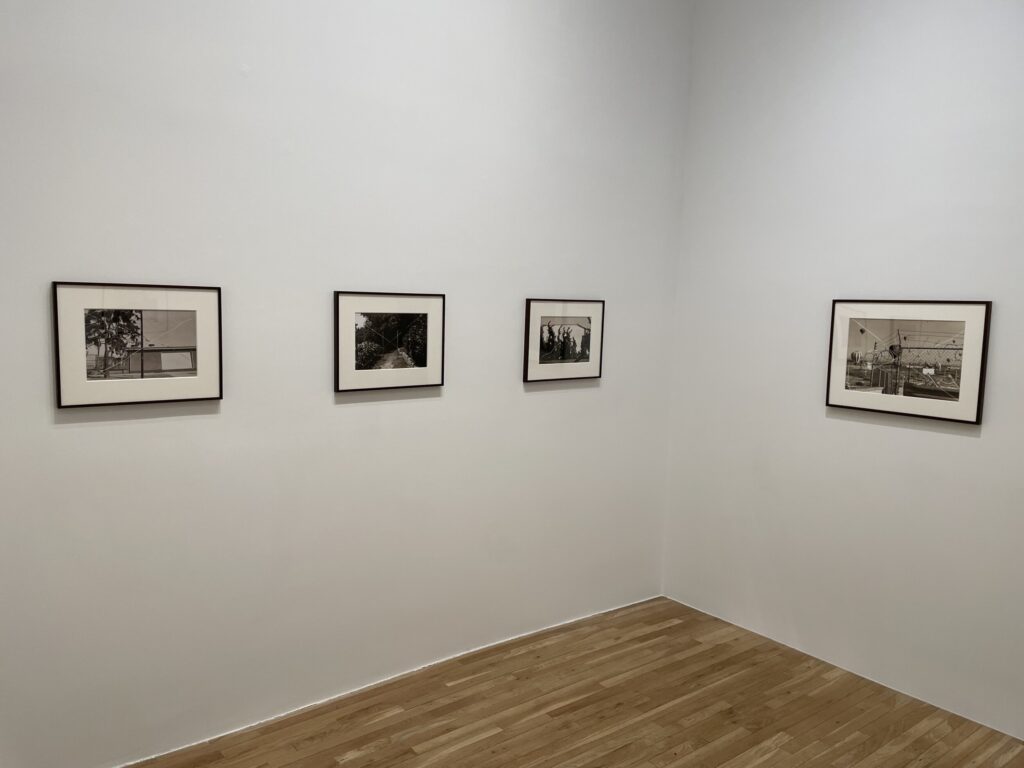
JTF (just the facts): A total of 9 black-and-white photographs, framed in brown wood and matted, and hung against white walls in the smaller North room. (Installation shots below.)
The following works are included in the show:
- 7 toned gelatin silver prints, 1974, 1974/1983, 1975, 1976, sized roughly 9×13, 10×13 inches
- 2 toned gelatin silver prints, 1979, sized roughly 13×19 inches
Comments/Context: One way to think about the wide flow of art history is to consider most deliberate movements forward as a reaction to something else. In this way, the artistic impulse is rooted in a conscious decision to re-interpret or push back – perhaps against the artist’s own history or background; the themes, aesthetics, or processes of his or her own previous work (or those of another artist); the larger trends or prevailing conceptual frameworks; or even simply the mood or feeling of the times. This active process of synthesis often leads to new ideas and new ways of seeing, where available building blocks are both re-used and rejected.
For a photographer working in the mid-1970s (particularly in the American West), the two primary sets of ideas that would have been percolating around in the artistic air were the engaged documentary approach to the land of the New Topographics photographers and the active (and sometimes playful) questioning of the medium itself by the photoconceptualists. And given that specific context, Thomas Barrow’s “Cancellations” series (1973-1981) feels like a direct outgrowth of the tension between those two artistic vantage points.
Barrow had studied with Aaron Siskind at the Institute of Design in Chicago in the mid 1960s and had worked as a curator at the George Eastman House through the early 1970s, so he would have been acutely aware of (and grounded in) those two trends in the larger photographic world of that moment. Barrow then took a teaching position at the University of New Mexico in Albuquerque in 1973, creating an opportunity to photographically engage with the unique terrain and built environment of the American Southwest.
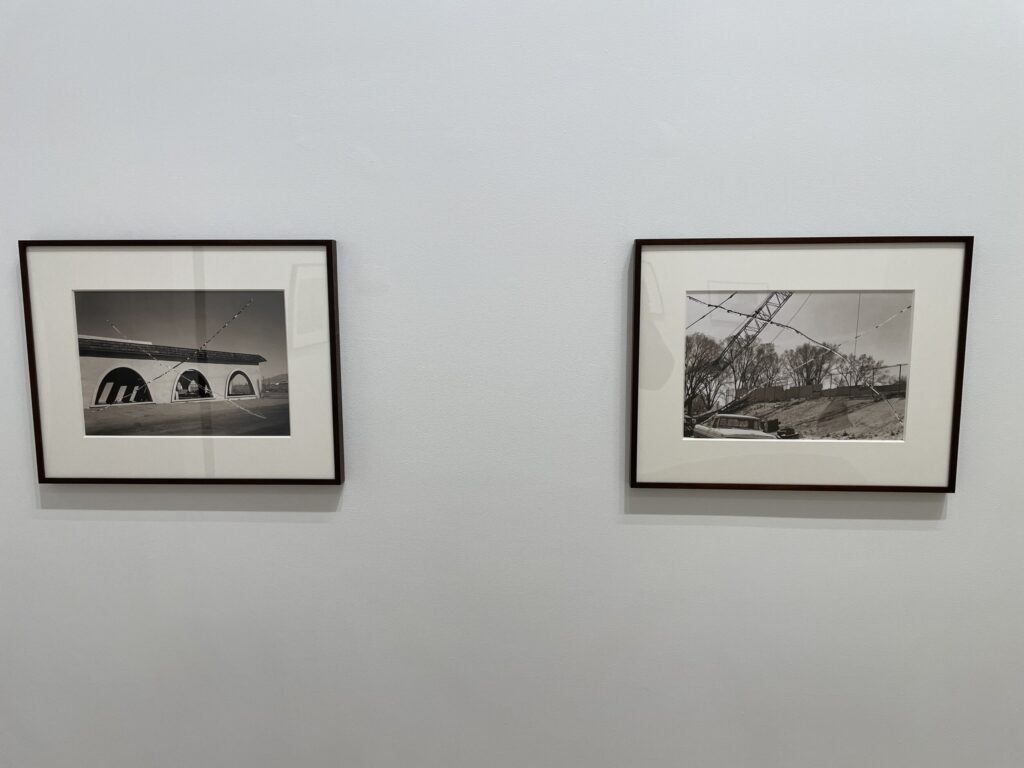
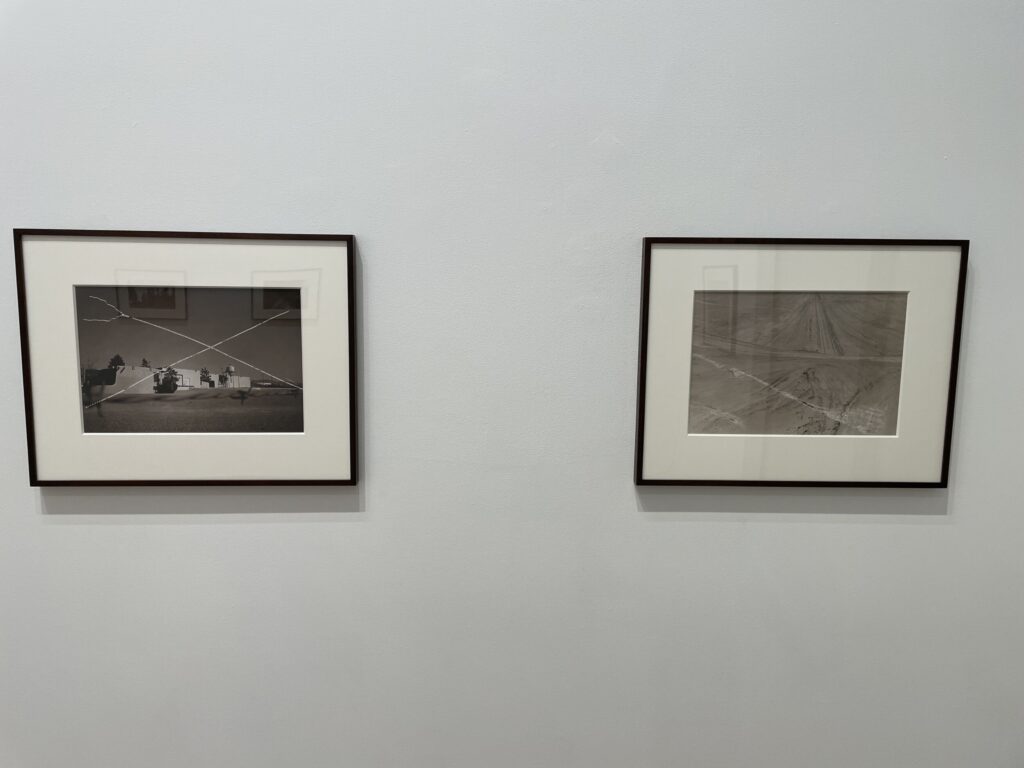
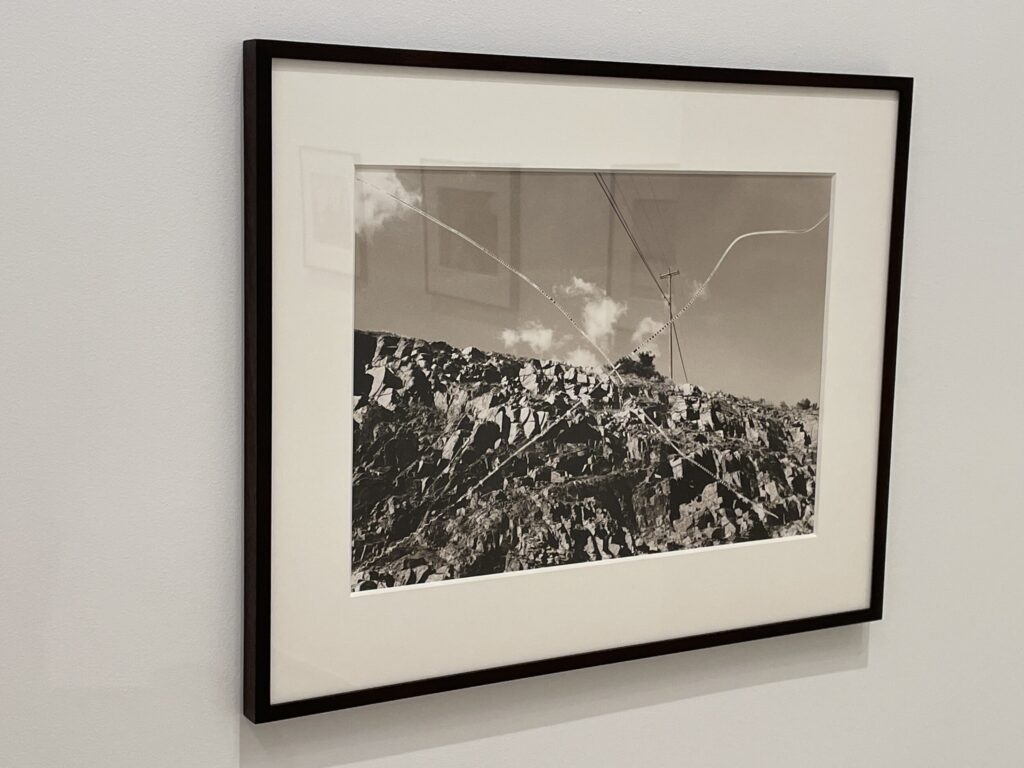
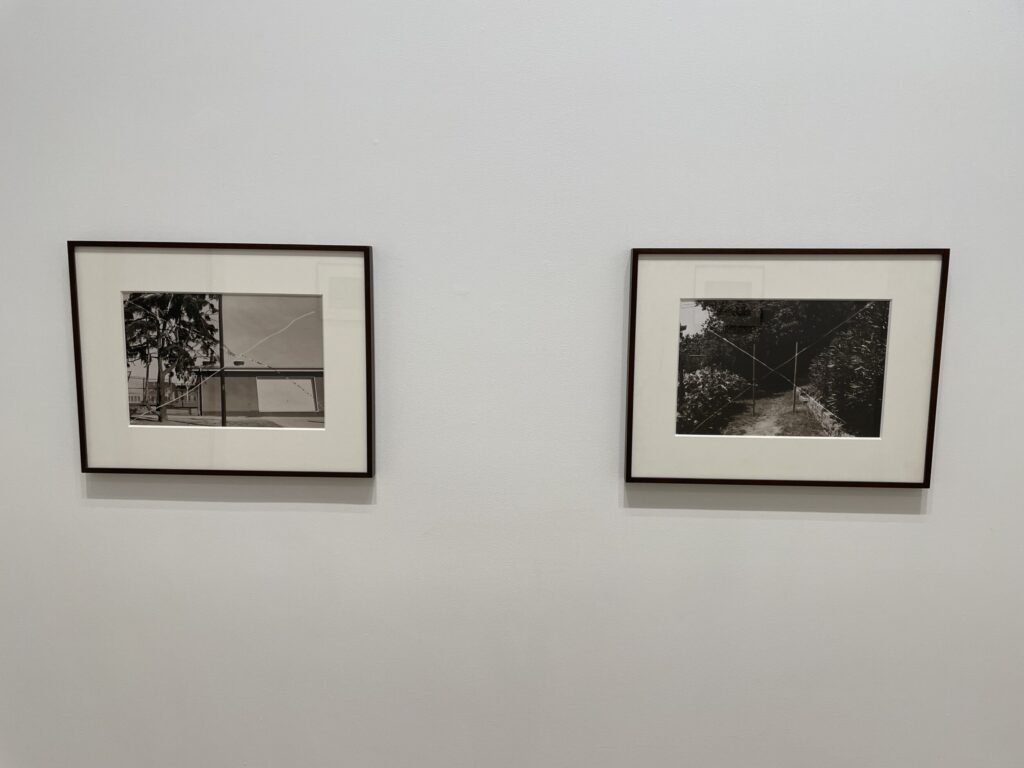
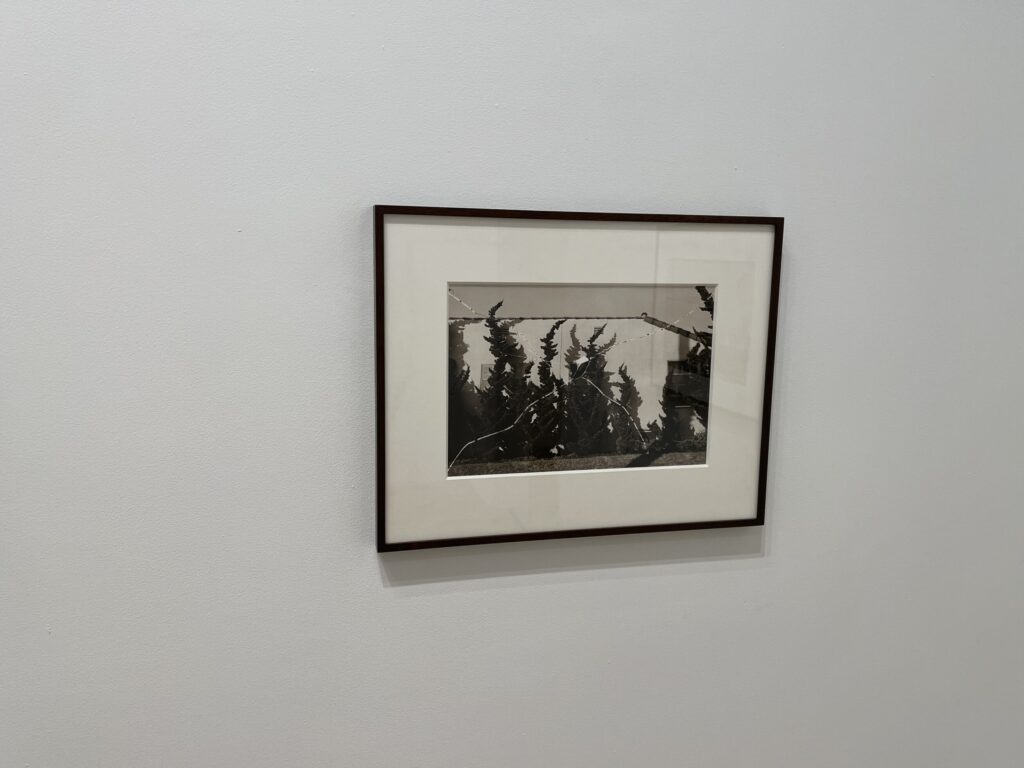
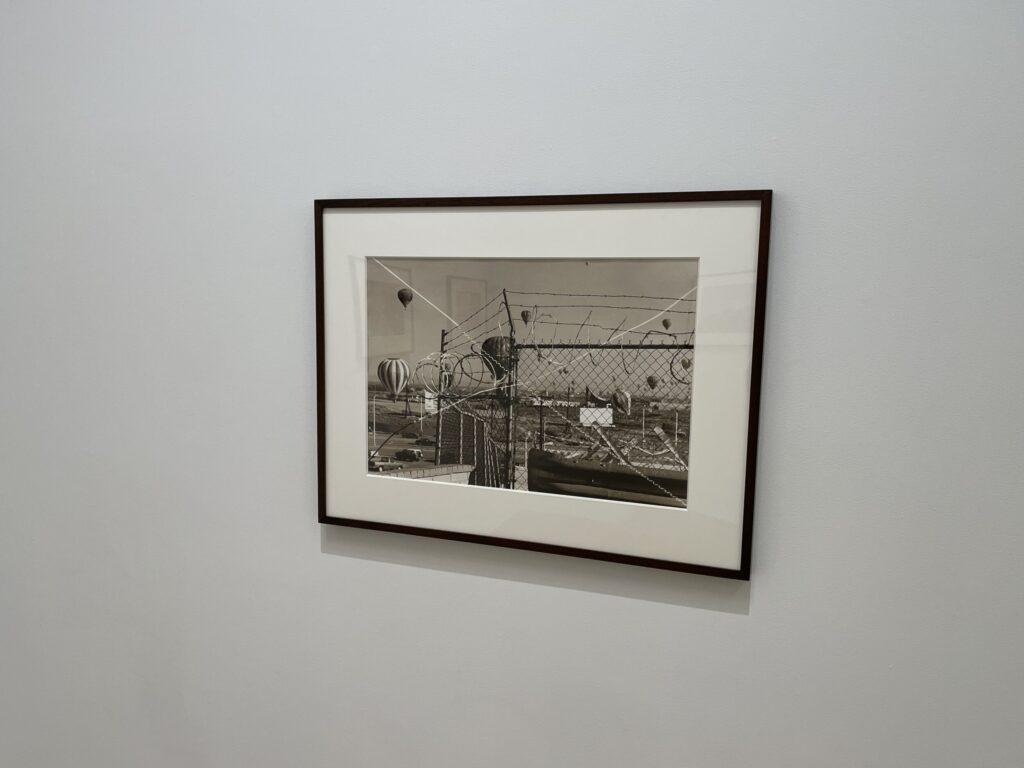
As seen in this small but tightly edited single project show, Barrow’s “Cancellations” are a sophisticated photographic hybrid, starting with unassuming landscape and suburban views in toned black-and-white (largely from New Mexico and southern California) and transforming them with hand-crafted interventions and interruptions. For the most part, these marks take the form of bold scratches made in the negative with an ice pick (generally in an emphatic X that covers the image), but in one work, Barrow has also used sandpaper to create a different kind of abrasion. The overall effect is akin to a second layer of commentary placed over the original scene, upending the deadpan documentation (of the New Topographics) and infusing it with wry insider critique (of the photoconceptualists), in a manner that feels inventively personal.
As the “Cancellations” title implies, Barrow’s marks can, in their simplest sense, be read as negations, or a rejection of the underlying image in some manner. But to my eye, that emphatic “NO” is never quite what is going on – Barrow always makes his marks with careful attention to how they will interact with the composition of the photographic scene below. His lines are never perfect or ruler straight, which might imply a kind of meticulousness or precision; instead, his interruptions aways feel hand made, gestural, and quickly executed, the energy of the mark making infusing the works with intention and artistic presence.
“Wave” and “Cut” both place the marks in the context of other lines in the composition, including the arm of a crane, a chainlink fence, a telephone pole and overhead wires, and even the horizon line, Barrow’s surface slashes interacting and crisscrossing with the existing geometries, creating an interpretative visual dialogue between what was there and what Barrow has added (or canceled) later.
Three other works find Barrow subtly tweaking his mark making to better echo or respond to various compositional elements. In “N.M. Stretch”, a blur of horizontal barbed wire extends below a view of low buildings; Barrow adds an X to this scene, but with a split and frayed end that wiggles like the twist of wire. In “Santa Monica House”, another white stucco building is surrounded by dark evergreen foundation plantings, the branches reaching upward in bending contours and creating doubled shadows on the wall behind; Barrow’s X jitters and turns in a similar manner, actually cutting a hole in the center of the negative, which becomes a peeled back dark void (like a entry point into the wall) in the print. And in the complicated “Fiesta Fence”, a hot air balloon jamboree provides the setting for a veiled view through a chain link fence adorned with spirals of barbed wire, with Barrow’s X adding a layer of harmony via its tight undulations and linear divisions.
Two additional works more overtly use the scraped interruptions to play with the compositional proportions of the image. In “Lincoln Jr. H.S.” (another standout work), Barrow starts with a view of the flat roofed school buildings, with a dark pole running straight through middle of the composition and an evergreen tree set to the left of the pole; Barrow’s X is aligned so that the intersection of the inscribed lines sits in the sky to the right of the pole, helping to rebalance the unbalanced arrangement. And in “Altadena Corn”, a garden view with a stone wall already looks down a central path into the shadowy woods, but Barrow’s X amplifies the implied lines of perspective, landing right between two vertical wooden poles with geometric precision.
Seen as a group, Barrow’s “Cancellations” are too consistently smart to have been improvisationally tossed off. In the years following, he would further experiment with breaking images down, tearing prints, layering them together, reassembling them with caulk, spray painting them with stencils, and other techniques (as seen in gallery shows in 2019, reviewed here, 2015, reviewed here, and 2013, reviewed here), continually unraveling and reinterpreting the way a photograph communicates. “Cancellations” remains a keystone project from 1970s American photography, one that subtly blends observation with disruption. The strongest of these images continue to find a playful feeling of unease and negation, both offering and taking away in the same artistic moment.
Collector’s POV: The prints in this show are priced at $6800 or $11000 based on size. Barrow’s work has very little secondary market history, so gallery retail likely remains the best option for those collectors interested in following up.



I’ve always been in awe of this project, (jealous, is probably more accurate). It’s such a seemingly simple idea but to figure out exactly why it is so effective, and unforgettable, is tantalisingly difficult. Well done Thomas Barrow – legend.