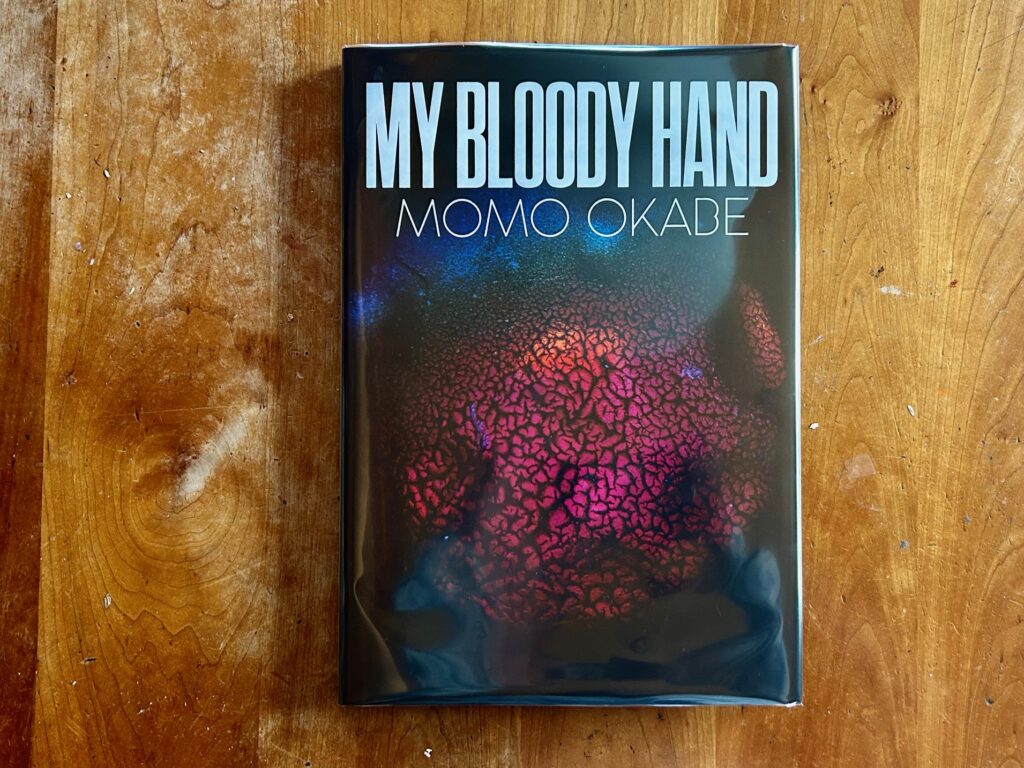
JTF (just the facts): Published in 2026 by Little Big Man Books (here). Hardcover with dust jacket, 298 × 229 mm, 144 pages, with 86 color reproductions. Includes a brief text by the artist, in Japanese and English. Design by BEGOOD Studios and Joshua Hong. In an edition of 1000 copies. (Cover and spread shots below.)
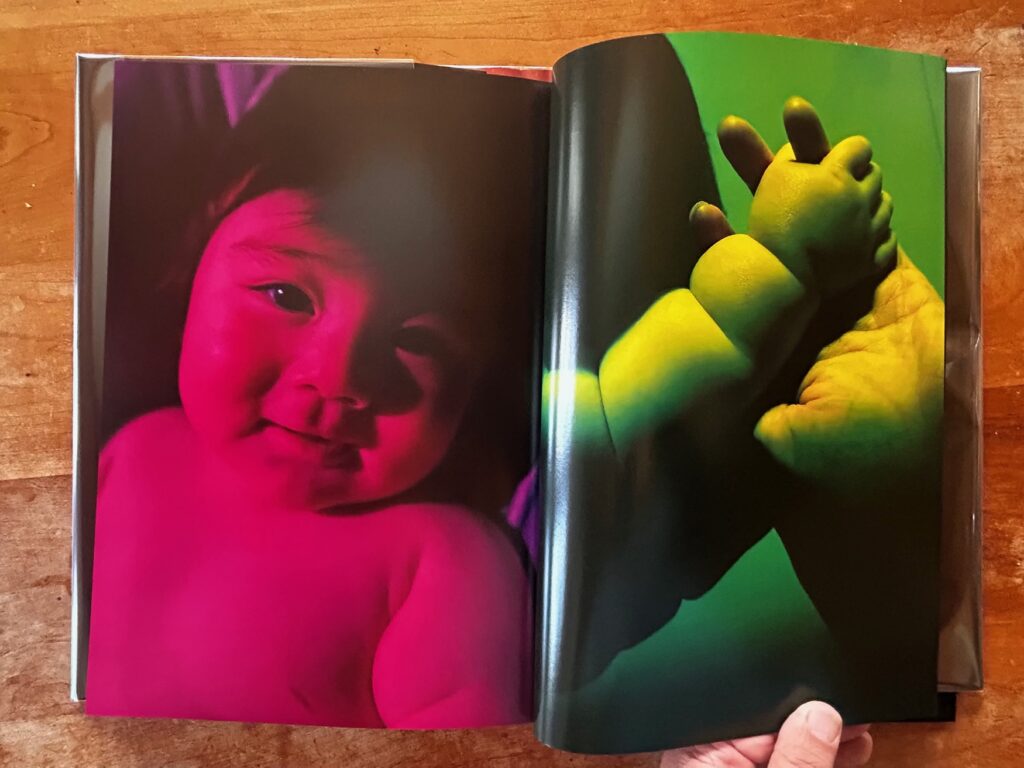
Comments/Context: What images pass through the mind of a fetus in the dark chamber of a mother’s womb? That’s an impossible question to answer, and a difficult one to portray photographically. Never mind the logistical road blocks, Momo Okabe has taken a stab at it anyway. The Japanese photographer is well positioned to explore the issue, having recently settled into motherhood. Not only did she nurture a baby (now a thriving young girl) in her belly for nine months. There were four pregnancies preceding it, all ending in miscarriage.
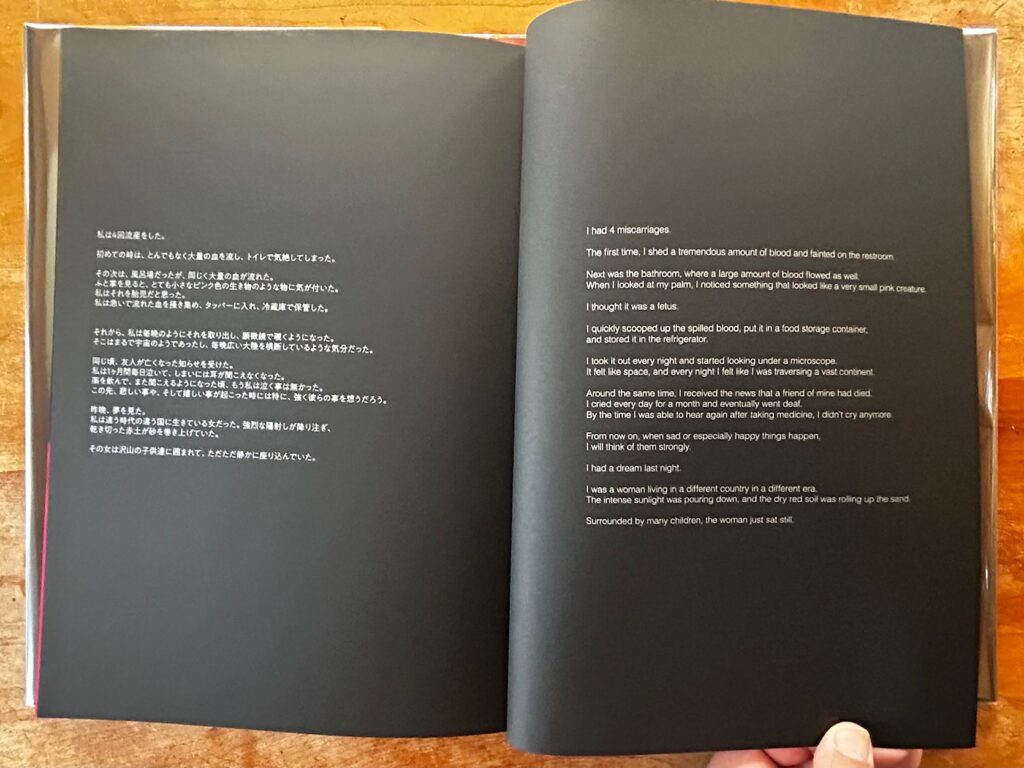
Okabe’s experience may be relatively common, but it was still difficult to process. She approached her grief from an artistic angle, converting her trauma into source material. “When I looked at my palm,” she remembers, “I noticed something that looked like a very small pink creature. I thought it was a fetus.” If the blunt equanimity of this statement feels extraordinary, Okabe is just getting started. “I quickly scooped up the spilled blood, put it in a food storage container, and stored it in the refrigerator. I took it out every night and started looking under a microscope.”
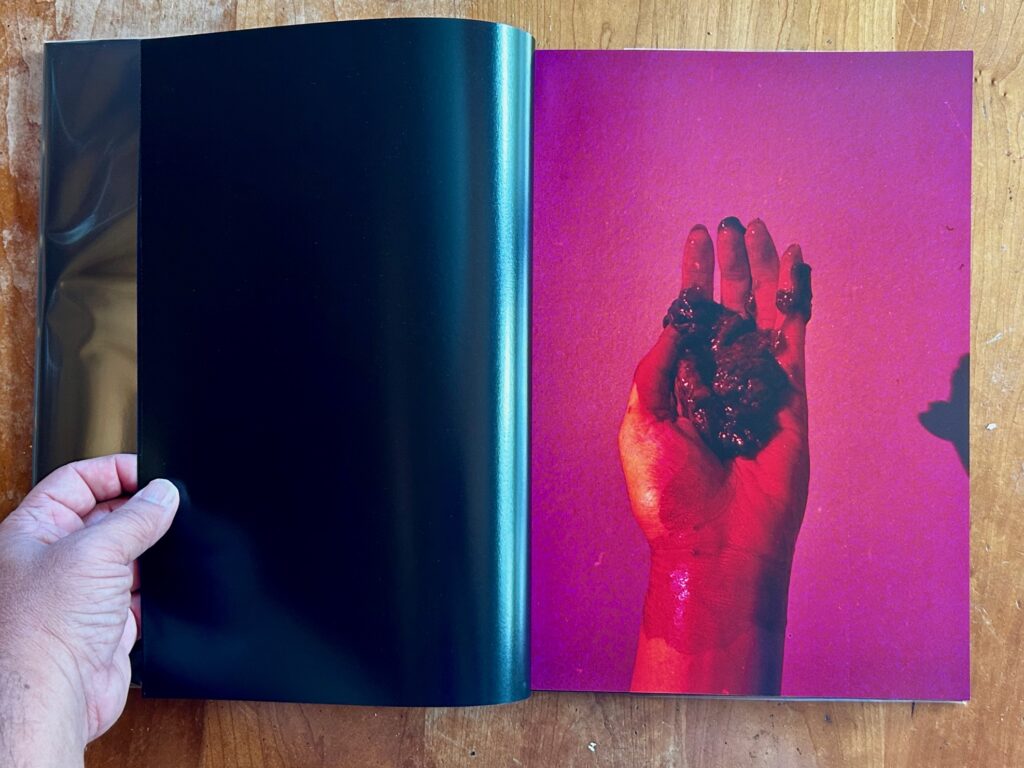
Momo Okabe’s latest monograph—from which these anecdotes are excerpted—takes its inspiration from that initial encounter. It’s called My Bloody Hand, and its first two photos show just what the title promises. Each image is a graphic closeup of her palm holding slimy body parts. The first photograph is tinted blood-red like a horror film. Because, hey, why not get right to the point? The second is amber toned, and slightly less suggestive. If both churn the reader’s stomach, it’s but a minor discomfort compared to the experience of miscarriage. For a resilient photographer who has cycled through prenatal hell and back—asexual, queer friendly, and tough as nails—these blips of effluent are mere speed bumps. Okabe appraises them calmly, presses the shutter ka-shink, and moves on.
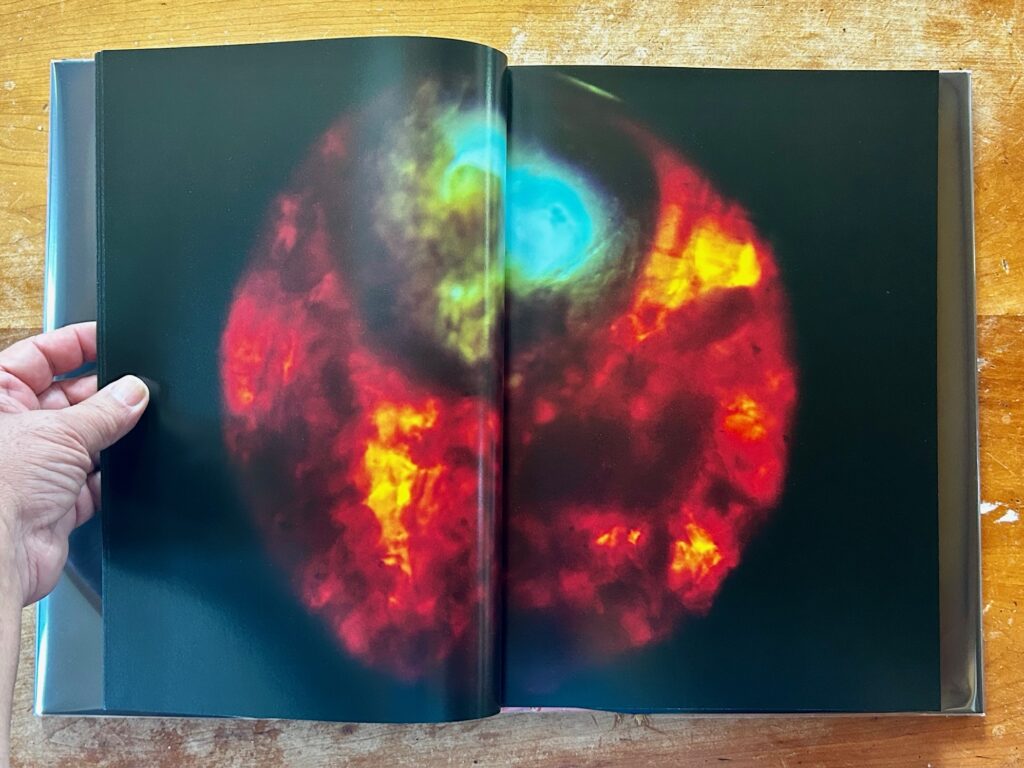
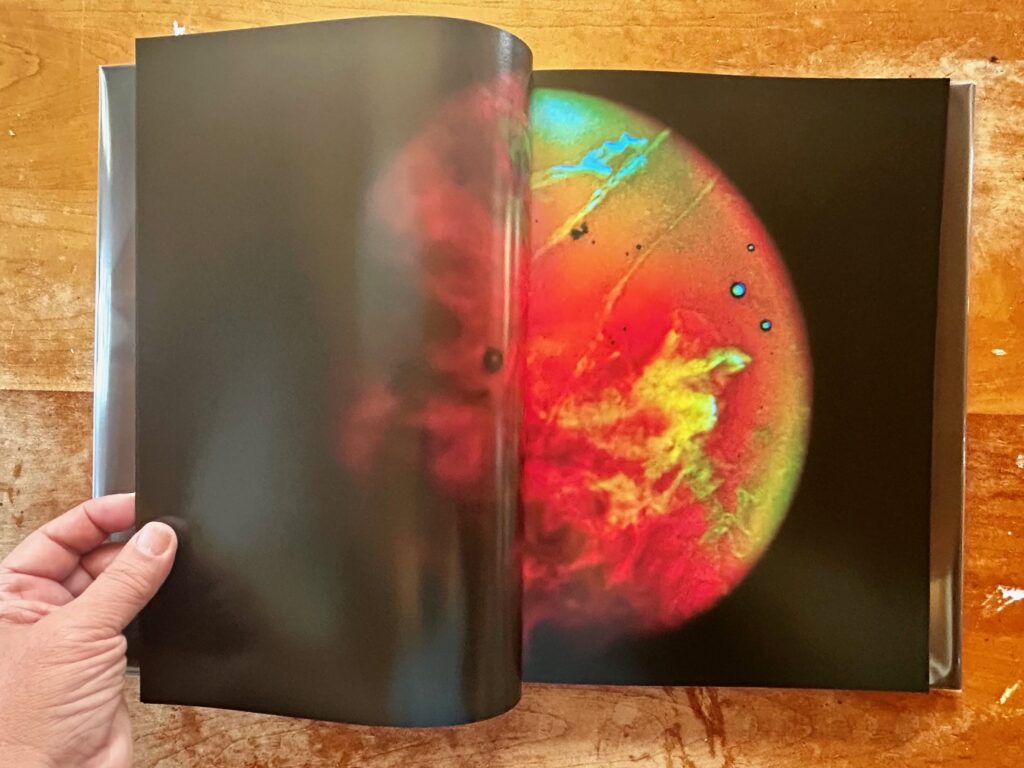
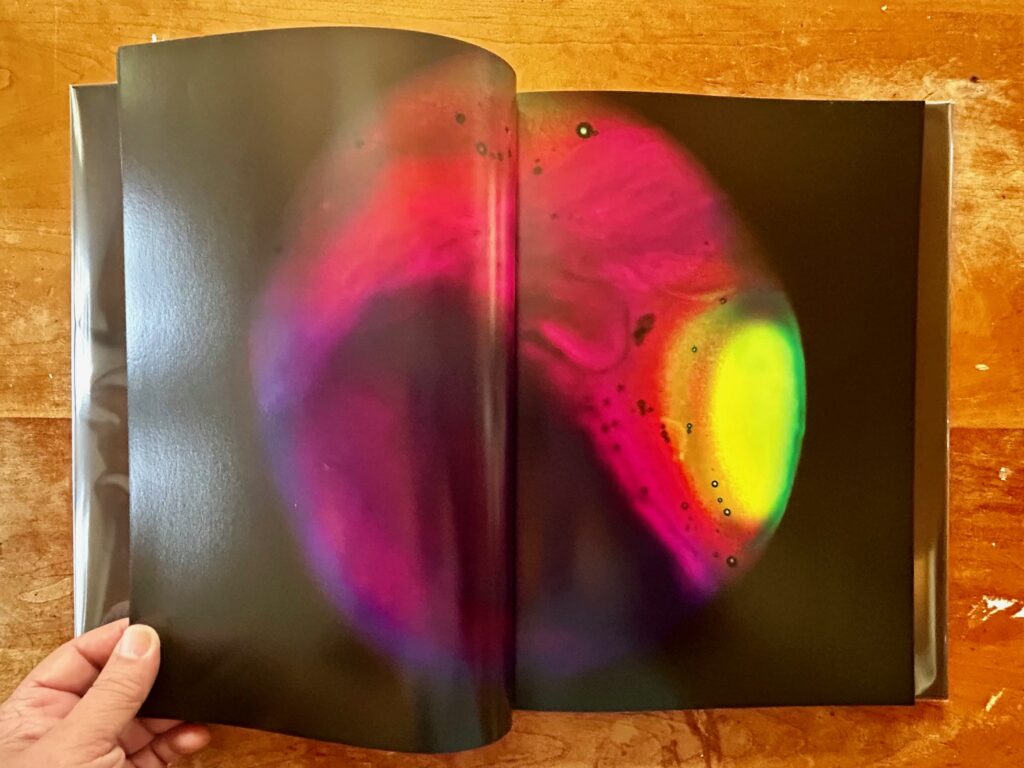
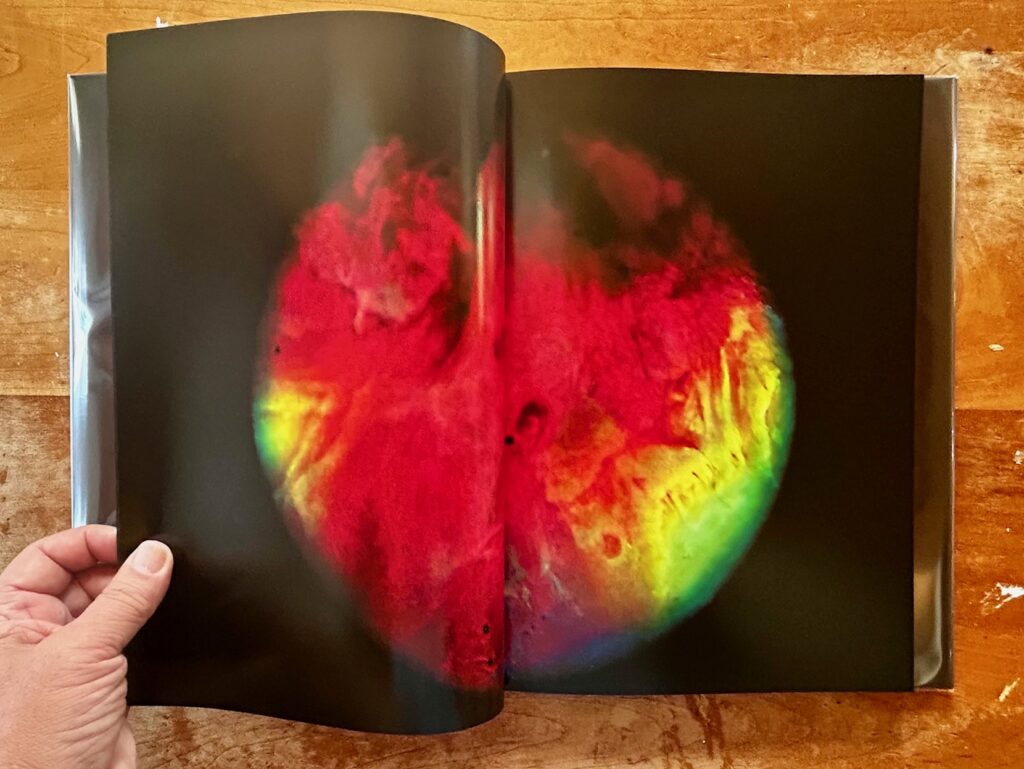
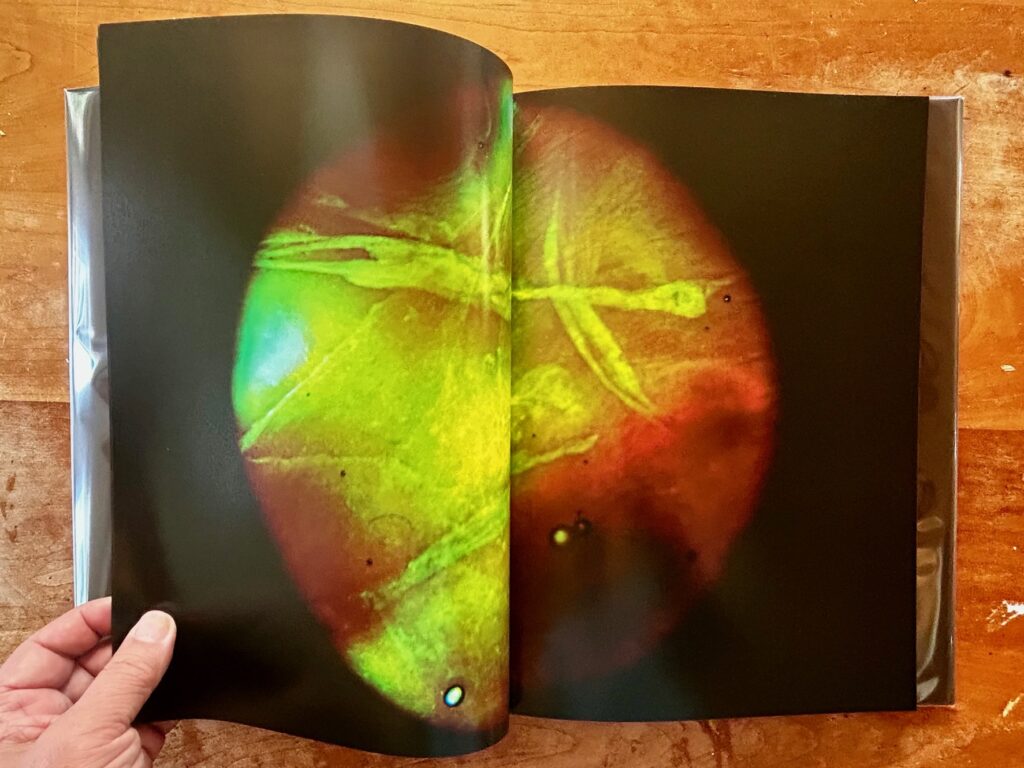
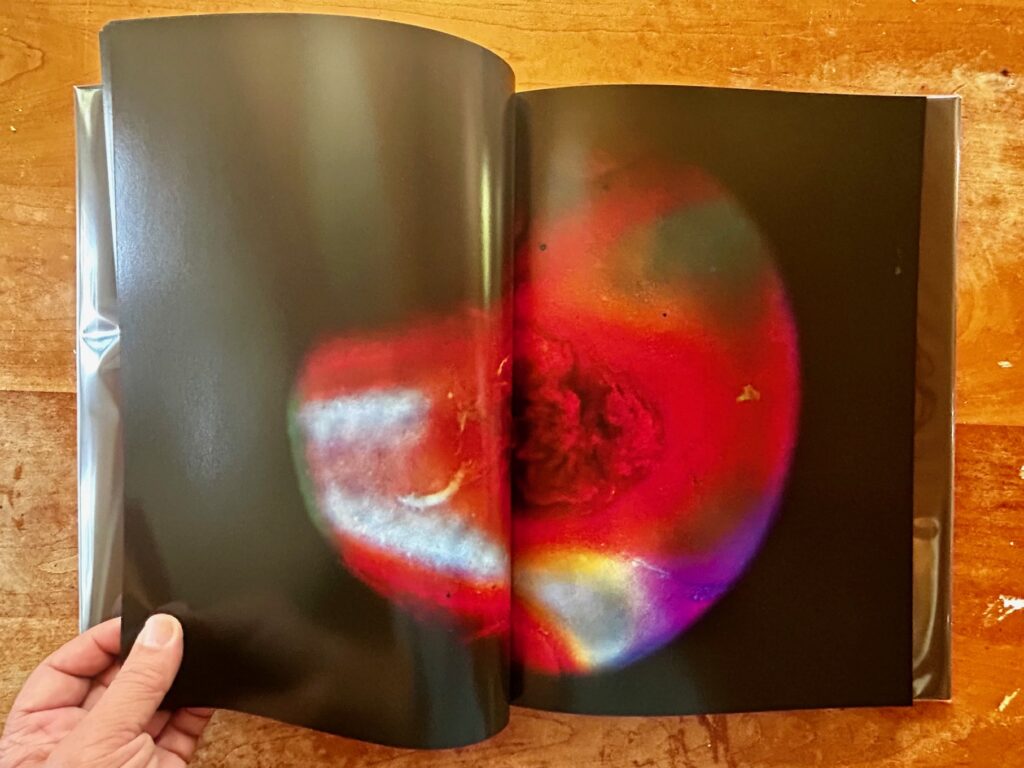
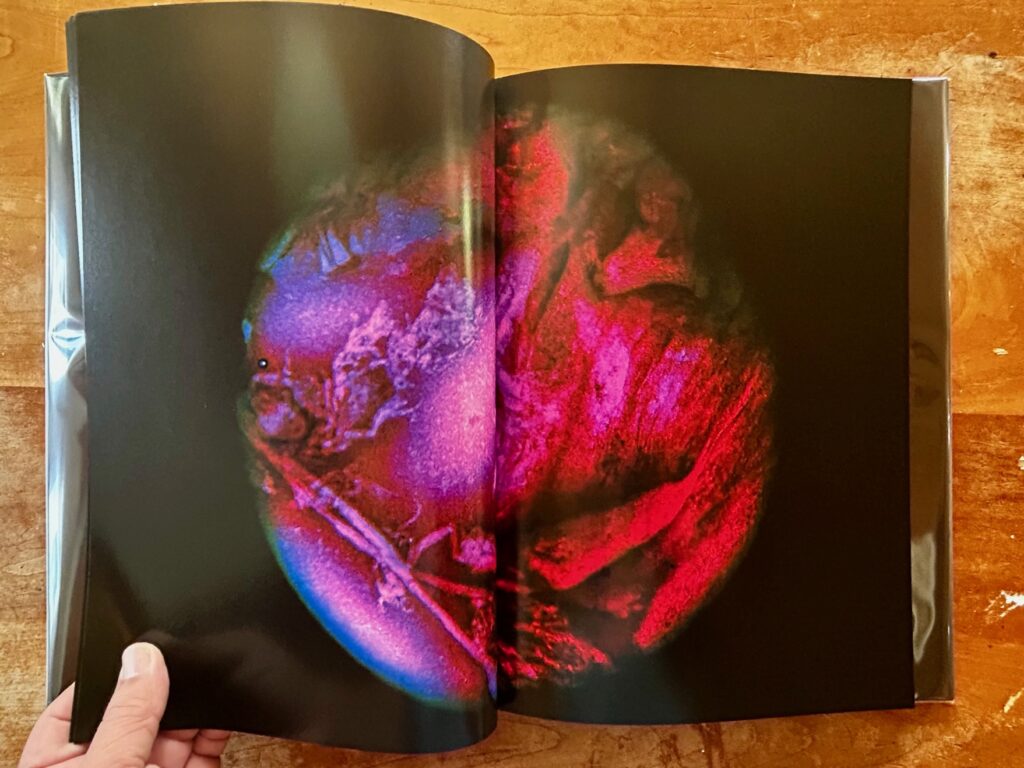
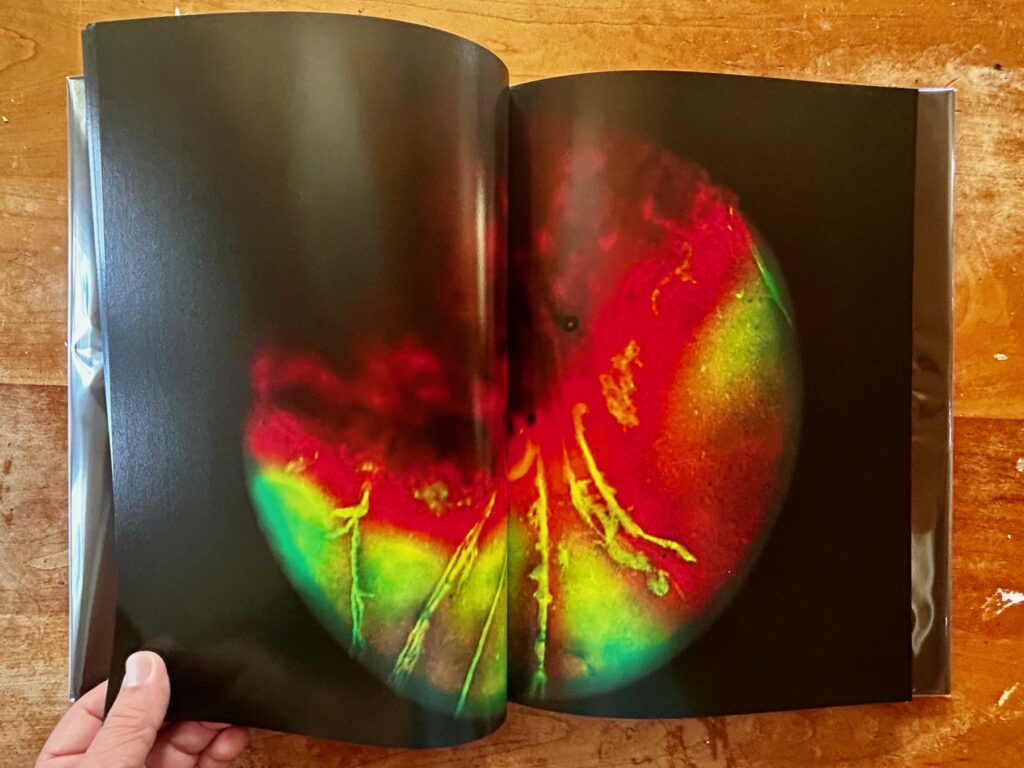
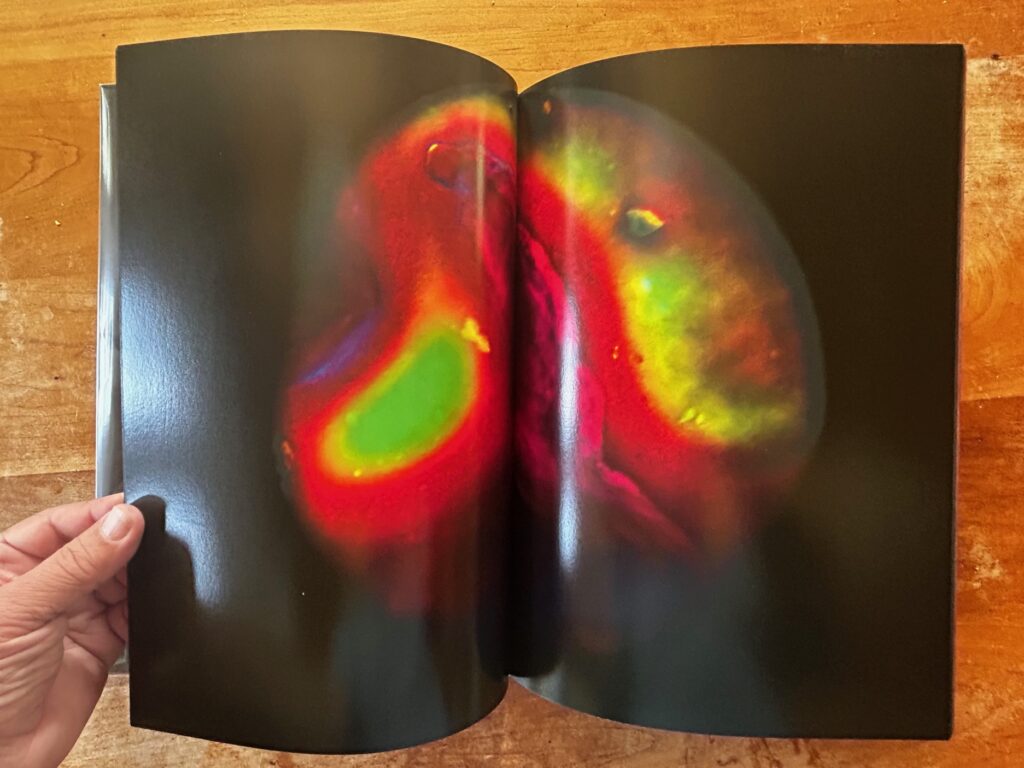
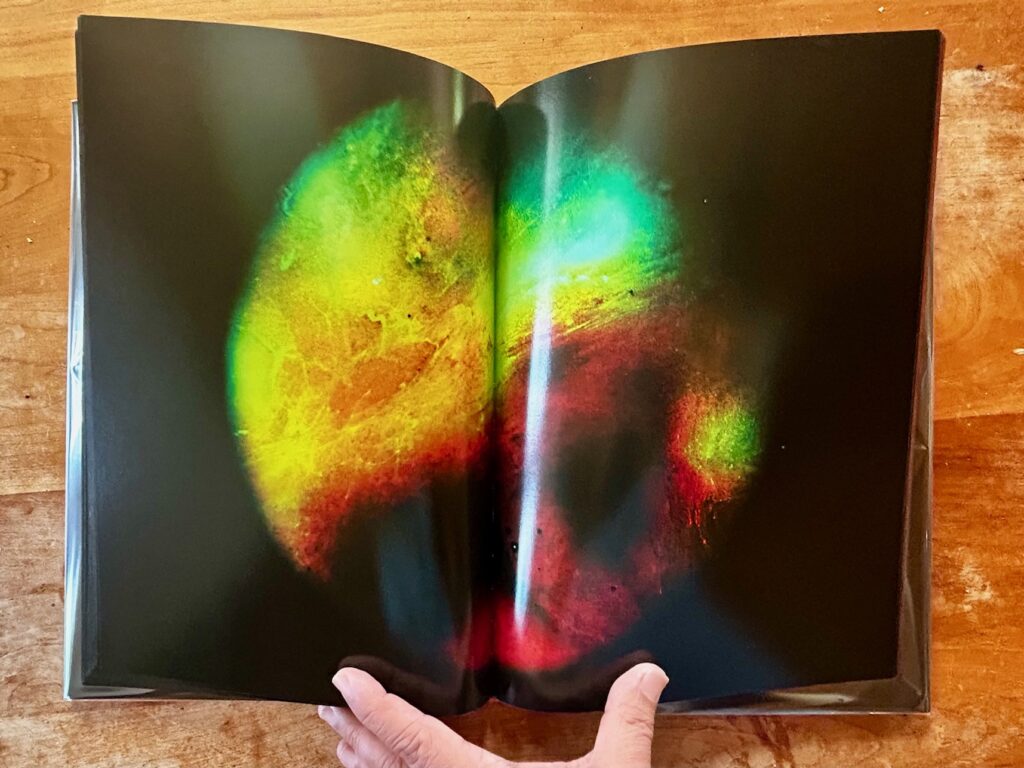
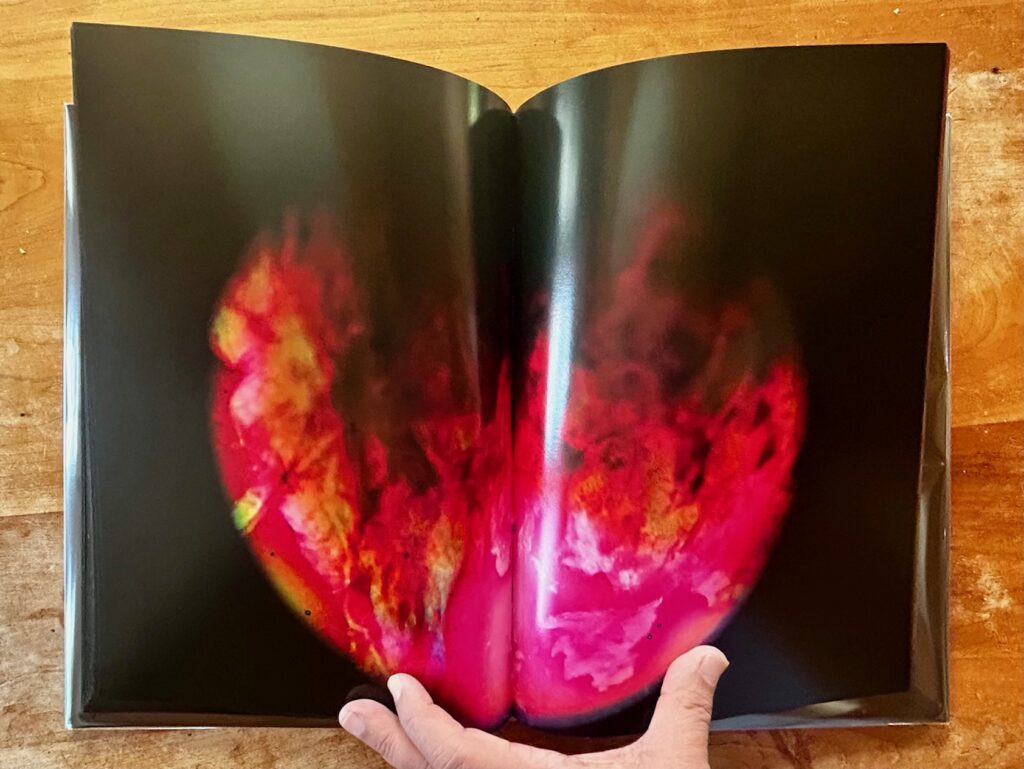
These titular palm shots are just the prelude. The core of the book soon settles on Okabe’s main focus: her refrigerated discharge, enlarged by a microscope into abstract forms. Photographs of this material comprises the first two-thirds of My Bloody Hand. Each image is broadly similar: a surreal rainbow of saturated color, cropped into circular form by her focusing lens, and centered across the gutter as a double spread on glossy black pages.
Taken collectively, the globules form a disengaged typology, and the documentary details are hard to pin down. We are probably looking at veins, cell walls, plasma, organs, or some combination of these things, but that’s just an educated guess. Stripped of supporting context, these mysterious orbs might be misidentified as gaseous planets or nebula viewed through a telescope. “It felt like space,” Okabe describes her photo process, “and every night I felt like I was traversing a huge continent.”
As photographed from above by Okabe, that continent bears a passing resemblance to Stephen Gill’s fish parts (Notify The Sun, reviewed here), Frank LeBon’s forensic slides (One Blood, reviewed here), or the slimy entrails of Lucille Boiron. Disturbing, in other words, at least on one level. But Okabe’s anatomical flayings are sufficiently abstracted for emotional distance. Miscarriage must be a brutal ordeal for any woman. But in the photographic act, she seems to have found a coping mechanism.
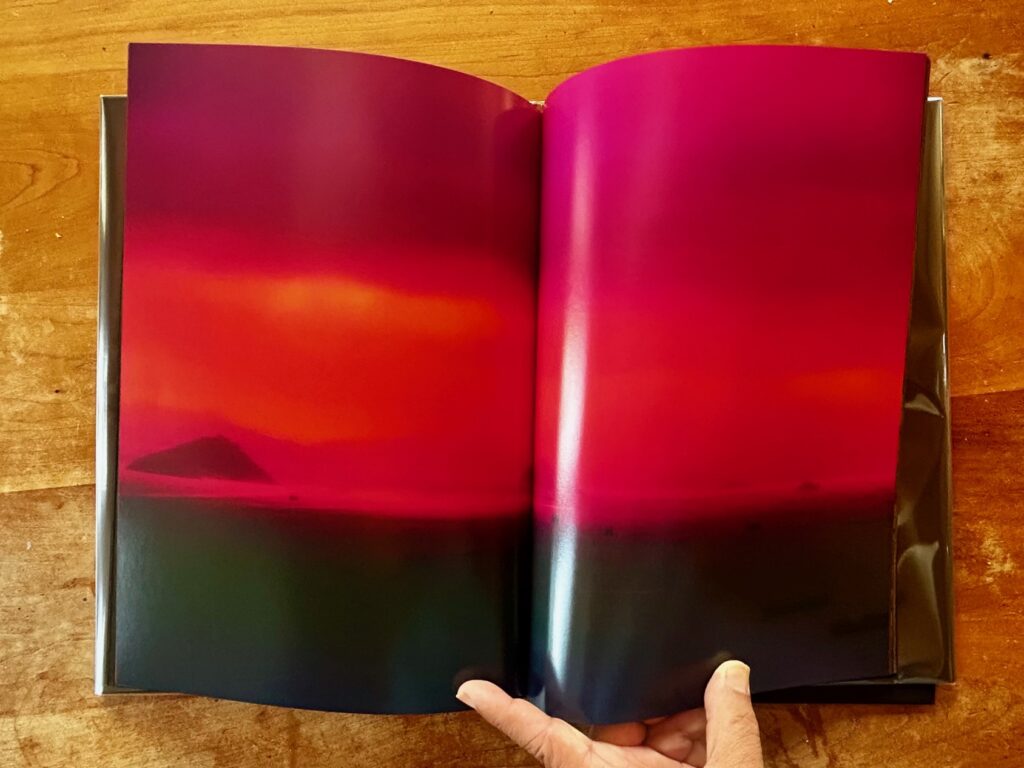
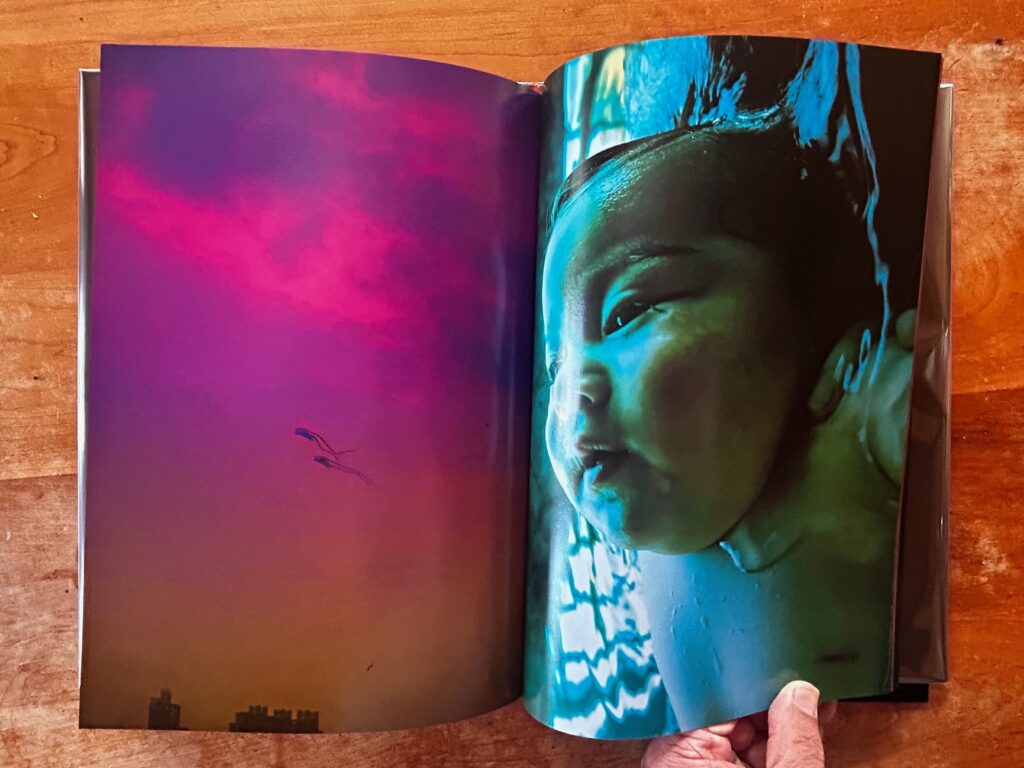
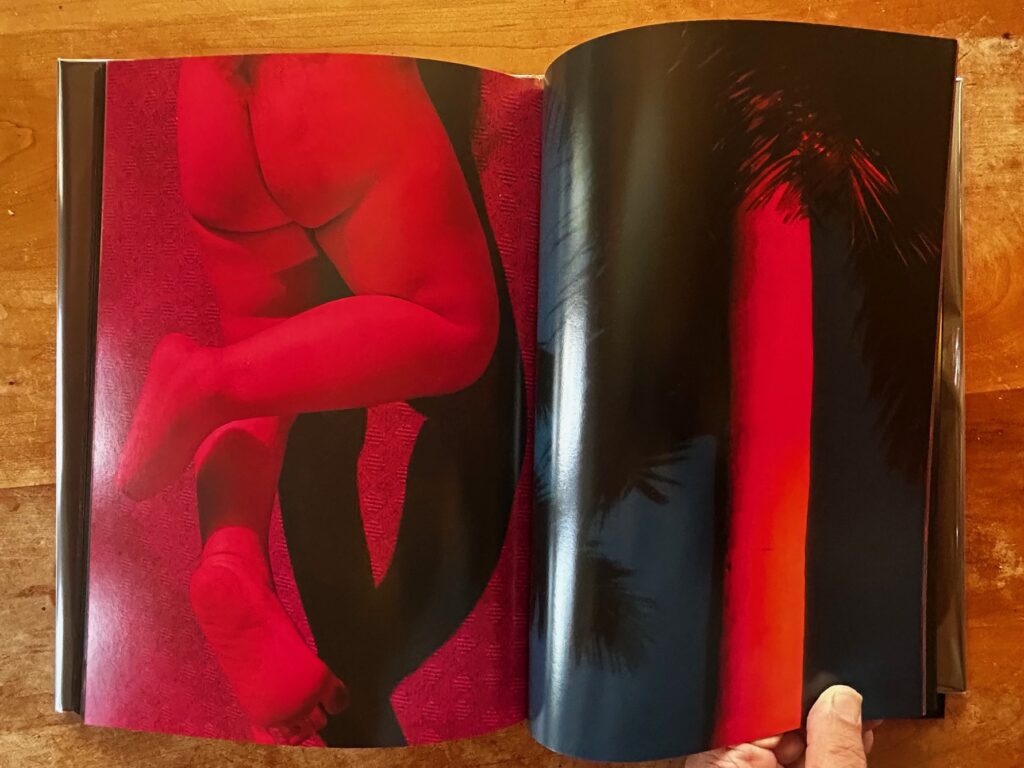
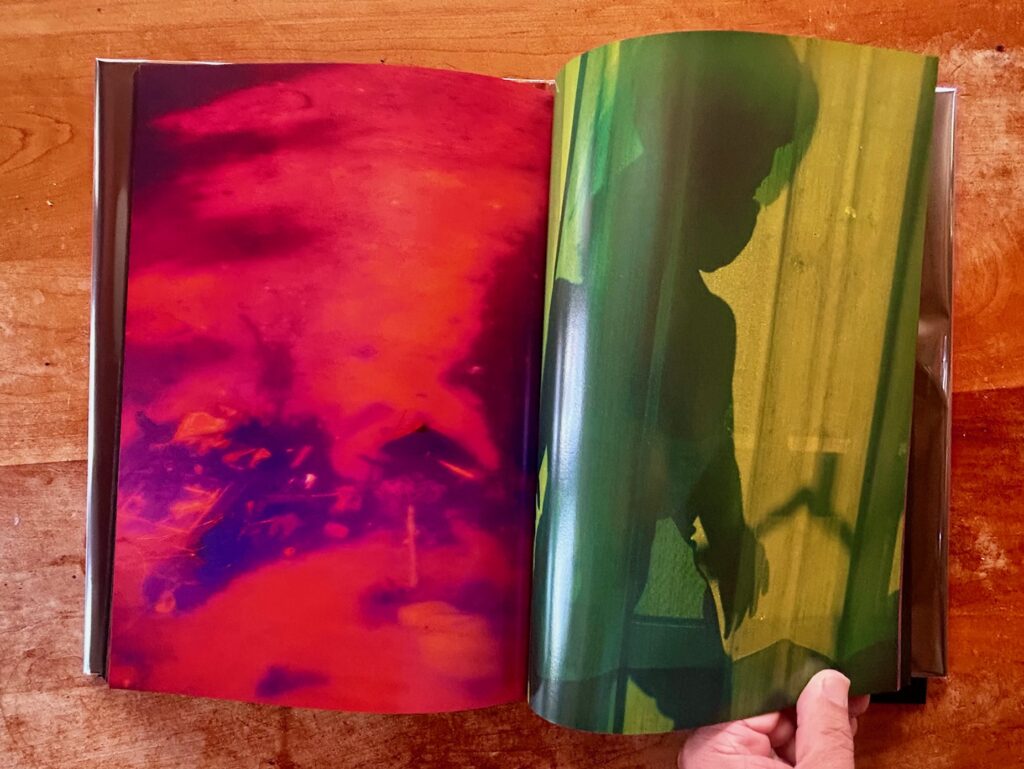
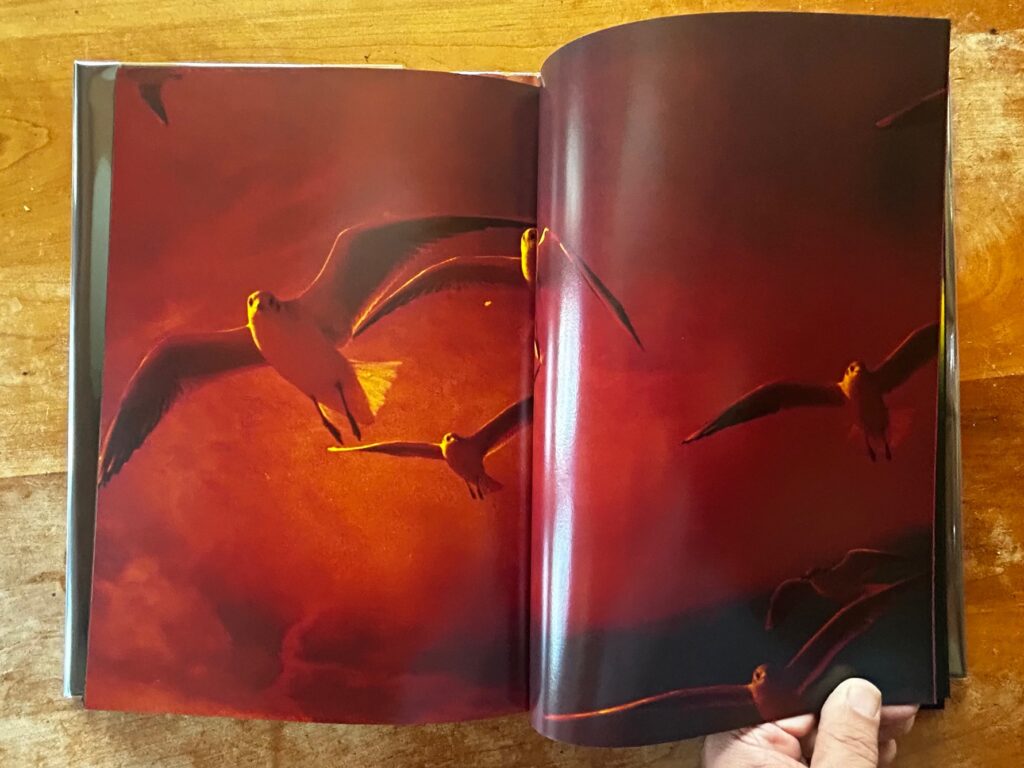
All well and good. But Okabe’s dark forays might have been tossed—and the project scrapped—if not sustained by a light at the end of the tunnel. Salvation was delivered in the form of her daughter. In the last third of the book, we get to meet her and peer in on her childhood through a series of more conventional pictures. She is shown at various ages from infancy to Pre-K. This blissful period is enmeshed in magical thinking, as her nude form is juxtaposed with ethereal subjects: glistening seas, dusky skies, a flock of gulls, palm fronds, and other idylls. In one image pairing, her daughter suckles Okabe’s breast, opposite a photo of decaying fruit rinds. In one fell swoop she’s covered life, death, and rebirth. The boundary between warm womb and cold reality is blurrier than we might think.
The visual impact of each photo—and the whole book, which wallows in deep-space black down to its edges, endpapers, and cover—is enhanced with Okabe’s vivid filtrations. There are no straight colors in My Bloody Hand. Instead, the hues are radically skewed into far corners of the CMYK spectrum. The images appear nearly monochrome, but instead of conventional black-and-white, the tonalities are rooted in chroma.
These effects might be created through Photoshop, cross processing, or color gels. The method is not clear or important, but it’s a familiar device for Okabe. Her previous books Bible (reviewed here) and Ilmatar offered similar tinctures. “Okabe’s images are bathed in acidic washes of lush filtered color, giving the entire collection of photographs an edge of uneasy desperation,” we wrote about Bible in 2014, a description which applies equally to the current work. Okabe has developed these heavy tints into a distinctive voice. Applied to motherhood, kids, or vernacular objects, they lend any subject a dreamy dimension, as if viewing reality through a flashback scene.
If the last third of My Bloody Hand is a visual extension of Bible and Ilmatar, Okabe’s microscopic photographs surely probe new territory. I’ve orbited the book’s first two-thirds over and over, exploring its inky depths and celestial bodies. What strange worlds am I looking at? What ideas are being expressed? What was Okabe after, and what drove her to photograph the same material repeatedly?
I’ve found no answers. Extracting information from these roundels is like pulling blood from a stone. But perhaps that’s the point: My Bloody Hand is motivated as much by process as results. Okabe’s nightly fridge raids must have been therapeutic in her recovery, and the ritualistic results helped her pull through disappointment. If she created strange and exotic worlds, that was the icing on her pregnancy cake.
Momo Okabe follows a long tradition of photographer moms who have documented their own pregnancies and young motherhood. Predecessors include Andi Gáldi Vinkó (reviwed here), Elinor Carucci (reviewed here), Annie Wang, and Megan Mattiuzzo, who famously photographed her own delivery, and many more. Each one has pushed the field forward in her own way. But few have escaped the gravity of miscarriage’s black hole with such force and imagination. Momo Okabe got her hands dirty making this book. The psychic scars will fade eventually, but her work should have a long shelf life.
Collector’s POV: Gallery representation for Momo Okabe, either in the US or Japan, is unclear. Given this uncertainty, interested collectors should likely follow up with the publisher (Little Big Man Books) for further information on available prints.