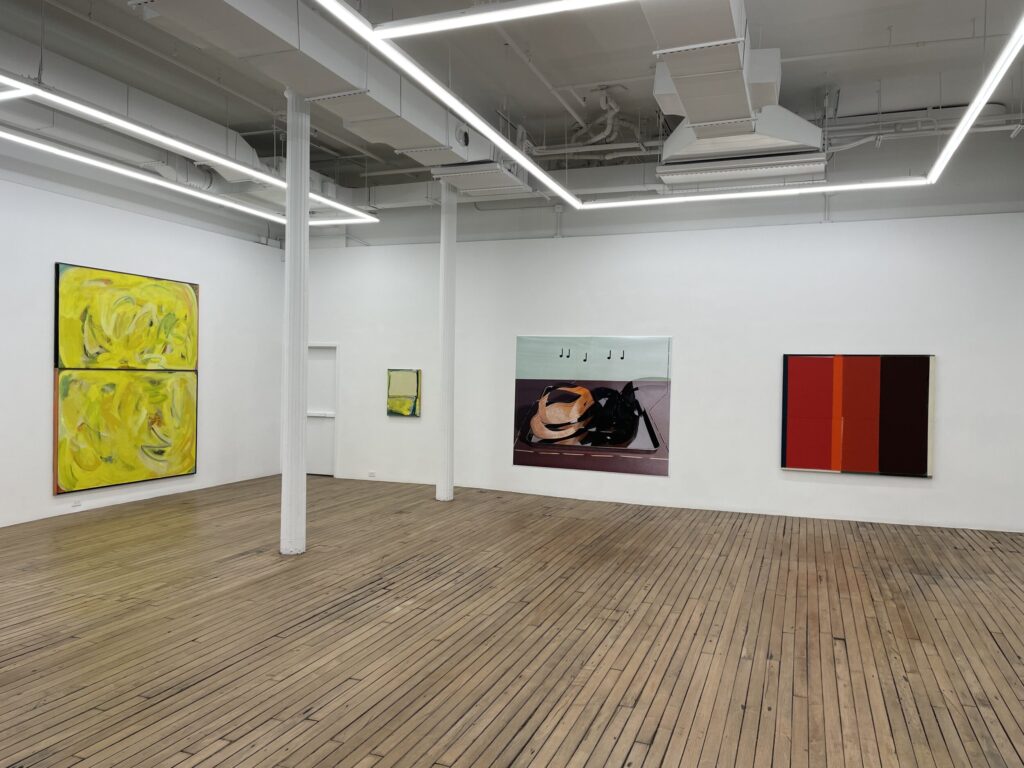
JTF (just the facts): A paired show of works by Lucas Blalock and Julia Rommel, hung unframed against white walls in the main gallery space and in the smaller gallery on the lower level. (Installation shots below.)
The following works are included in the show:
Lucas Blalock
- 3 archival inkjet prints, 2025, sized roughly 19×22, 19×23 inches, in editions of 4+1AP
- 3 archival inkjet prints, 2025, sized 72×84, 72×86 inches, in editions of 1+1AP
Julia Rommel
- 6 oil on linen, 2025, sized roughly 24×23, 28×22, 56×60, 56×64, 84×73, 102×82 inches, unique
Comments/Context: Back more than a decade ago now and perhaps nearer to two, there was a moment in contemporary photography when software-based digital image manipulation started to more overtly make its way into the artistic conversation. At first, primitive cloning, mirroring, erasing, and other Photoshop effects were being experimented with by a younger generation of risk takers, and a few more established photographers were caught making sneaky digital modifications, leading to a kind of performative shaming and community outrage about the polluting of photographic truth. And during that formative time, Lucas Blalock was among those out on the leading edge of the medium, transforming the emerging language of manipulation into his own unorthodox visual vocabulary.
Looking back now, it’s easy to see how Blalock’s art was perplexing to many, to the point of being misunderstood or even discounted. While most everyone else was trying to hide their manipulations, Blalock was actively going the other way, making marks that were messy and obvious, using tools that everyone knew how to use, leaving remnants and “mistakes” in place, and adding layers of subversiveness and irreverence to his process of deliberately disrupting his own images. His photographs were unstable, elusive, and conceptually hard to pin down, often with flashes of crackling digital humor that seemed to provocatively poke the viewer in the eye, always leaving us with uneasy questions about whether it was all on purpose or if there was yet another inside joke we were actually missing. And as a result, I think Blalock’s approach led him to drift slightly outside the mainstream, appealing most to those who could see the method in his madness.
Now in his late 40s, Blalock should be in his power zone as an artist, and a 2025 Guggenheim Fellowship is one recent accolade that signals that the art world is coming back around to better appreciate his unique point of view. Over the years, we’ve followed Blalock through gallery shows (in 2021 here, 2016 here, and 2013 here), photobooks (in 2024 here, 2016 here, and 2014 here), and various group shops and art fairs, and he’s now overdue for a robust mid-career institutional survey that would put all of these pieces into better order and surround them with more comprehensive chronological and curatorial context.
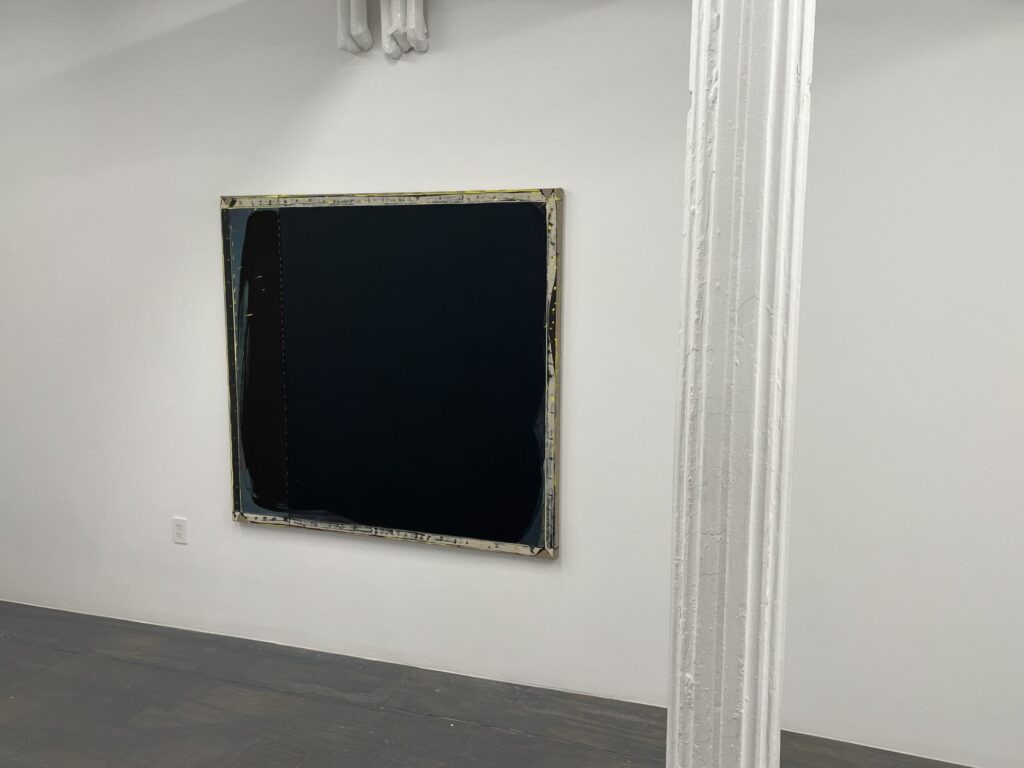
This paired show, which places a handful of Blalock’s recent photographs in dialogue with paintings by Julia Rommel, offers a glimpse of how his style is evolving. As an aside, here at Collector Daily, we don’t pretend to be current enough with contemporary painting to tease out the subtleties in Rommel’s work, or to even thoughtfully enumerate the ways that features of her paintings create echoes with Blalock’s aesthetics, aside from obvious parallels of color, texture, or composition. So with all respect to Rommel’s contributions to this combined show, Blalock’s photographs are the main focus of this discussion.
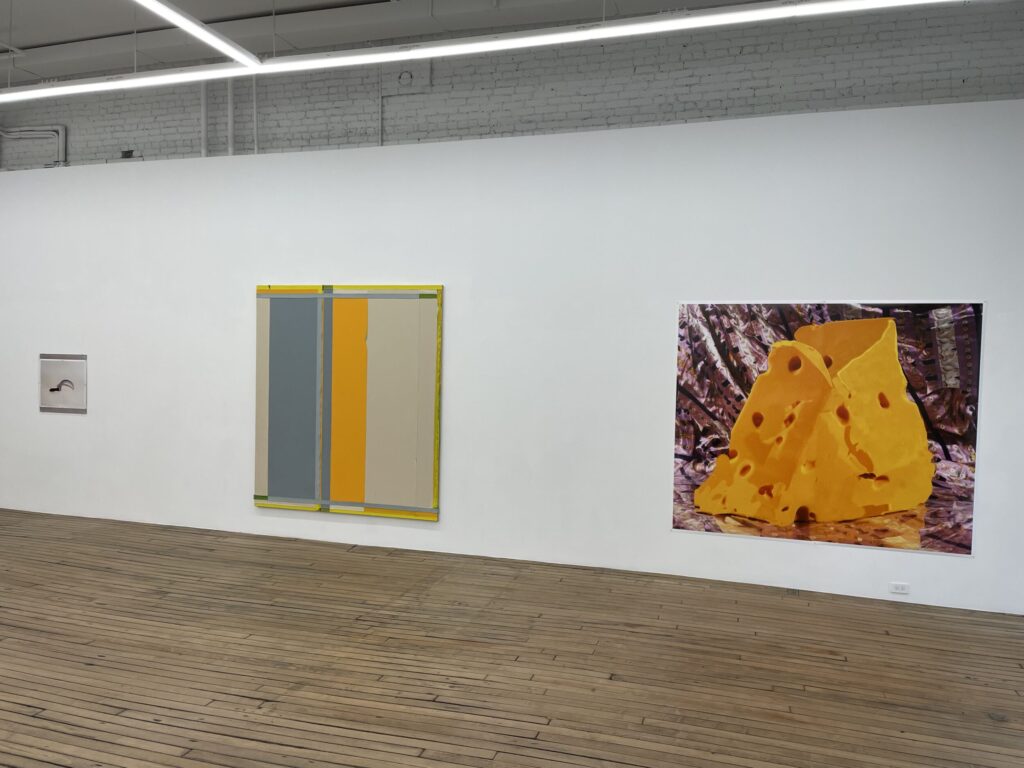
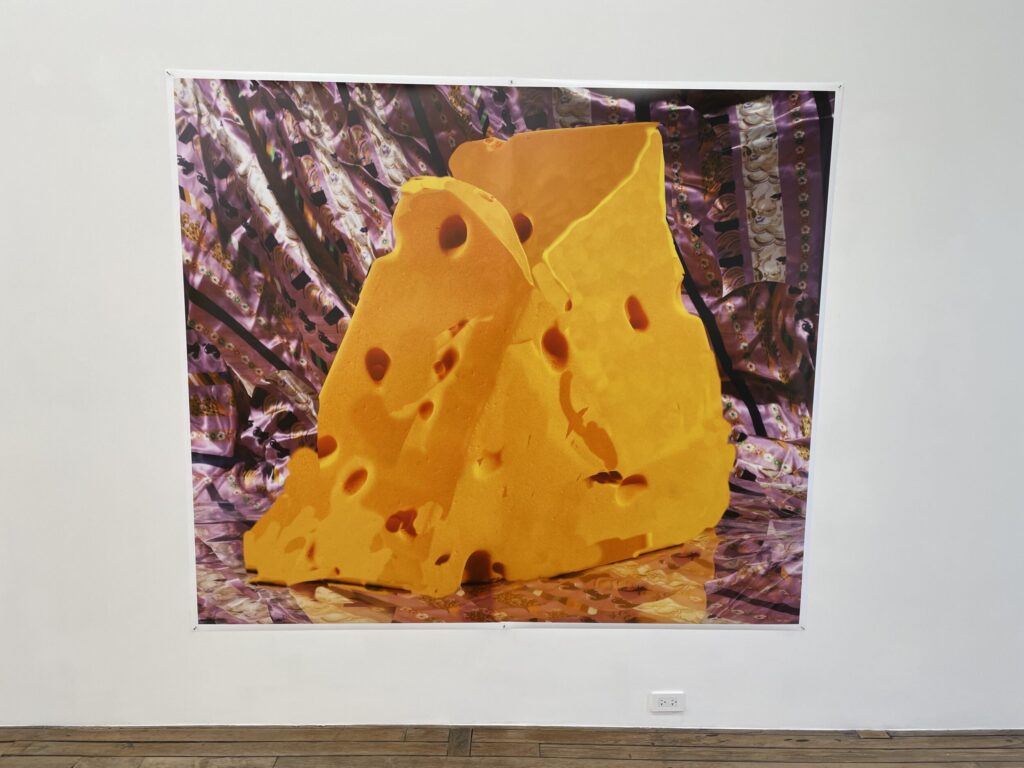
The photographic prints included in the show are displayed in two sizes, essentially large and small for the purposes of comparison. And what surprised me most about the large scale pictures was just how elegant and synthesized I found them – which of course I might attribute to Blalock incrementally refining his approach over time, or more likely, my eye finally getting comfortable with the frictions, contradictions, and challenges he’s always presented. I certainly realize that calling a wall-sized photograph of a block of vividly orange cheese “elegant” is itself a kind of puzzling reaction, but there is something altogether sophisticated about the way Blalock has undermined the still life and its sparkly draped surroundings, cutting and reassembling visual fragments into a shiftingly unstable swirl of impossibility, where arcs, curves, angles, overlaps, and edges that fail to match partially coalesce into something that approximates reality. “Cheesehead” is a knockout picture, and one that will likely confound (and enthrall) viewers for years to come.
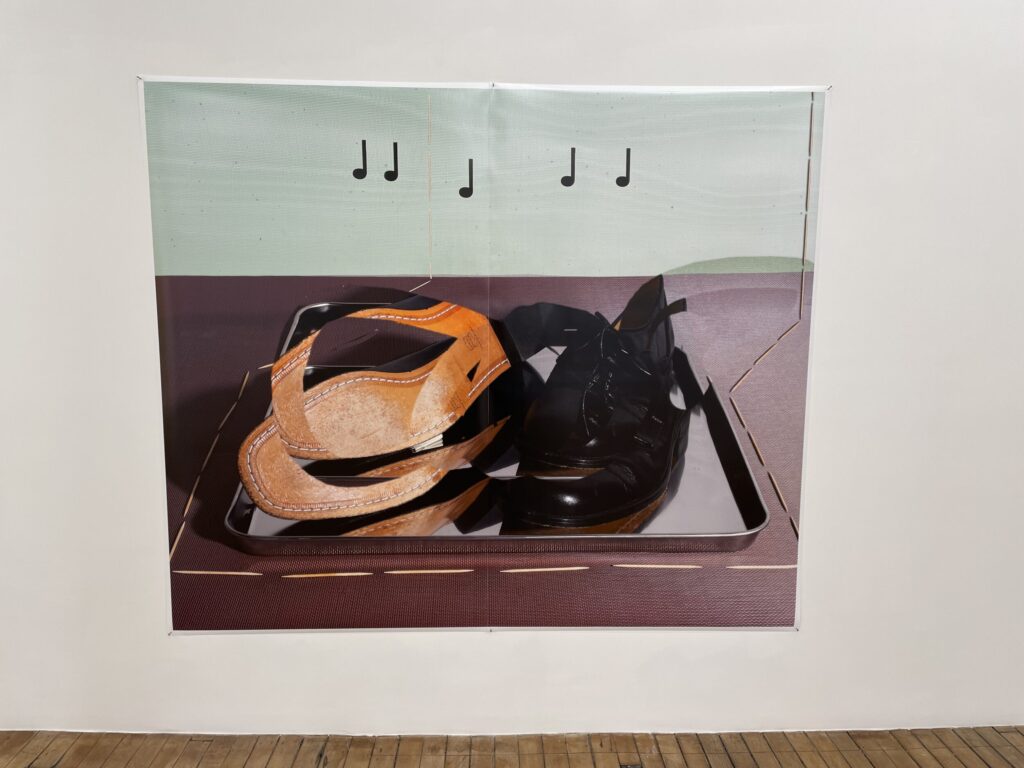
A setup of black leather dress shoes placed on a metal tray provides the subject matter for the other large print installed in the main gallery space, and it offers even fewer plausible explanations than the block of cheese. Blalock disassembles the shoes into stuttering layers of overlapped repetition, the stitching motif on the bottom of one of the shoes then repeated around the tray and up the wall (breaking the sense of depth and scale implied by the tabletop and back wall) using a twisting line of toothpicks to mimic thread. He then decorates the space above, or along the green wall, with floating musical notes that while inserted digitally seem to ride the faint undulating lines of a score like a short melody. There’s a lot to unpack in this picture, particularly in terms of the illusionistic spatial dynamics, giving the photograph a satisfying sense of deliberate mystery, the tune in the air never quite audible.
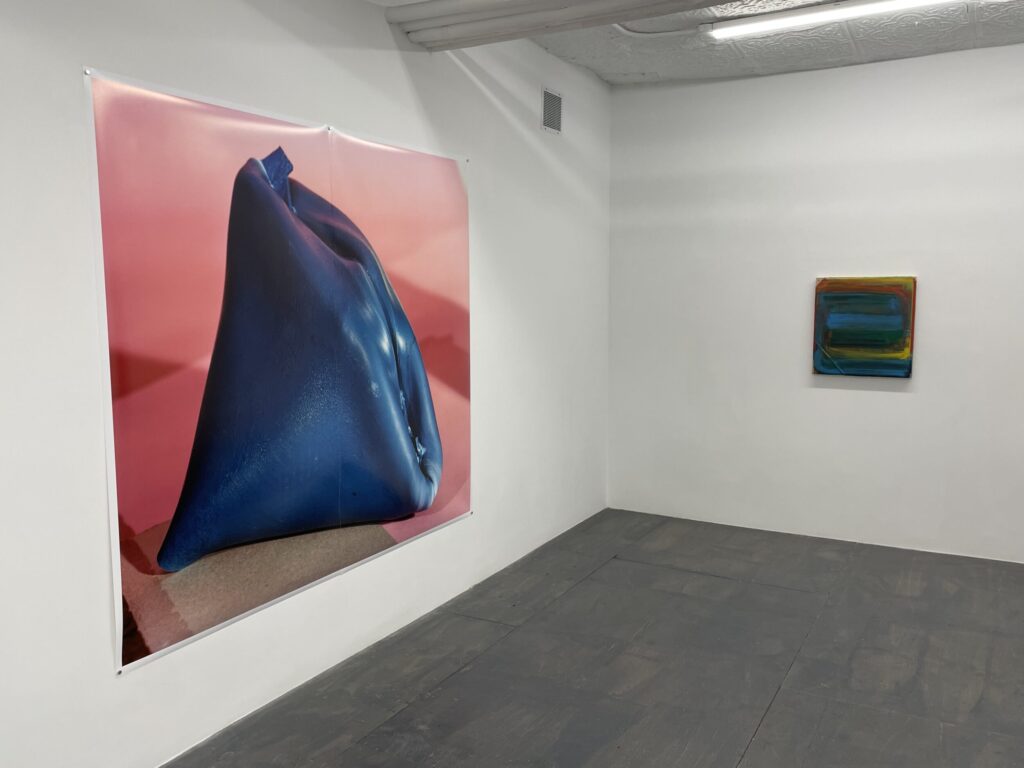
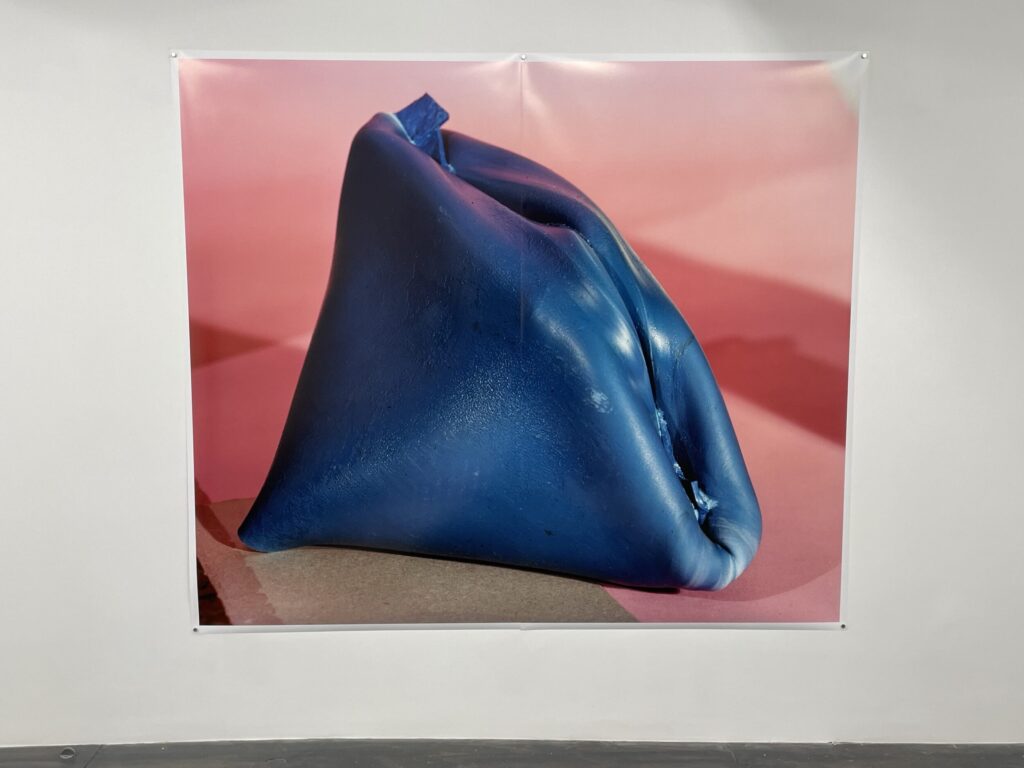
Downstairs, the last large print pushes us off balance once again, in a different direction. Some kind of foam (or maybe rubber) object has been folded into a lumpy triangle and gracefully isolated against a blurred pink backdrop in the manner of a product shot with the lighting gone slightly awry. What the blue sculptural object might be is never explained, and even though there doesn’t seem to be any overt manipulation going on, the image doesn’t resolve into anything identifiable. So once again, Blalock has left us wondering about what we don’t know, and questioning our assumptions about the ability of a photograph to communicate clearly.
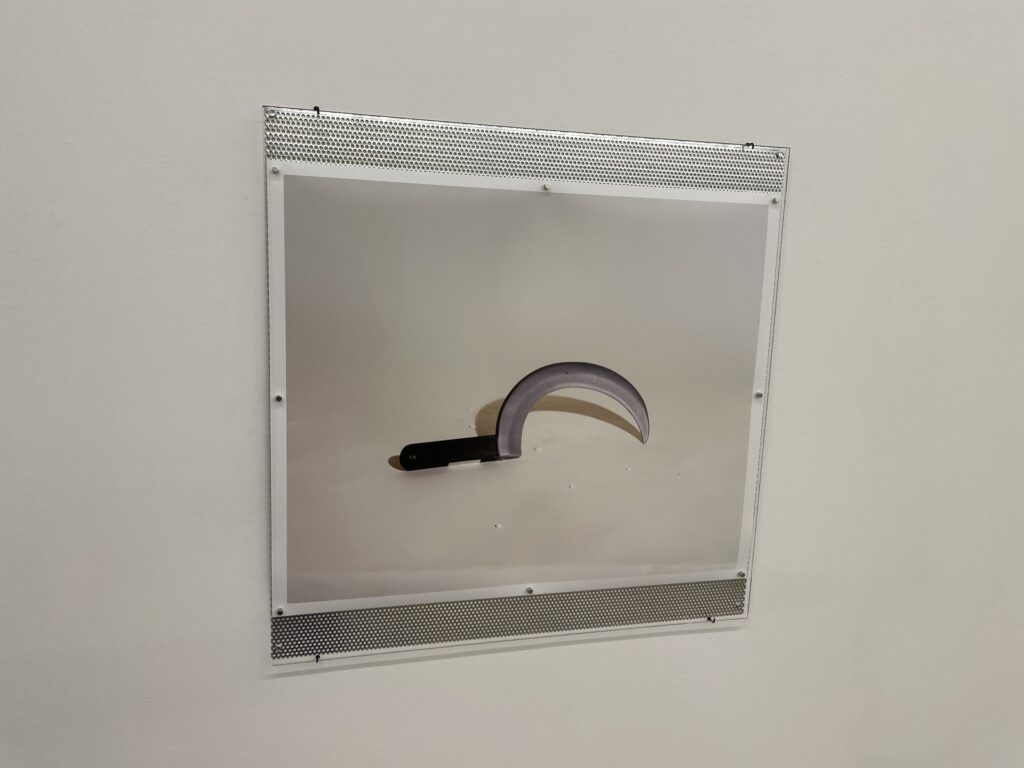
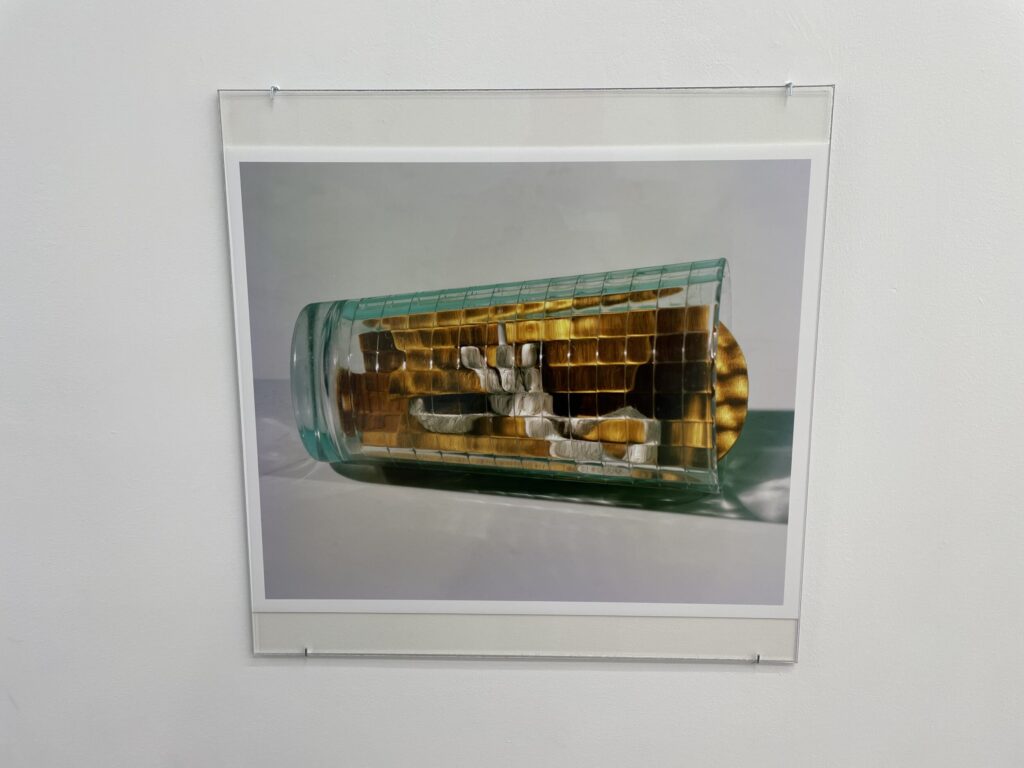
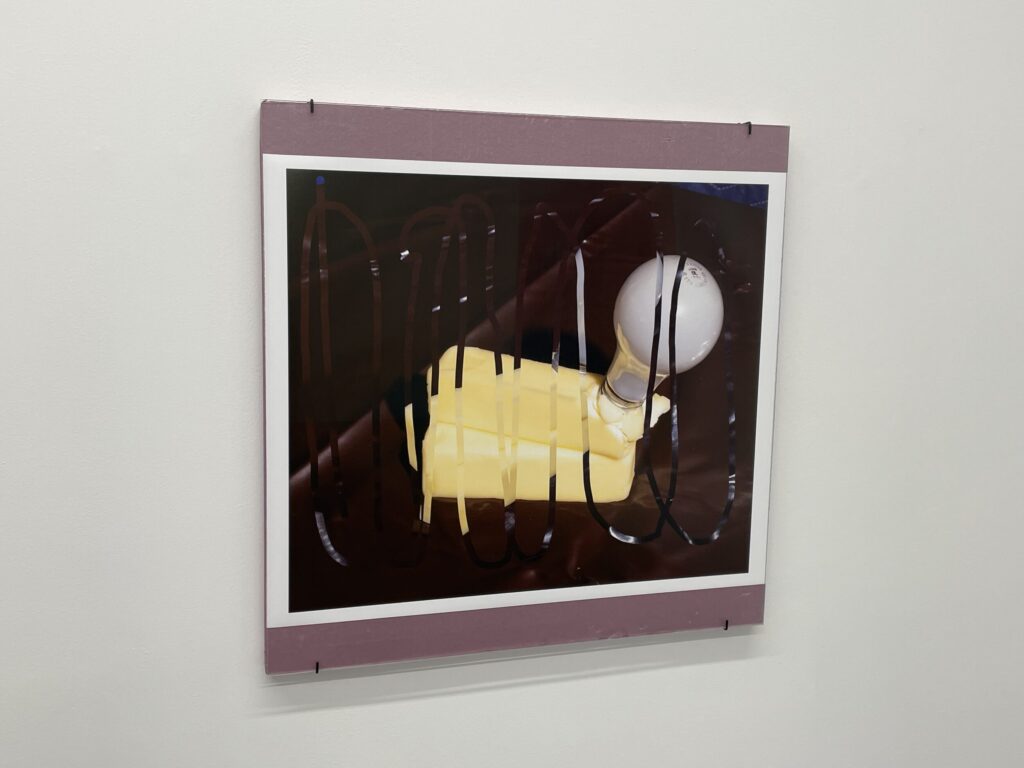
While the large photographs in the show have been displayed unframed as prints tacked to the wall, the smaller images have been variously backed with perforated metal mesh and purple board and covered with glass, giving them a more object-quality presentation. All three pictures have a sense of intentional misdirection and playfulness. The strongest of the three turns some kind of felt sandal stuffed inside a gridded glass into what looks surprisingly like a corncob, Blalock again letting the confusion of the object itself (and our perception of it) stand on its own without additional tweaking. His “Fat Lamp” – a lightbulb stuck into a stack of butter sticks – has an offbeat Dada cleverness and irreverence, which is then amplified by a gestural squiggle of digital mark making/erasing that seems to either add a twist of electrical wire to the composition or cancel the whole art making effort. And his seemingly straightforward photograph of a sickle is titled “Hammer”, pricking us with yet another moment of wordplay and misunderstanding, as if to remind us that we can’t possibly trust what we’re being shown.
While versions of Blalock images like these from years past often felt a bit rough and improvisational, with the visual joke making and digital rework done with seemingly overflowing casual energy, these 2025 photographs are more confidently refined. It’s as if Blalock has become more secure in his sidelong relationship to the medium, and more comfortable that the process and vocabulary he has developed for image-making still have plenty to say about the malleable nature of photography. Maybe it’s age or the accumulation of artistic experience, but his restlessness feels more controlled, allowing him to both choreograph and dissect imagery with more precision. Perhaps he’s on the cusp of delivering that bold career-making body of work that will vault him even higher.
Collector’s POV: The prints by Lucas Blalock are priced at $7000 or $20000 each based on size. Blalock’s works have not reached the secondary markets with any regularity, so gallery retail likely remains the best option for those collectors interested in following up.