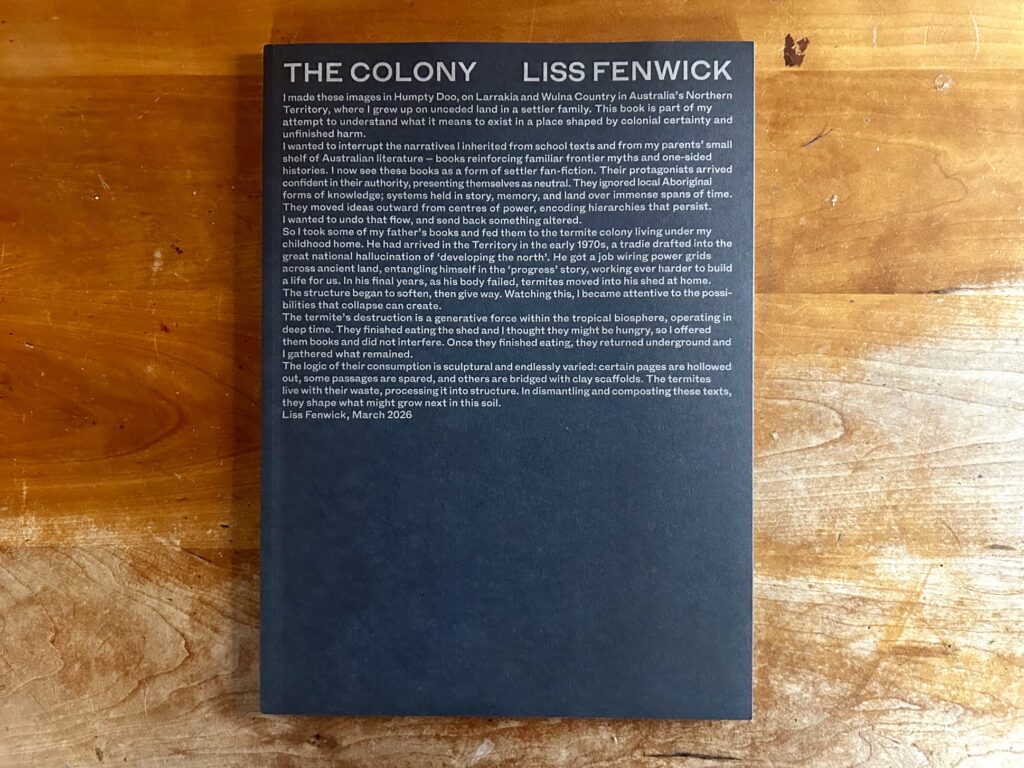
JTF (just the facts): Published in 2026 by Perimeter Editions (here). Softcover with gatefold end flaps, 24.5 x 34 cm, 72 pages, with 41 color photographs. Includes a short text by the artist. Design by Stuart Geddes. In an edition of 800 copies. (Cover and spread shots below.)
Comments/Context: Colonially speaking, there’s a fine line between termites and Australians. A termite colony expands into fresh territory by releasing a swarm of flying alates. A male and female find each other, drop wings, mate, and burrow into damp soil or wood. Settling in for the long haul, the new king and queen reproduce and gradually build their city-state, consuming local resources in the process. Presto! A new colony.
The European settlement of Australia followed a similar course. In the late 1700s the continent was established as a distant penal colony for England. Early immigrants planted roots, swarmed, and reconnected in new permutations, then settled in for the long haul. Along the way, they consumed resources, steamrolled the indigenous population, and gradually established an enduring nation. Presto! A new colony.
The Australian photographer Liss Fenwick has been a front seat witness to both forces. She grew up in Humpty Doo (the subject of her debut photobook Humpty Doom, reviewed here) in the Northern Territory, “on unceded land in a settler family.” Her father had carved out the family homestead there in 1972. Among other jobs, he wired power grids across ancient land, paving the way for Humpty Doo’s expansion. As described by Liss Fenwick, he was “a tradie drafted in the great national hallucination of ‘developing the north’.”
Her father’s plans ran roughshod over the Aboriginal Larrakia/Wulna settlements already there, but they dovetailed nicely with the local termites’ ambitions. Insects soon established a colony under his shed, and began to eat away at the wood. Unbeknownst to either party, termites and Fenwicks were on a collision course.
This turned out to be an ideal laboratory for young Liss Fenwick. She may have come from colonizer stock, but her sympathies were firmly with the local termites. Some early inklings of her outlook appeared in Humpty Doom, in the form of scattered termite pictures. As it turned out they were just a taste of things to come.
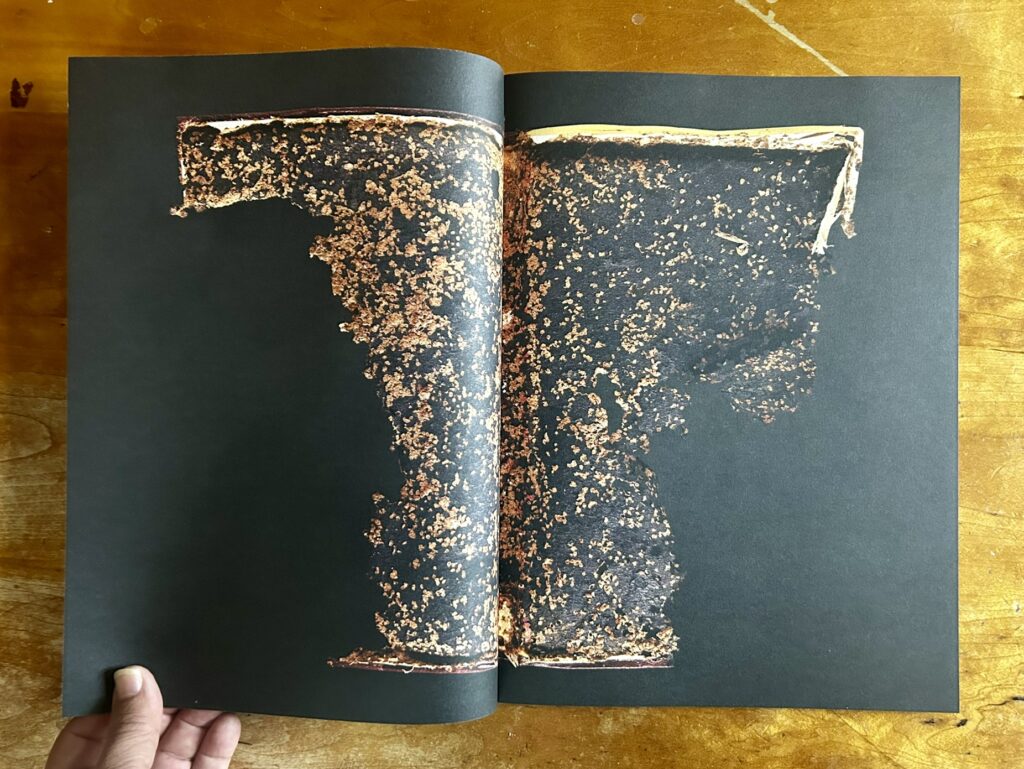
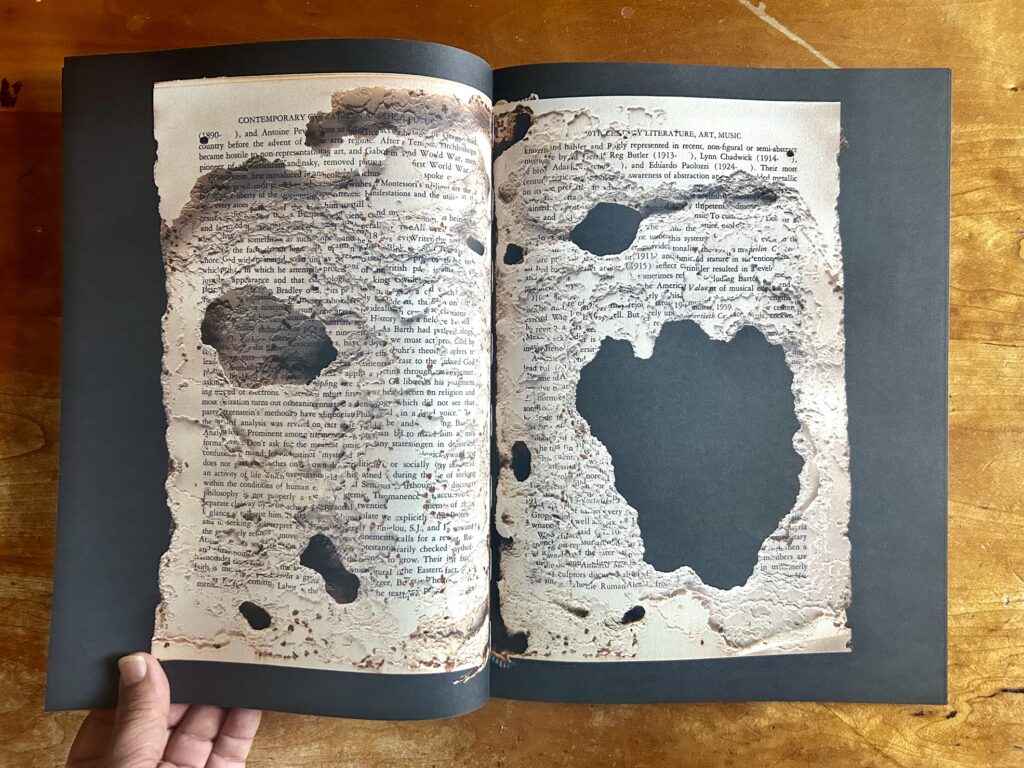
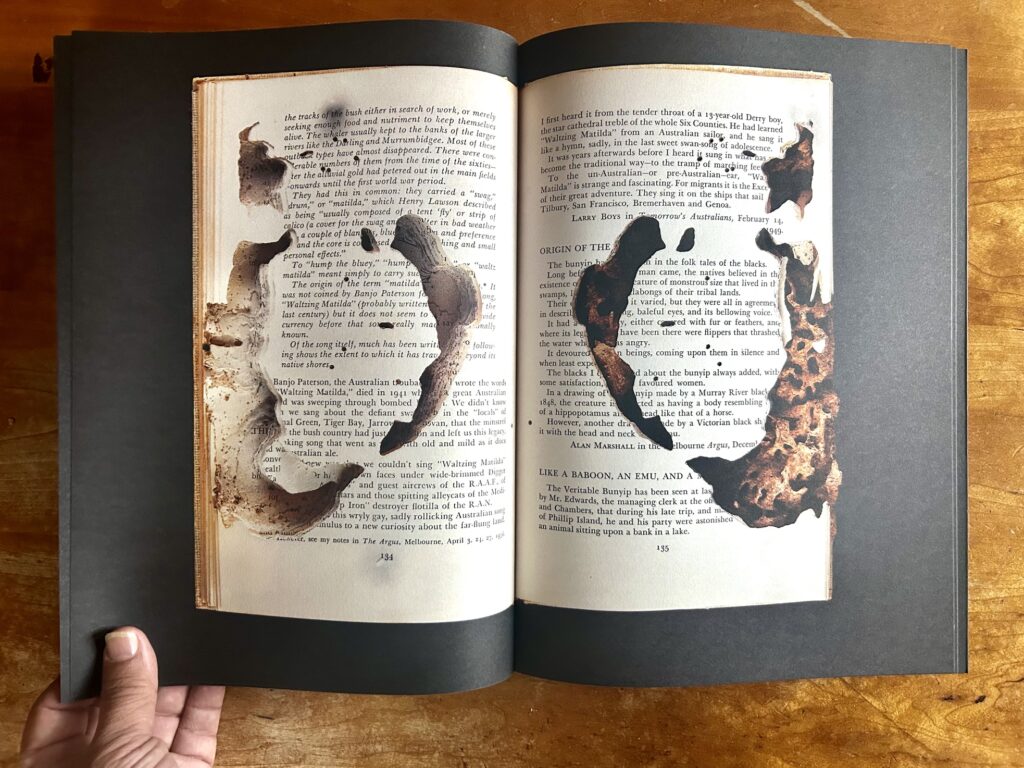
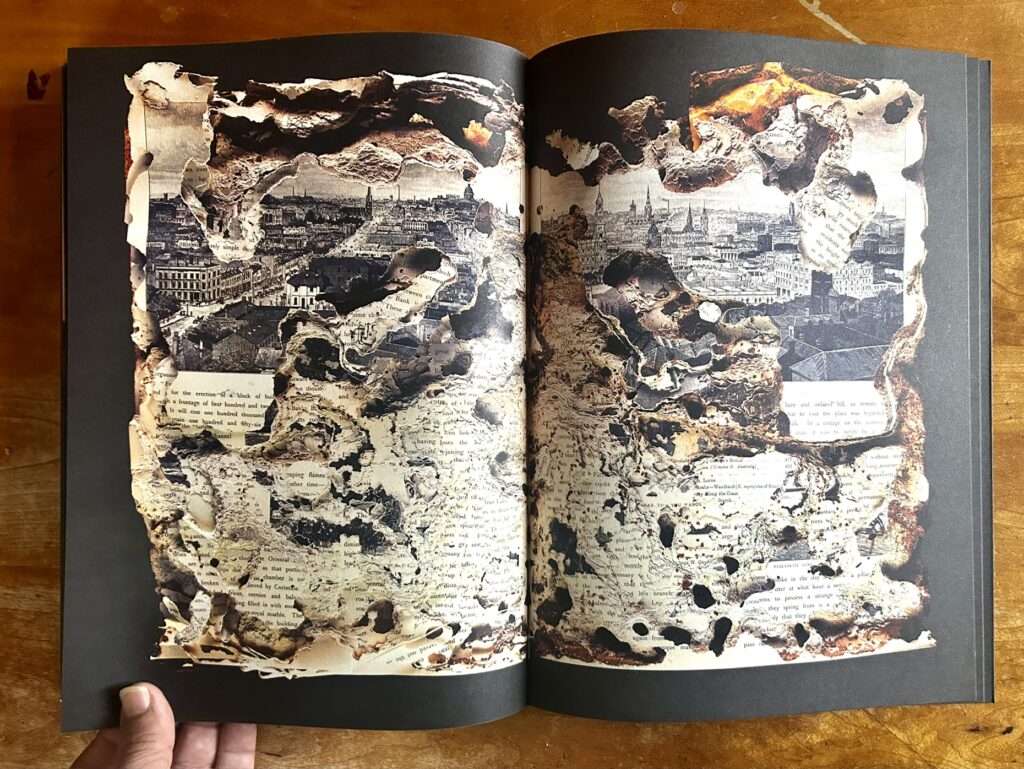
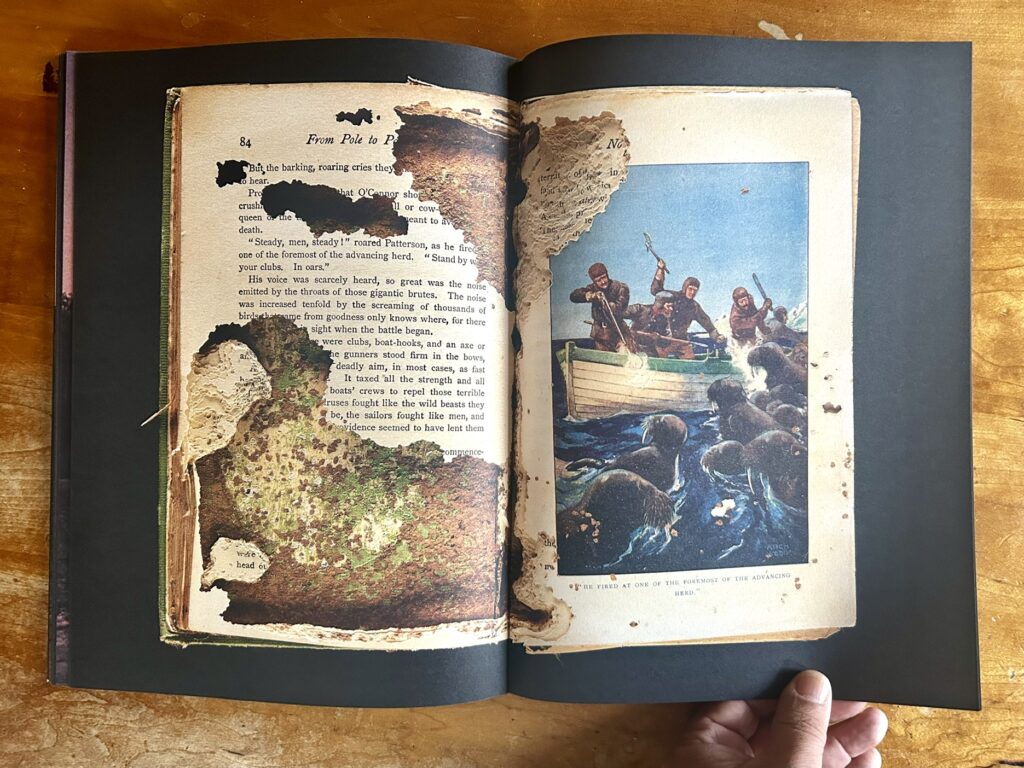
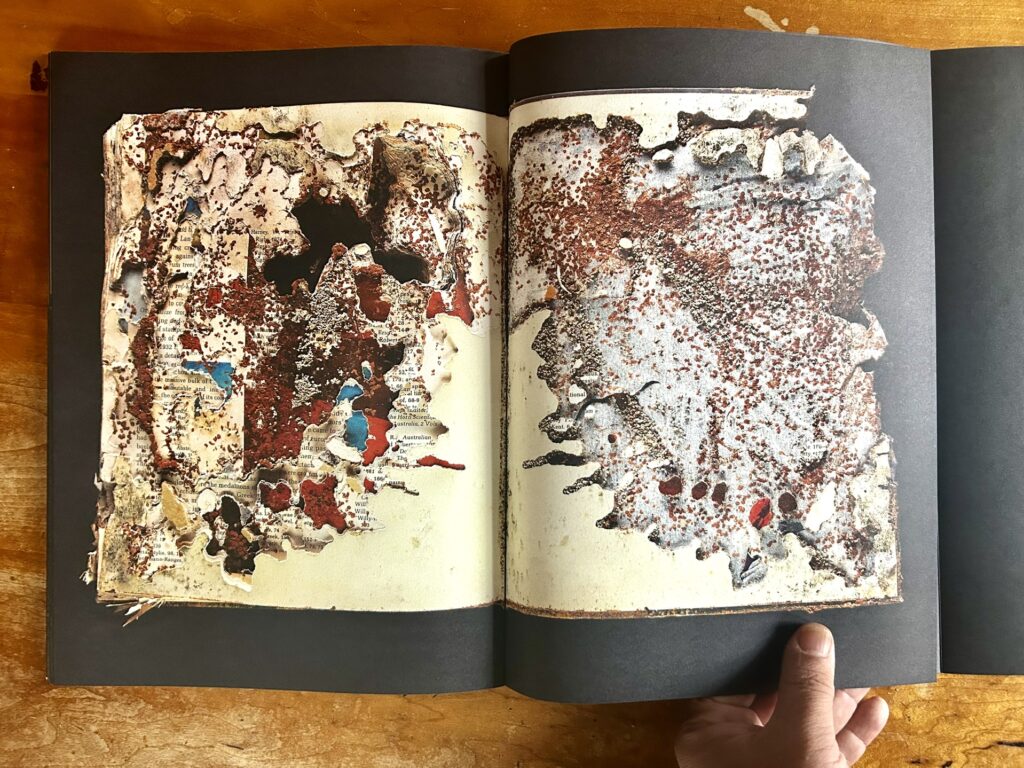
In 2020 Liss Fenwick buckled down in earnest, and began to feed colonialist books—“settler fan-fiction”—to the insects under the family shed. Her father and his outpost were both entering their last days, and the books were not far behind. After the termites had their fill of paper, she removed their half-eaten scraps to a well lit location, then documented the results in photographs.
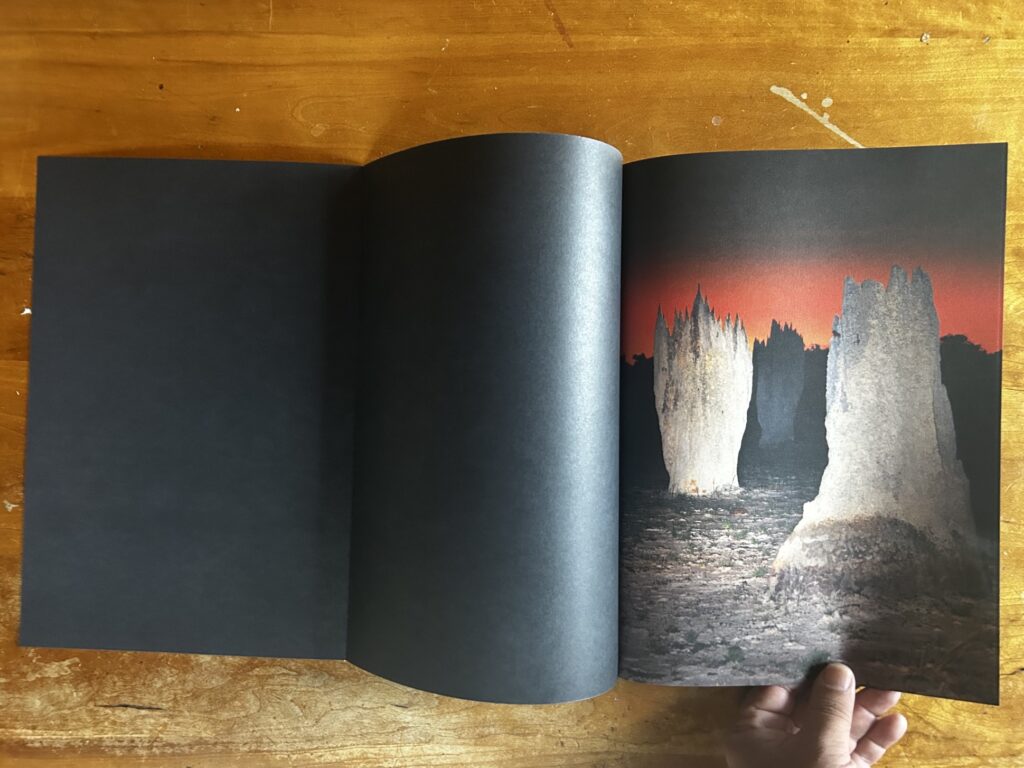
These fateful currents come together in Fenwick’s latest monograph The Colony. Its photographs are mostly comprised of hole-ridden pages in various states of decimation. These images are interspersed occasionally with pictures of termite mounds. Prefaced with a blunt critical treatise, The Colony is a study of occupation, imperialist mythology, and the temporal nature of all earthbound structures. At some point in the distant future, The Colony too will join humanity’s scrap heap. In the meantime, let’s dive in.
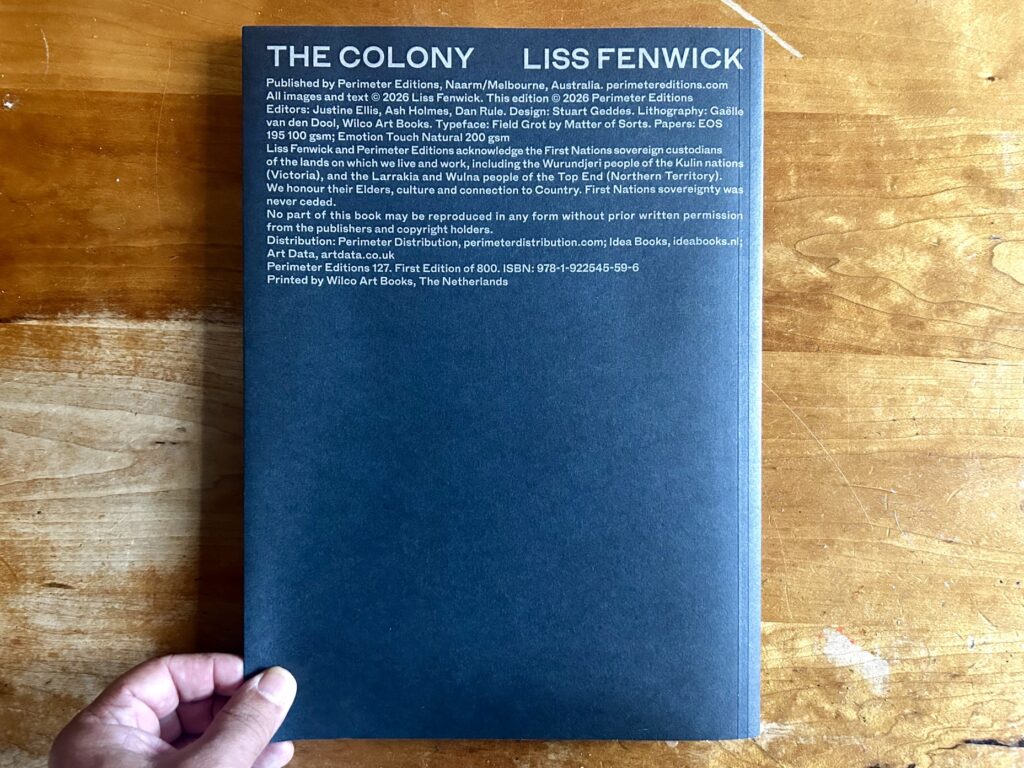
Readers needn’t search hard for The Colony’s underpinnings. Fenwick outlines her history and motivations in a brief essay on the front cover (the back cover holds the colophon). She is unabashedly revisionist and woke. “The book,” she explains, “is part of my attempt to understand what it means to exist in a place shaped by colonial certainty and unfinished harm.”
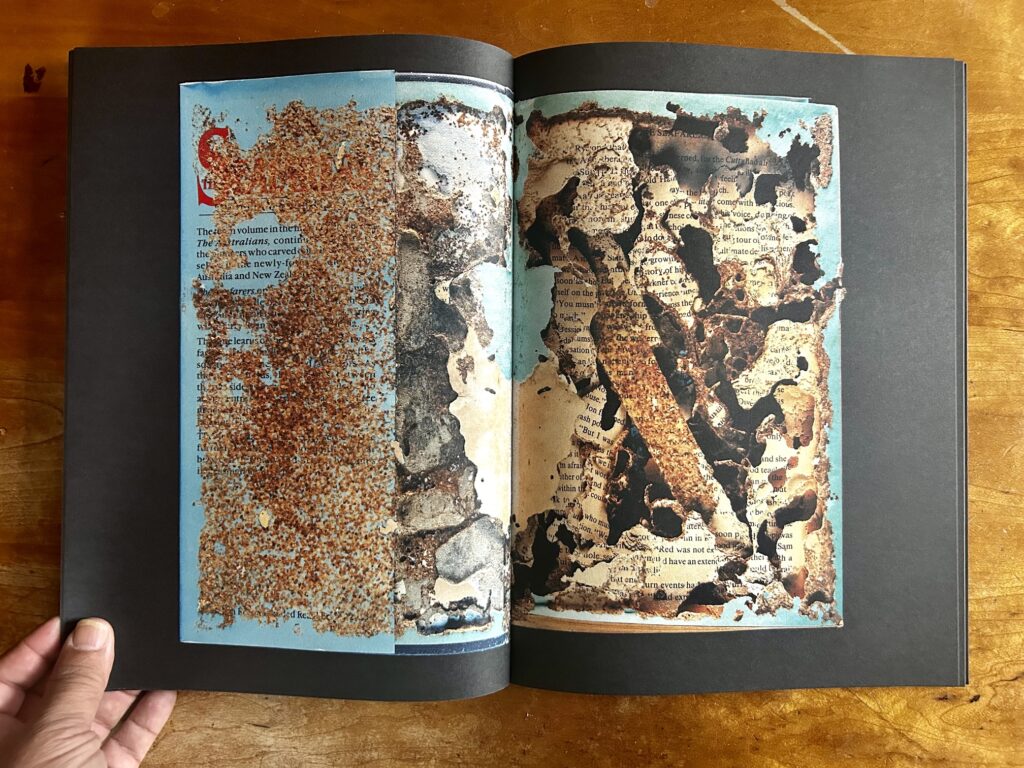
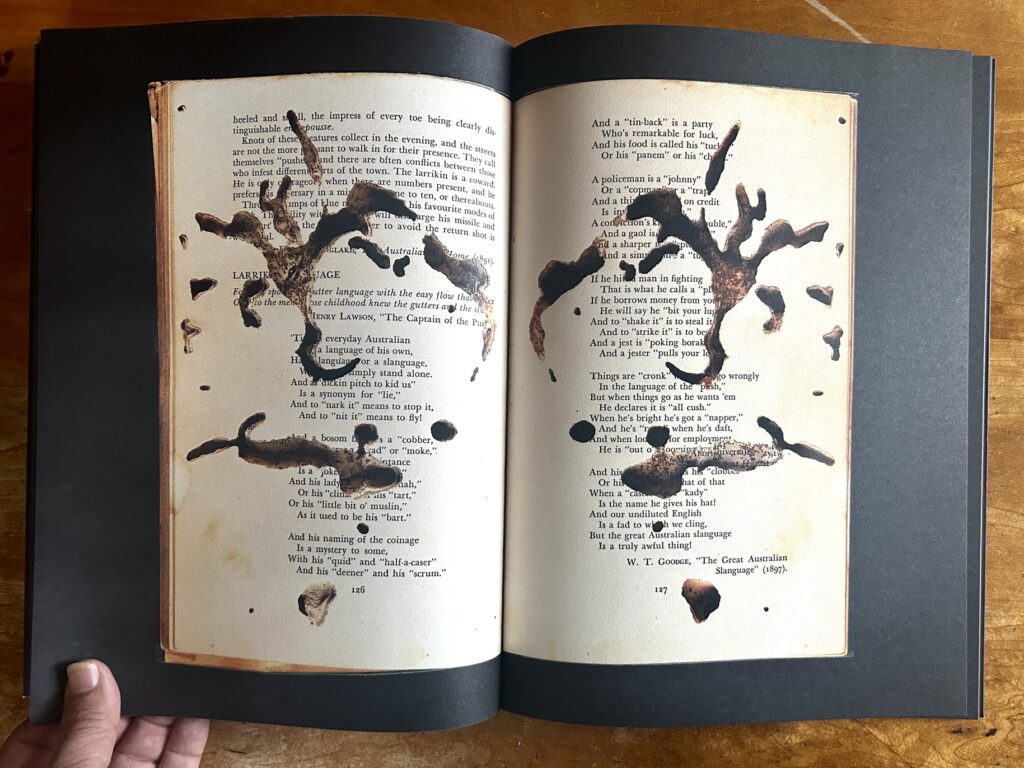
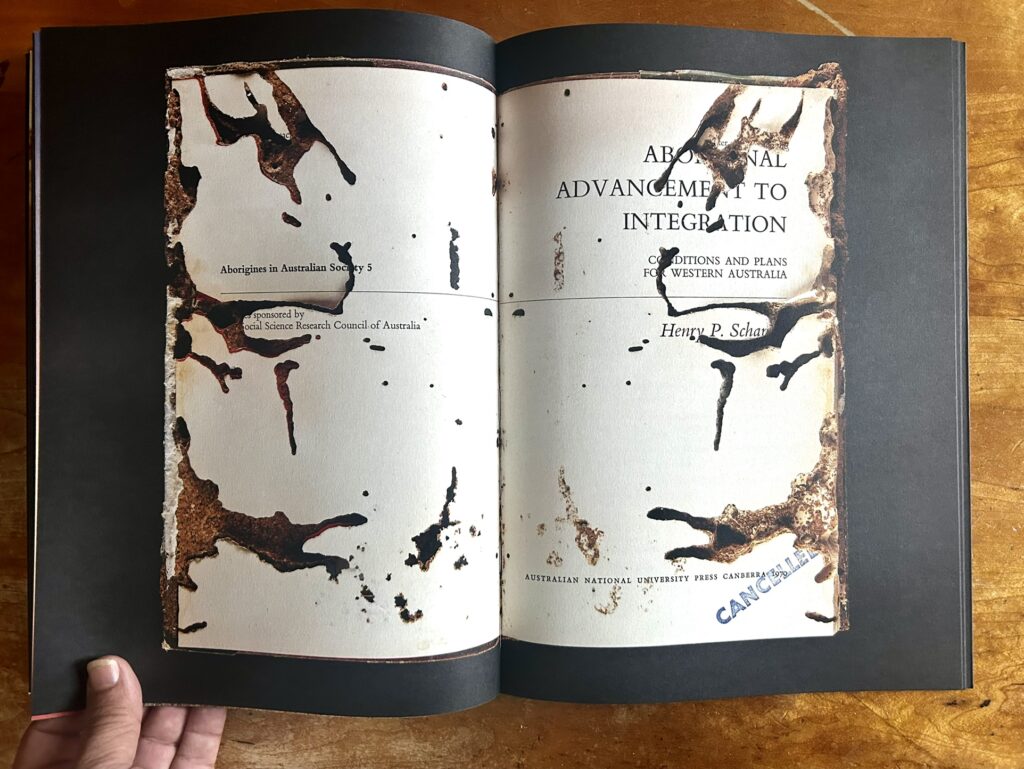
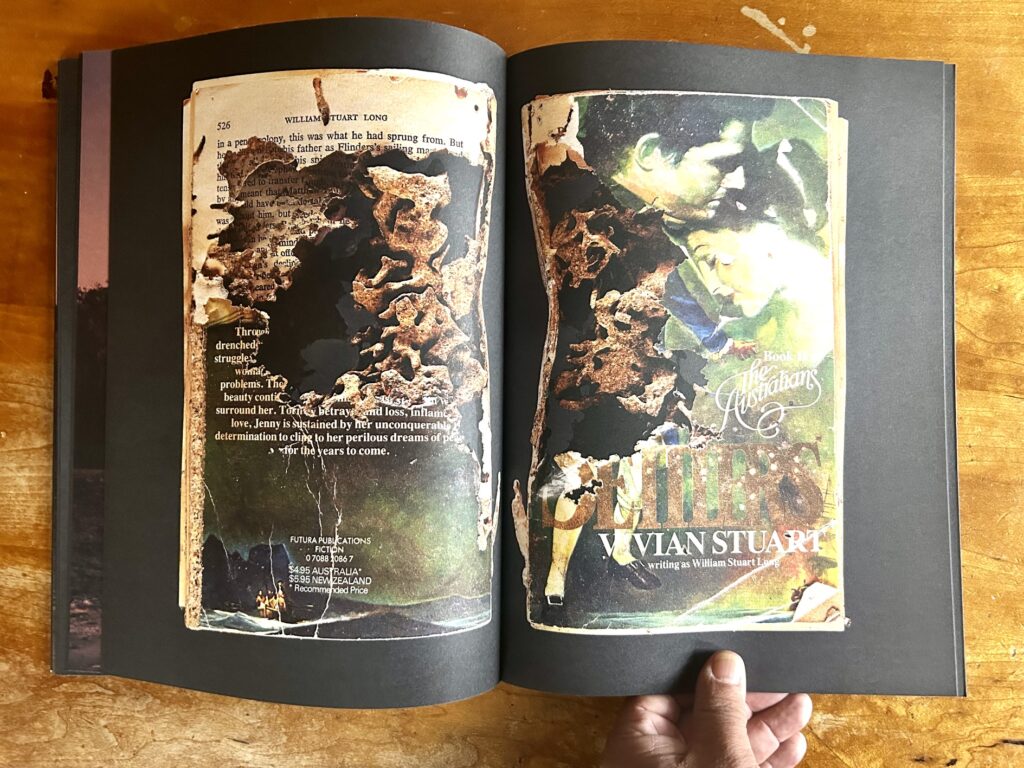
What does colonial certainty look like in photographs? A sampling of literary meals gets the point across: The Australians, The Explorers, The Imperialists, The Patriots, The Colonists, The Empire Builders, and Aboriginal Advancement to Integration. Whew! These cringeworthy titles were among many which Fenwick fed to the termites. Some books she had absorbed unwittingly in childhood. Others belonged to her father. Some were sourced from outside collections. Even without knowing the contents, the titles strongly suggest that they “reinforced familiar frontier myths and one-sided histories.” Presto! Termite food.
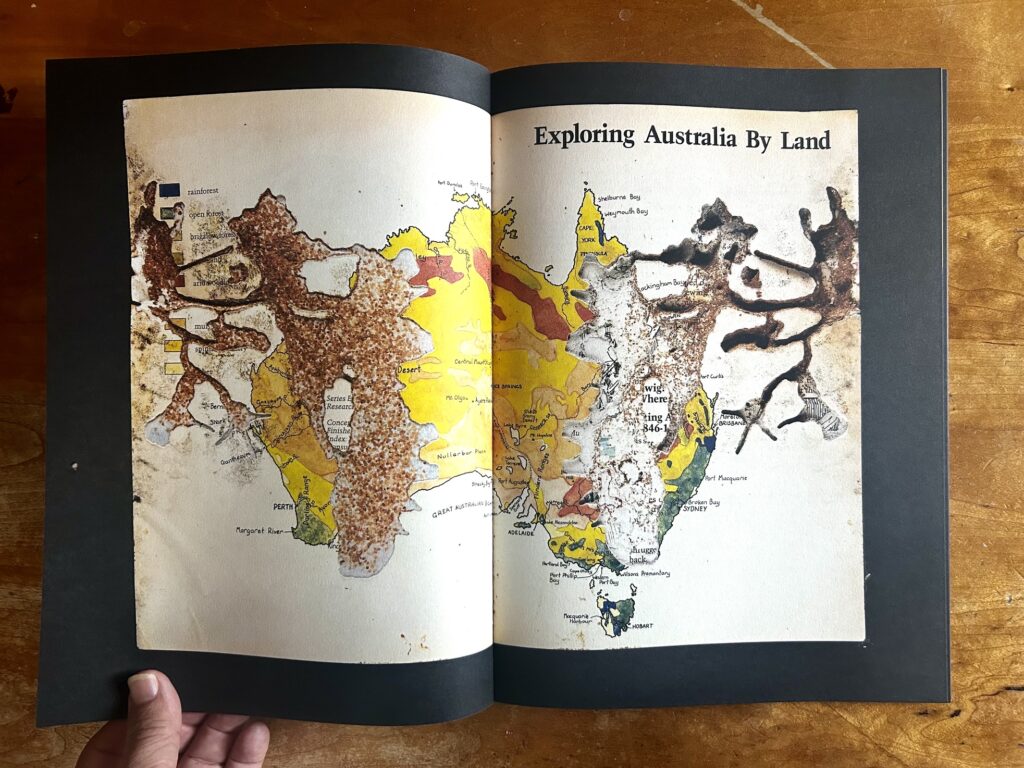
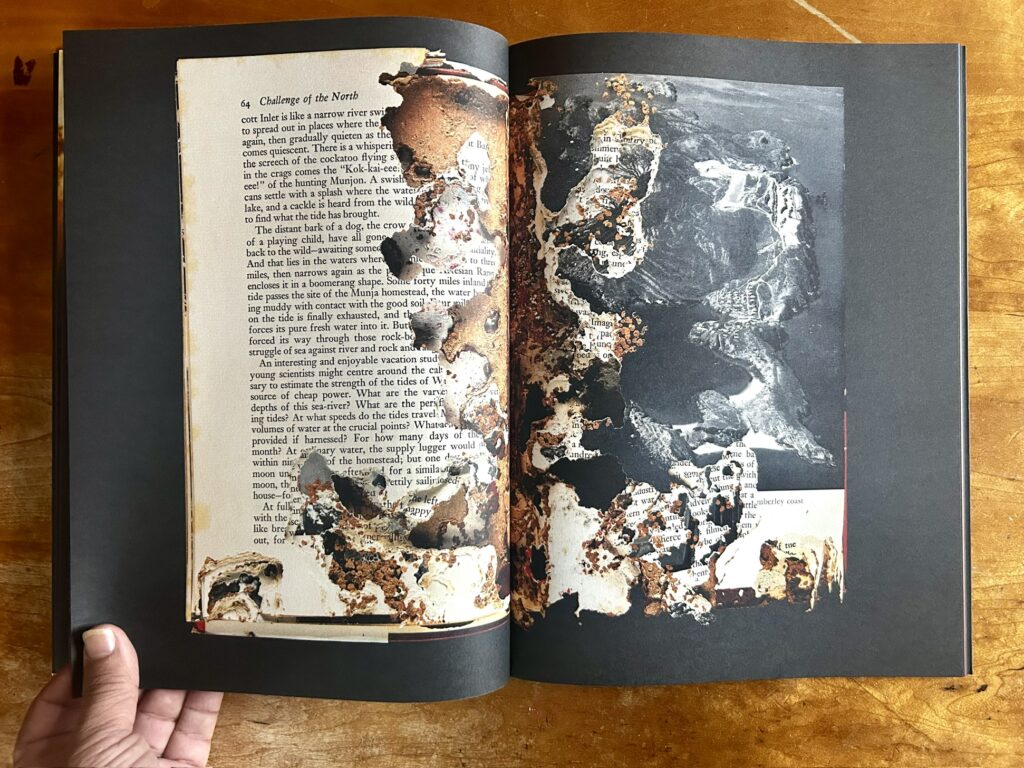
I’m extrapolating some of these details from outside sources, because the fragmented pages in the The Colony are difficult to read. It seems the termites have made a mess of things. Several double spreads show more void than book. One depicts an old map of Australia, with borders, locations, and legend montaged with insect excretions. Another cover image shows an Australian pioneer in khakis and safari hat, holding a rifle, foregrounding demure women and an aboriginal with a boomerang, all presumably vanquished. Perhaps this image was too on the nose? The termites have sniffed it out and swallowed up the page in great chunks.
Fenwick has done her best with presentation. Her gastronomic offerings are cleanly photographed, with spreads separated and illuminated against matte black pages. But the debris piles are still a muddle. Insect tunnels run wild in every direction, erasing text, diagrams, page numbers, and drawings with impunity. “They moved ideas outward from centers of power,” she writes, “encoding hierarchies that persist.” She’s critiquing white settlers here, but the description could apply to termites. Her rejoinder fits both: “I wanted to undo that flow,” she explains, “and send back something altered.” Mission accomplished.
In terms of entropic potential, The Colony recalls other photobooks rooted in havoc. Ricardo Cases’ Catálogo (reviewed here) comes to mind, documenting his personal library after a large flood. Tyler Sharkey’s Distorted Memory salvaged a monograph from waterlogged family snapshots, while Found Photos In Detroit by Arianna Arcara and Luca Santese employed urban decay as a catalyst for meaning. Renee Royale’s Landscapes of Matter harnessed decomposition as a collaborative agent. And Stephen Gill’s Nobody Books has published a small cottage industry of destruction, with monographs like Buried, Best Before End, and Coexistence. Taken collectively these photobooks find beauty hidden in decay, while affirming the bumper sticker aphorism: Nature Bats Last.
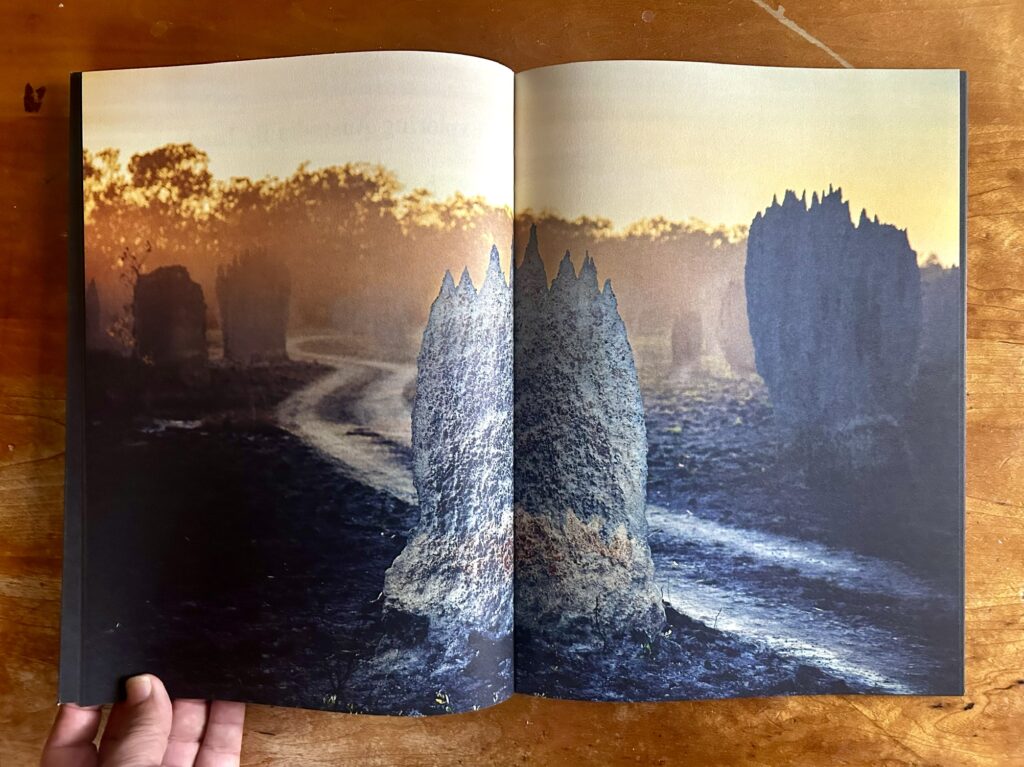
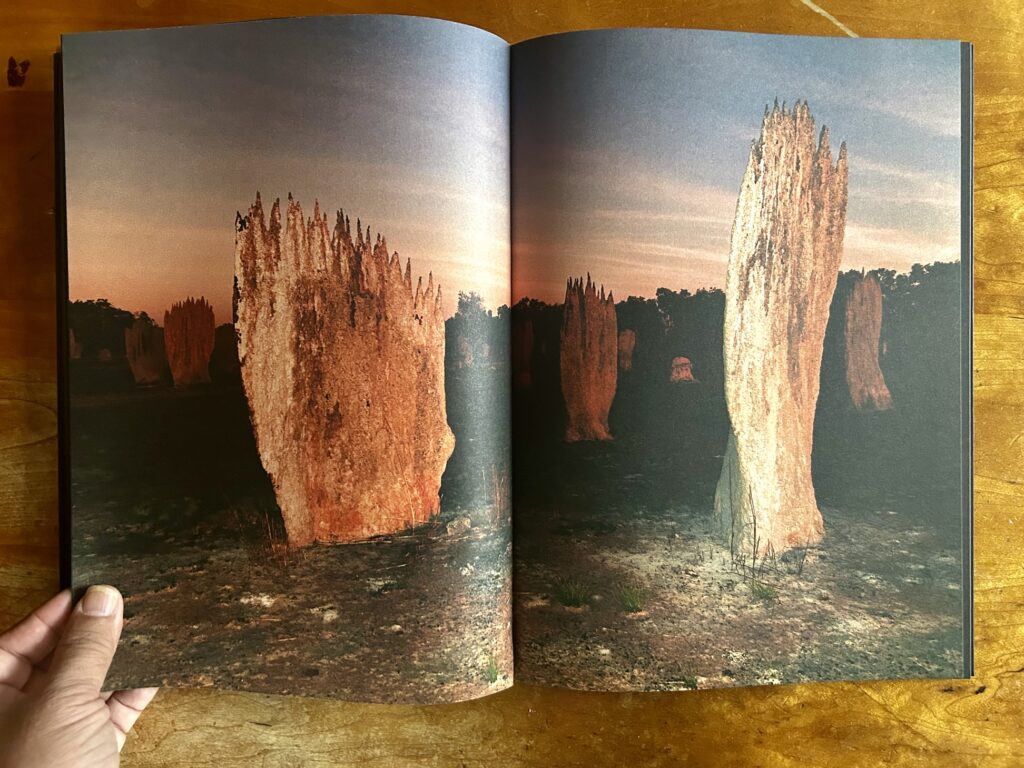
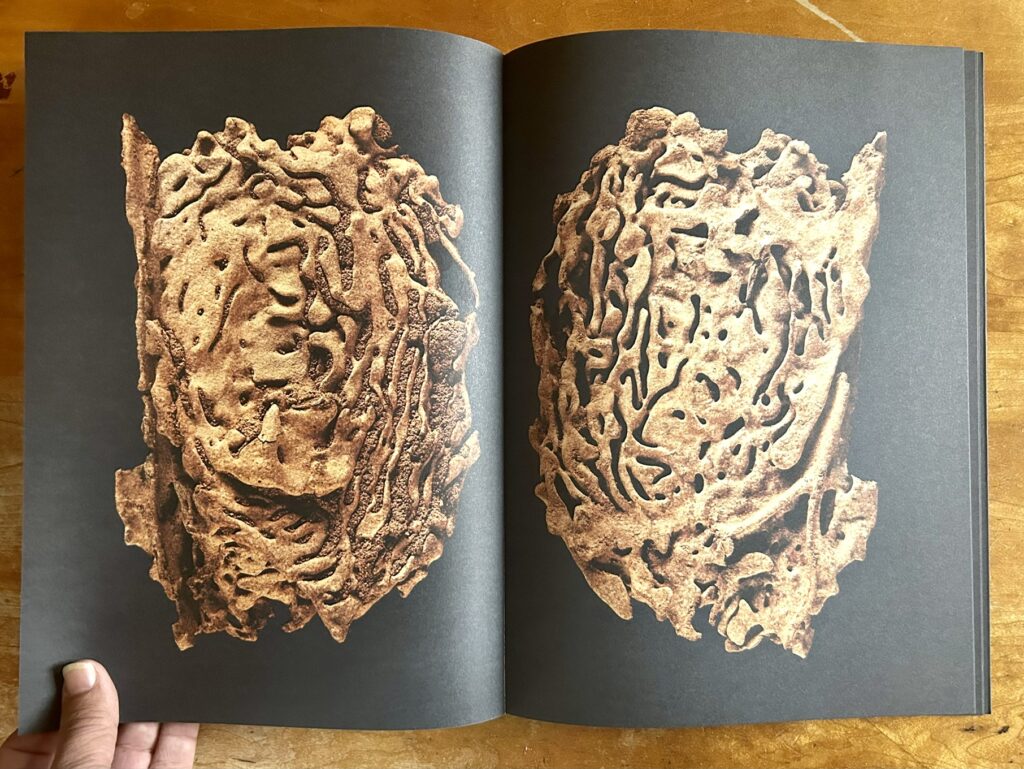
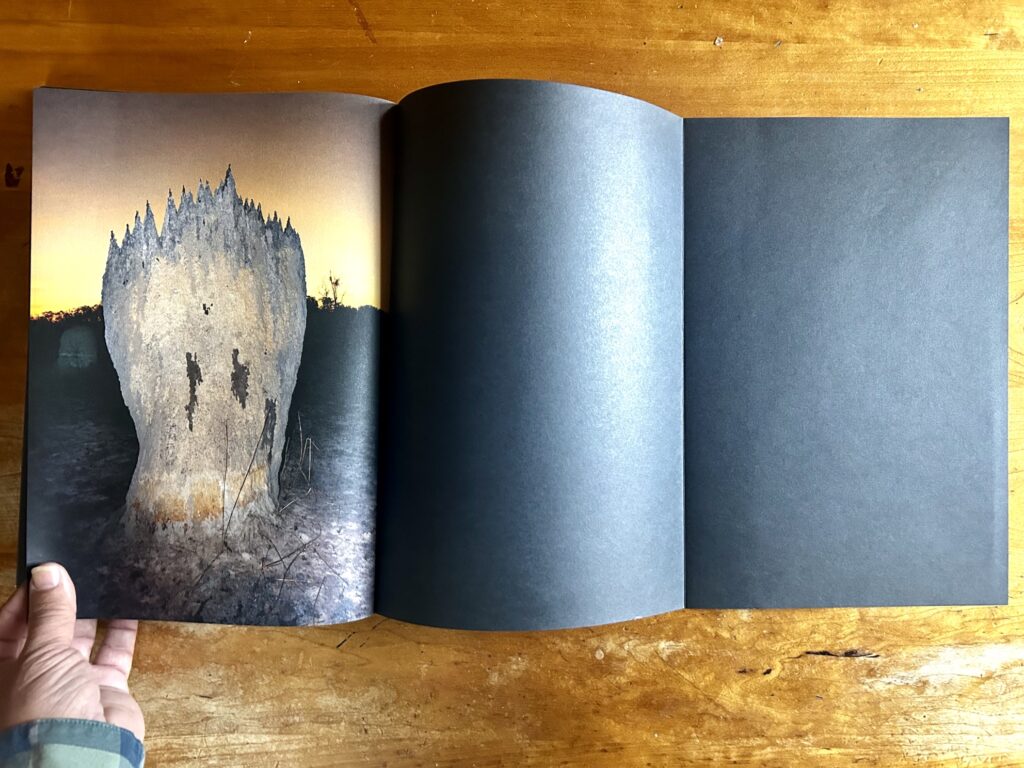
The Colony separates itself from these predecessors in a few ways. Obviously it is more rooted in ideology. This not just a meditation on impermanence, but a clarion call. In addition, unlike the examples above, The Colony buffers destructive pictures with models of endurance. I’m talking here about Fenwick’s pictures of monumental termite mounds, which come along in the book every dozen pages or so. Photographed from insect-level vantage in eerie twilit landscapes, these crowned forms are strange, imposing, and very sturdy looking. If a drip sand castle were crossed with the Sagrada Familia and a military bunker, it might look something like these creations.
Deftly sequenced into The Colony, it’s not hard to draw a line between these grand masses and decrepit tailings. In a sense we are viewing two sides of the same Trimurti termite coin. On one side is digestion, compost, and waste. On the flip side are huge construction projects, phoenixed from the very same materials. As Fenwick describes the effect, “The termite’s destruction is a generative force.” Indeed their impregnable mounds seem well prepared to outlive any book, shed, or European colonizers. How long they will last beyond that is anyone’s guess, but my money is on the termites.
Like any mound worth its salt, this book is bound together with special glue. In The Colony’s case, the adhesive element is Fenwick’s personal history. This is not an objective history of colonialism. Instead, every component springs directly from the author’s life. Family, readings, colonialism, and termites have helped to shape her through adolescence. The adult awakening and reinterpretation of these formative forces gives Fenwick’s manifesto heartfelt power. In another photographer’s hands this book might have been a very dry read. Tackled from an insider’s perspective, its twists, turns, and tunnels come alive.
Collector’s POV: Liss Fenwick does not appear to have consistent gallery representation at this time. As a result, interested collectors should likely follow up directly with the artist via her website (linked in the sidebar).