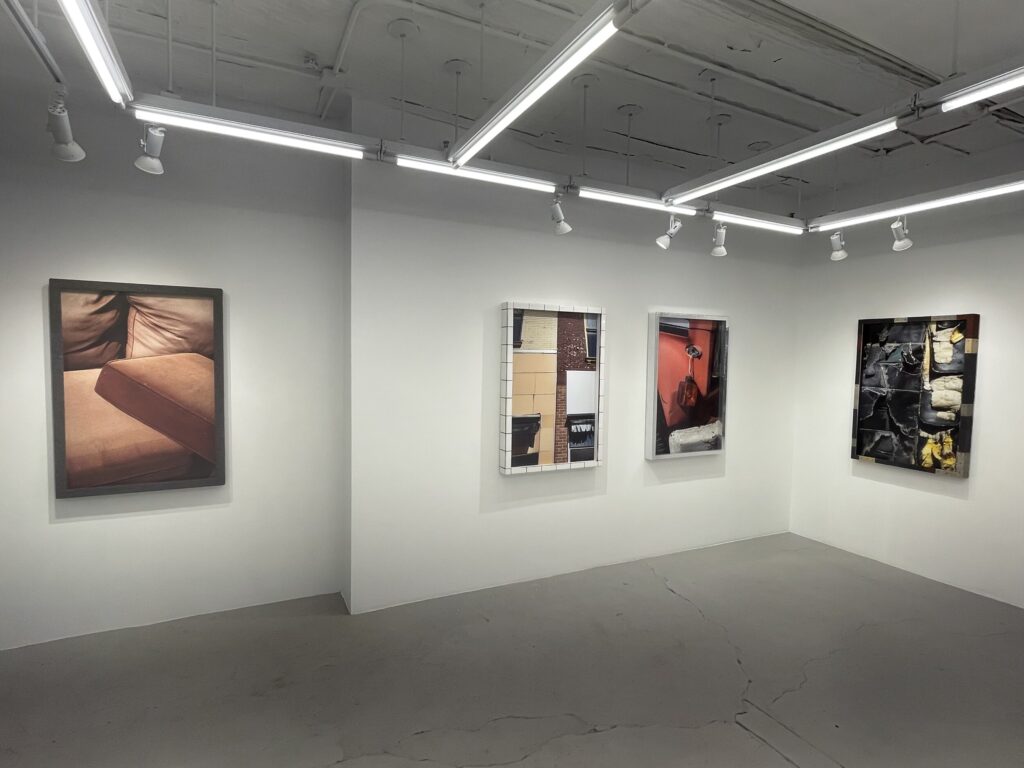
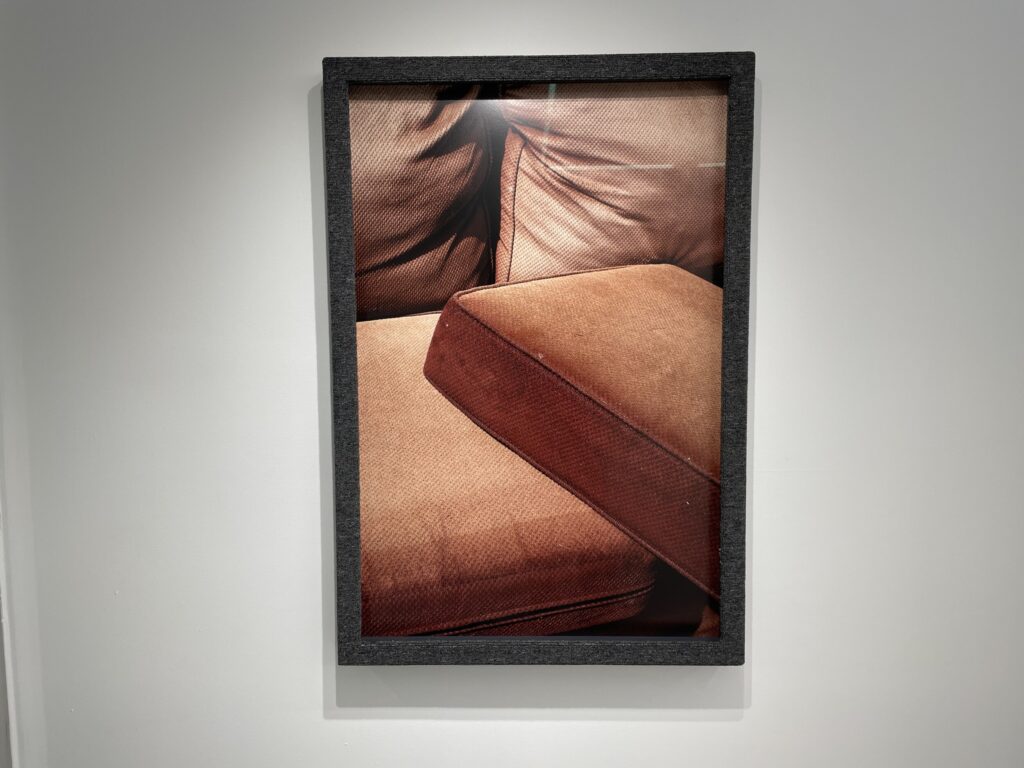
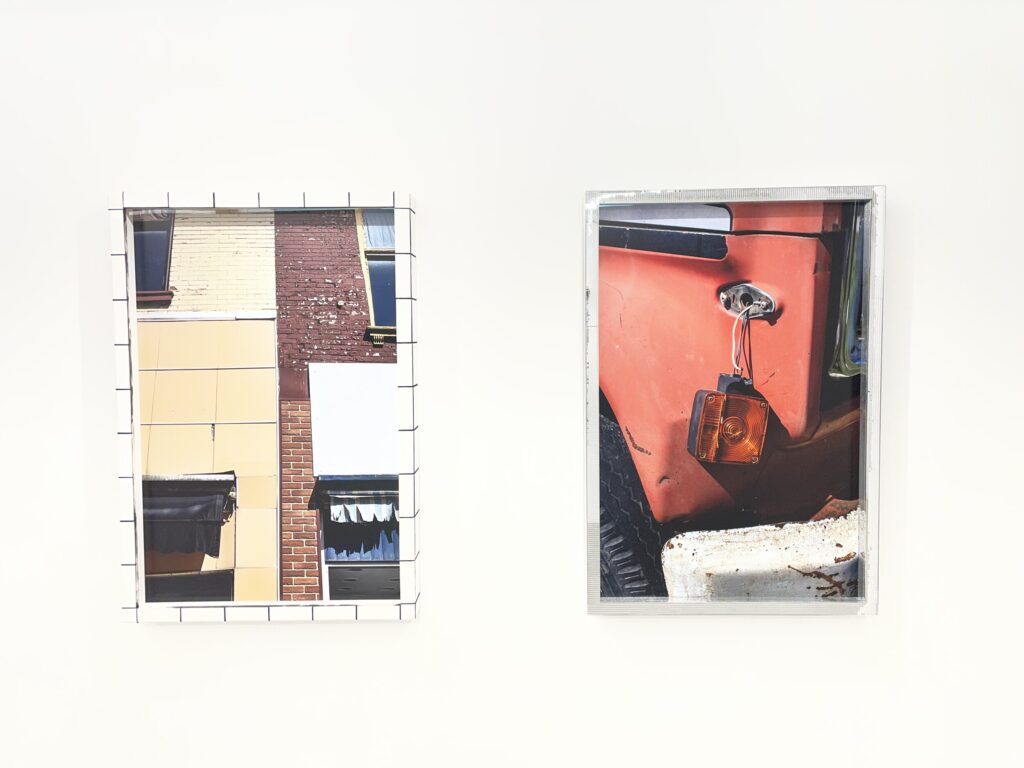
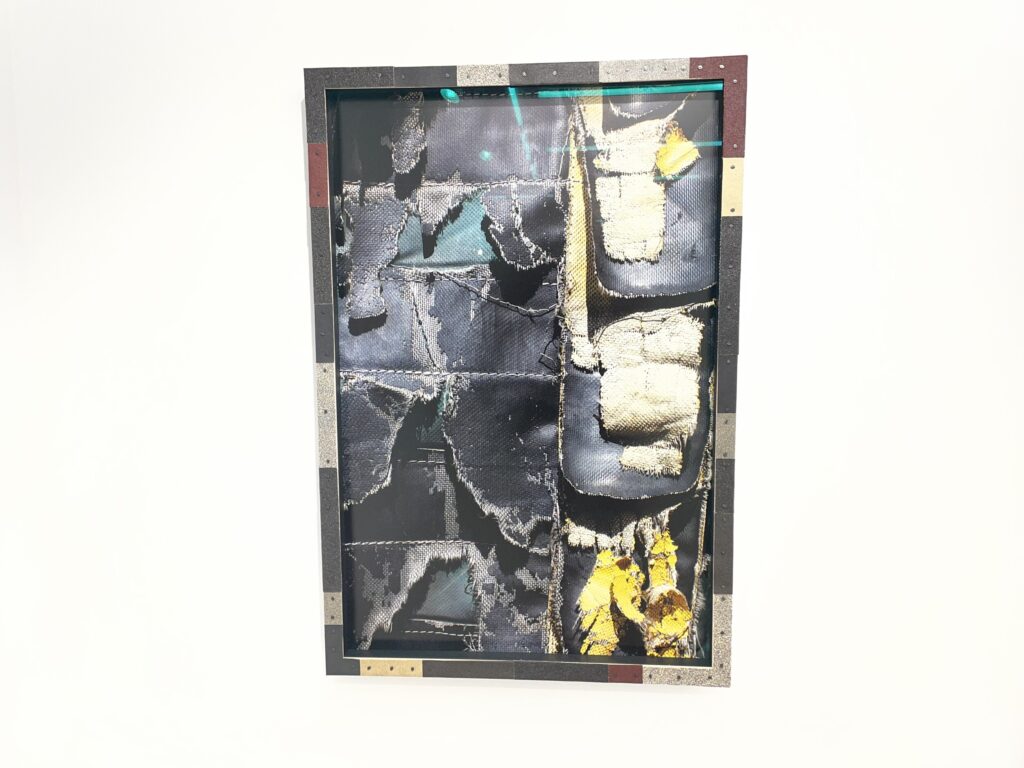
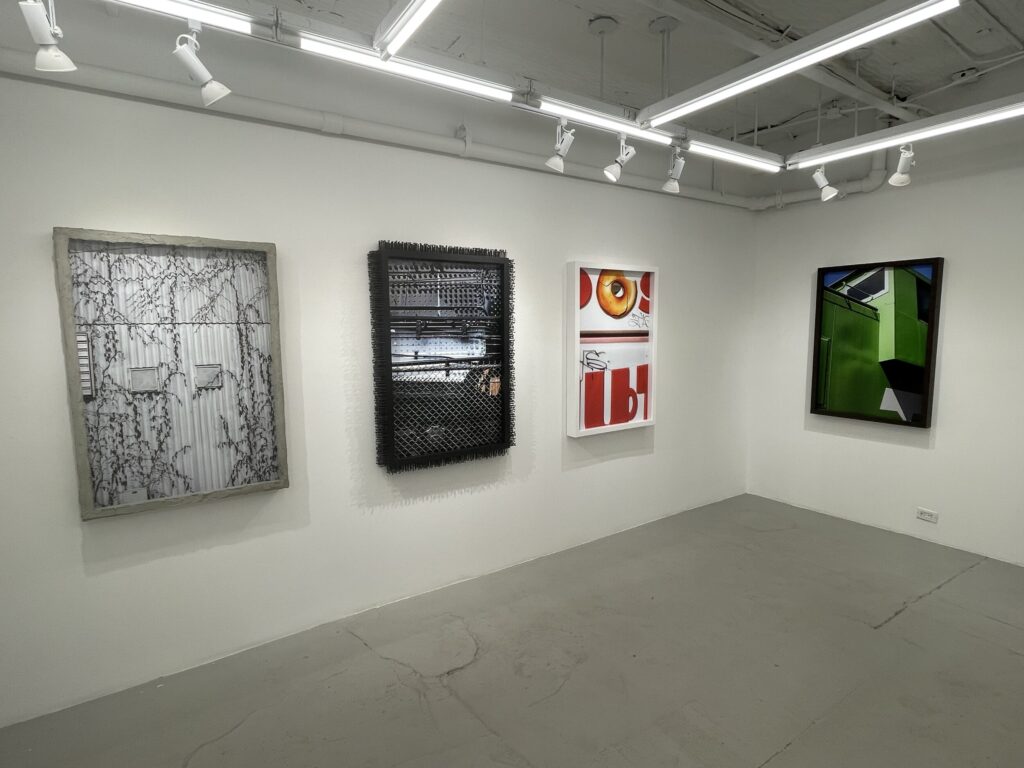
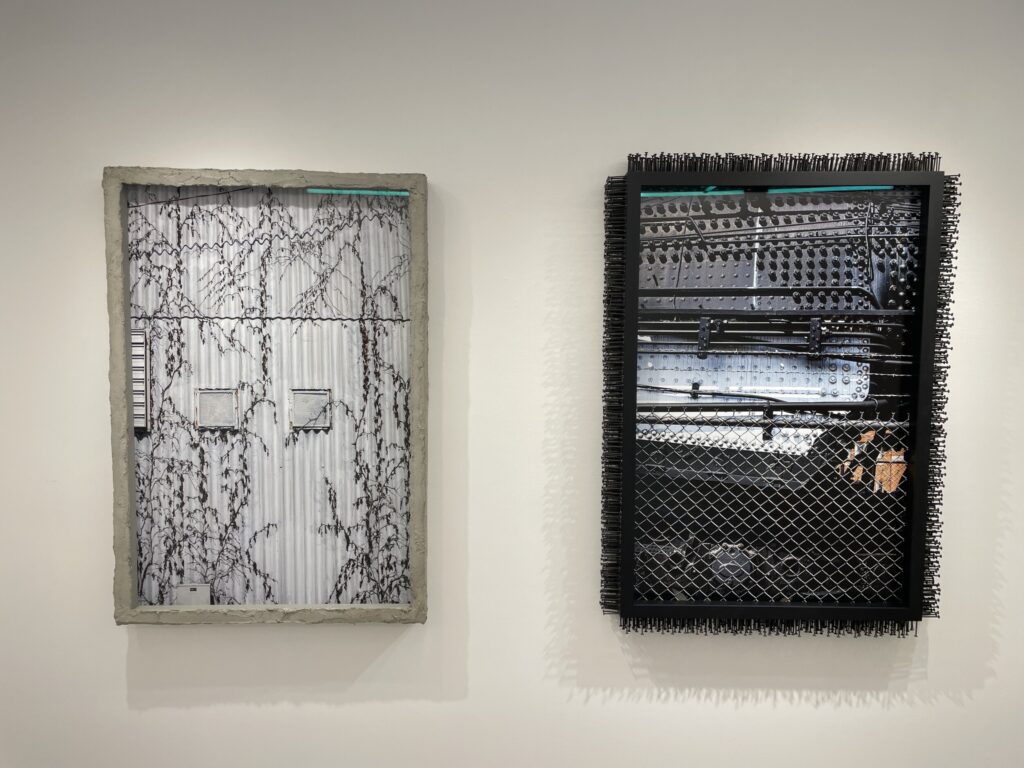
JTF (just the facts): A total of 8 photographic works, hung against white walls in the downstairs project space. All of the works are inkjet prints in artist’s frames, variously constructed with Trafficmaster carpet, tile, mirror tile, sandpaper and nails, concrete, screws, Plexiglas, and tarp, made in 2026. The works are sized roughly 42×29 inches each (with one work at roughly 46×32 inches), and all of the works are unique. (Installation shots below.)
Comments/Context: When a photographer makes an image of a painted brick facade, a plywood wall, a chain link fence, or some other everyday urban surface, he or she has a choice to consider when locating the viewer’s experience. One option is to make the location essentially anonymous, thereby abstracting the unique details of the place away, making it into a picture of anywhere, or even nowhere. The other is to readily offer a specific context, perhaps a definite place and time, which gives the viewer some clues about where we might be and why we might be there, and leads us to consider potential narratives that surround that place.
It’s been more than a decade since we last checked in with the work of Chris Wiley, and back then, he was largely working in an abstracted and anonymous urban observations mode. In gallery shows in 2012 and 2014 (reviewed here and here), Wiley reveled in the precise geometries of flattened layers (in his “Technical Compositions”) and the textures of brightly cropped down surfaces (in his “Dingbats”), adding hand crafted frames in a range of sculptural materials. At that time, it seemed like the complex interplay between the photographic imagery and the object-quality of the frames was the combination that might lead him forward artistically.
As it turns out, at least some of Wiley’s attention in the past decade was channeled into his work as a writer and critic, often at The New Yorker, where his insightful “Photo Booth” features of various photographers (often in the context of a recent show or photobook) have been dropping into the conversation every month or two for much of the time since his last gallery show. How that intellectual process of systematically unpacking the work of so many other photographers has influenced his own path as an artist isn’t a trail we can entirely follow, but what is clear is that Wiley’s new body of work has overtly turned toward a much more specific and personal context.
Wiley’s recent project “American Picture” gives us the broad beginnings of a physical (and perhaps psychological) location for his images, and the title of this show “Galesburg” narrows it down much further, in particular to Galesburg, Illinois, the hometown of his father’s family. In contrast to the urban realities of New York City (where Wiley lives now), Galesburg is resolutely Midwestern, a former railroad and factory town in the center of Illinois, still struggling to find its footing in the 21st century. Part of what Wiley observes when he returns to Galesburg is the feeling of nostalgia for the places and ways of living that haven’t changed much in the intervening years, mixed with the rhythms of the American dream that are now more than a little worn and frayed.
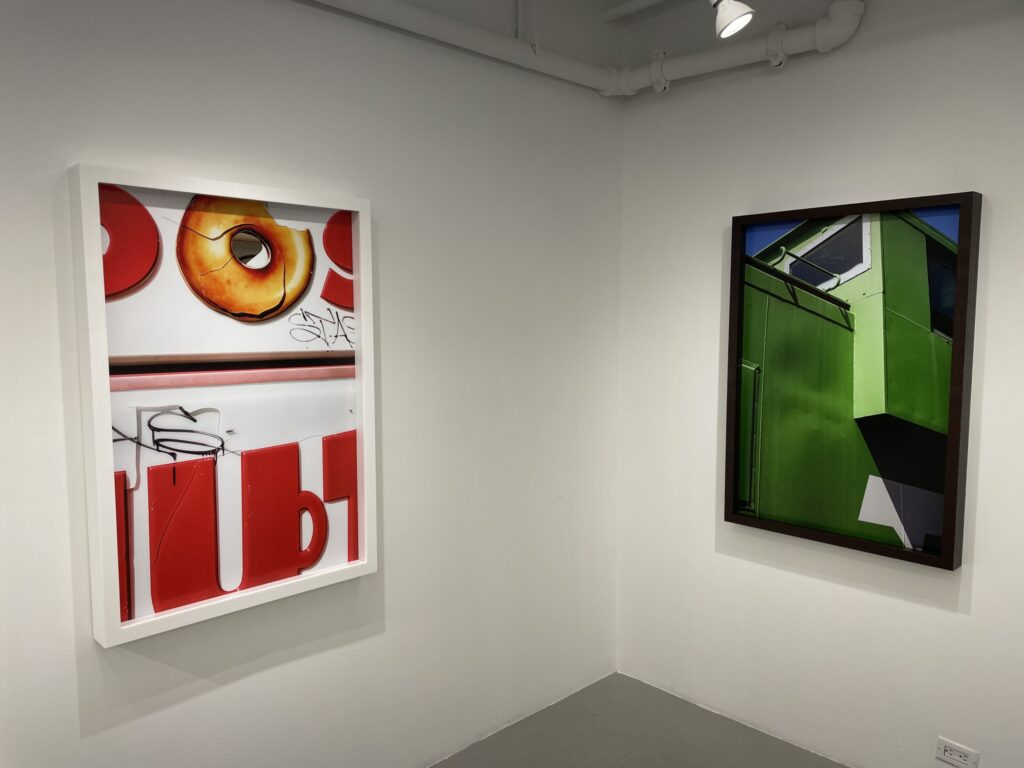
So what’s different about Wiley’s new Galesburg work is the sense of decay that permeates his photographs – the pictures are still seen in closely cropped bright color, and are printed at roughly the same size as before, but his choices of subject matter have much more scuffed wear than previously. A circle through the single room gallery space offers a parade of minor rot: some dated brown couch cushions, a tattered awning and some peeling paint, a broken taillight and a rusty bumper, some torn and frayed fabrics, a corrugated wall covered by dead vines, an array of steel rivets, chain link fence, and barbed wire, a graffiti-covered donut sign, and the geometries of what might be a green train car. Each of these small scenes of overlooked deterioration is then surrounded by a frame wrapped in industrial materials, the carpeting, screws, sandpaper, and concrete offering resonant textural pairings with the underlying imagery.
Of course Wiley isn’t the first photographer to point his camera at the fading remnants of industrial America. But the fact that he’s allowed some fading and wear to enter his methodically ordered aesthetics represents a subtle shift in his perspective. As a visual metaphor for an exhausted country, his pictures document a more haggard, less optimistic America, and if he were to allow further decay into his processes (either in subject matter, in the processing of the prints, or in the patination of the frames), he’d amplify that message. His Galesburg works feel like the potential starting point of a less arms-length approach, where the truth of the world gets a bit messier.
Collector’s POV: The works in this show are priced at $12000 each. Wiley’s work has not yet reached the secondary markets, so gallery retail remains the best option for those collectors interested in following up.