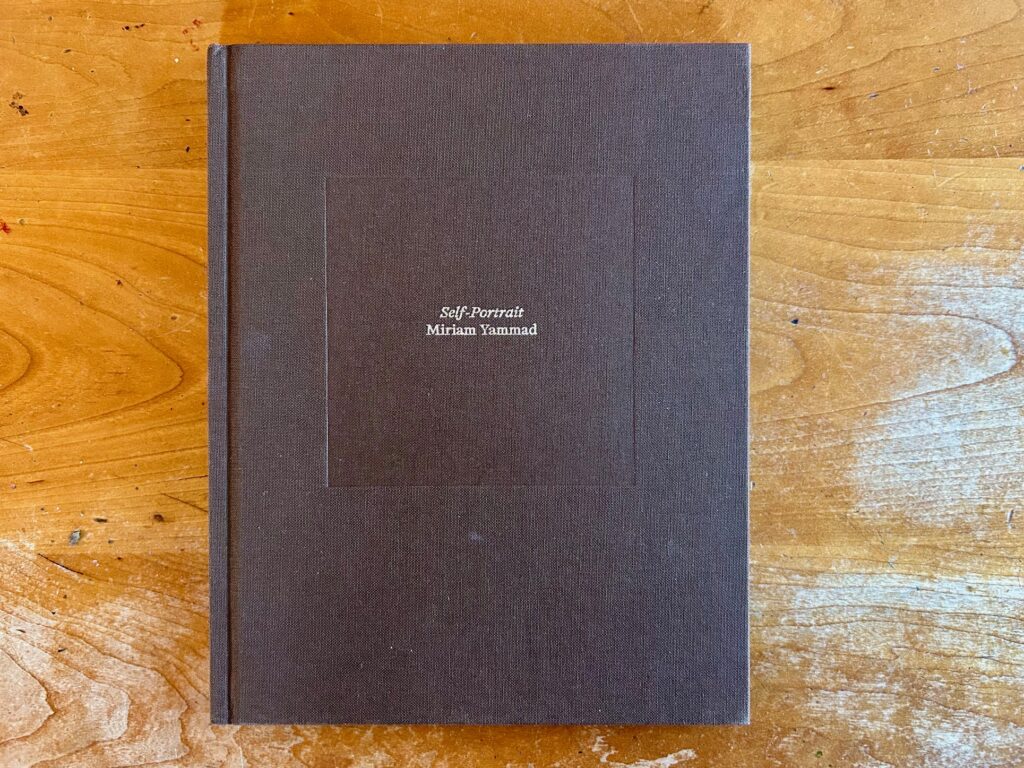
JTF (just the facts): Published in 2025 by Galerie 5b (here). Clothbound hardcover with debossed title, 215 x 170 mm, 48 pages, with 14 color photographs. Includes an essay by Miriam Stoney. (Cover and spread shots below.)

Comments/Context: If need a quick reminder of your physical appearance, there are plenty of options. Your driver’s license, passport, or other personal ID should bear a recent headshot. Perhaps you can find a likeness of yourself among the pictures on your mantle, shelves, or walls at home. The possibilities expand even further online, with various profile pictures, snapshots, anniversary reminders, reunion pictures, and selfies on social media, all showing versions of you. If those screens should ever go dark, their glass surfaces can become mirrors for self reflection. All of these outlets provide small snippets of your appearance over time, helping to shape a continuously evolving internal image of you. We’ve come a long way from antiquity, when a person might pass an entire lifetime with scant sense of their own visage.
Photography has been the central platform for visual self awareness, and all sorts of photographers have aimed a camera at themselves over the decades. The list includes street photographers like Lee Friedlander and Vivian Maier, documenting their own reflections and shadows framed against everyday windows and sidewalks. Photographers such as Martin Parr, Francesca Woodman, Alice Shaw, André Cadere (reviewed here), Melissa Shook (reviewed here), Rosalind Fox Solomon (reviewed here), and Yurie Nagashima (reviewed here) have approached self portraiture with more deliberate intention, positioning themselves against various backdrops and moments, and testing the boundaries of identity, self expression, and subjectivity in the process. Their self portraits are akin to visual journals, charting personal appearance over time.
Another subset of photographers has spurned diaristic recording in favor of plasticized expressions, casting themselves as character actors inside odd roles and outfits. Self image becomes an experimental vessel in these cases, open for tweaking, sometimes past the point of easy recognition. Cindy Sherman comes to mind of course (reviewed here most recently), along with Nikki S. Lee, Gillian Wearing (reviewed here), Yasumasa Morimura (reviewed here), and Samuel Fosso (reviewed here), among others. It’s hard to fault the logic of internal commissions. Why hire an outside model when your own body is right at hand? It obeys your every command and never complains. Better yet, existential questions are baked into every exposure.
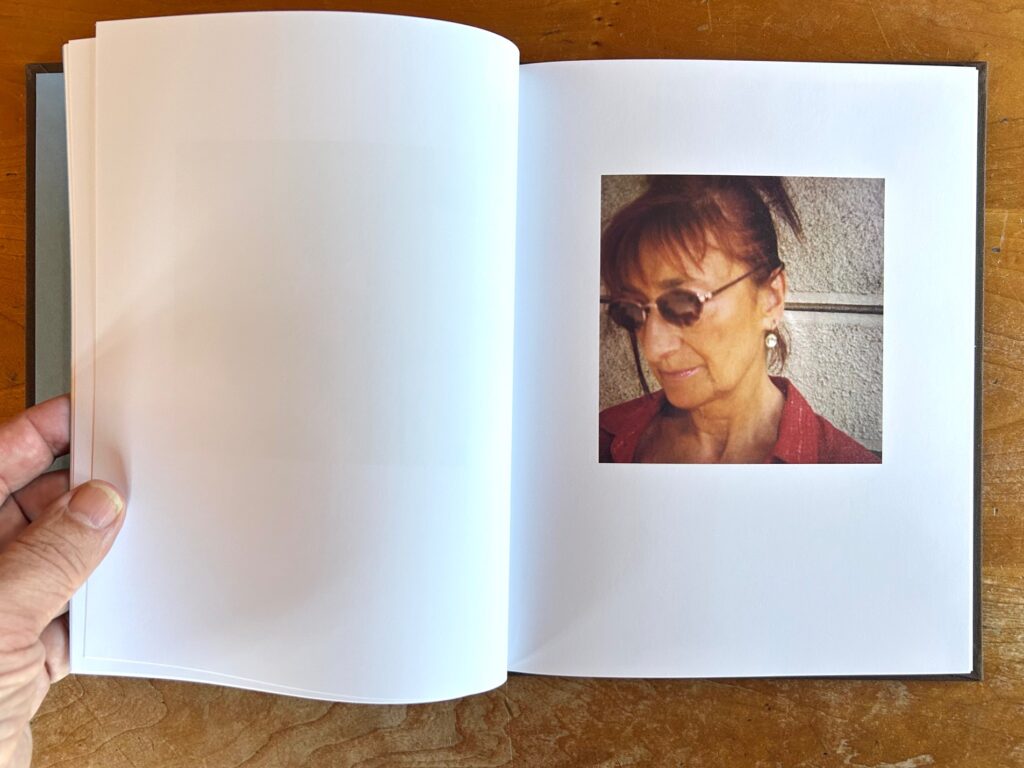
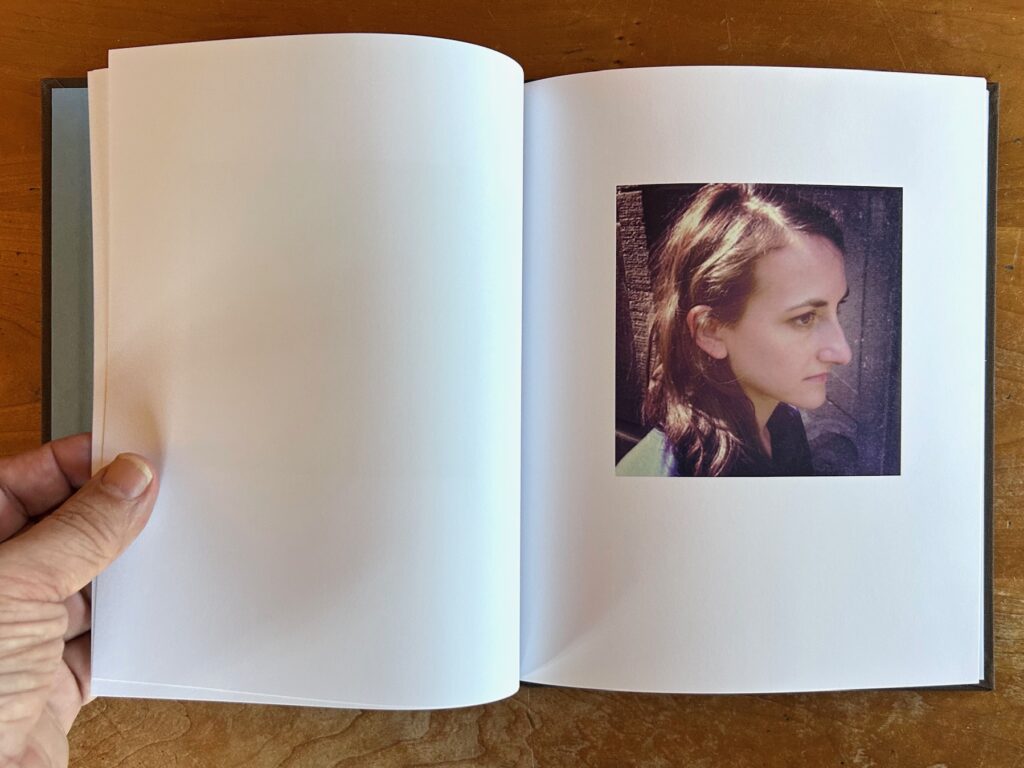
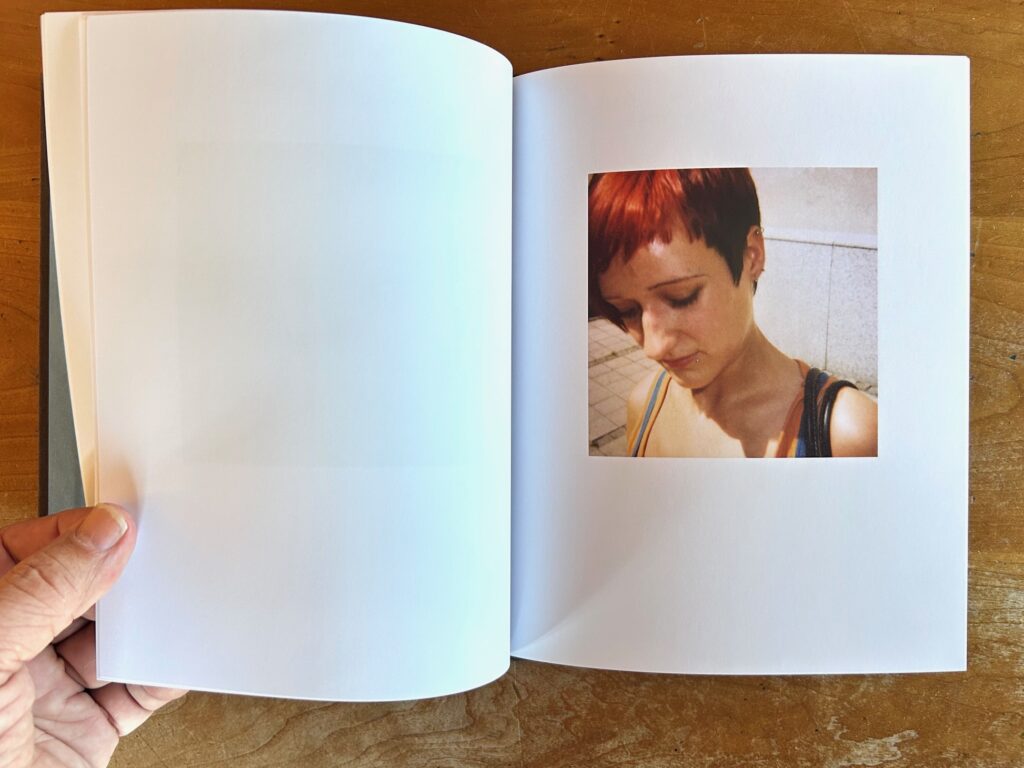
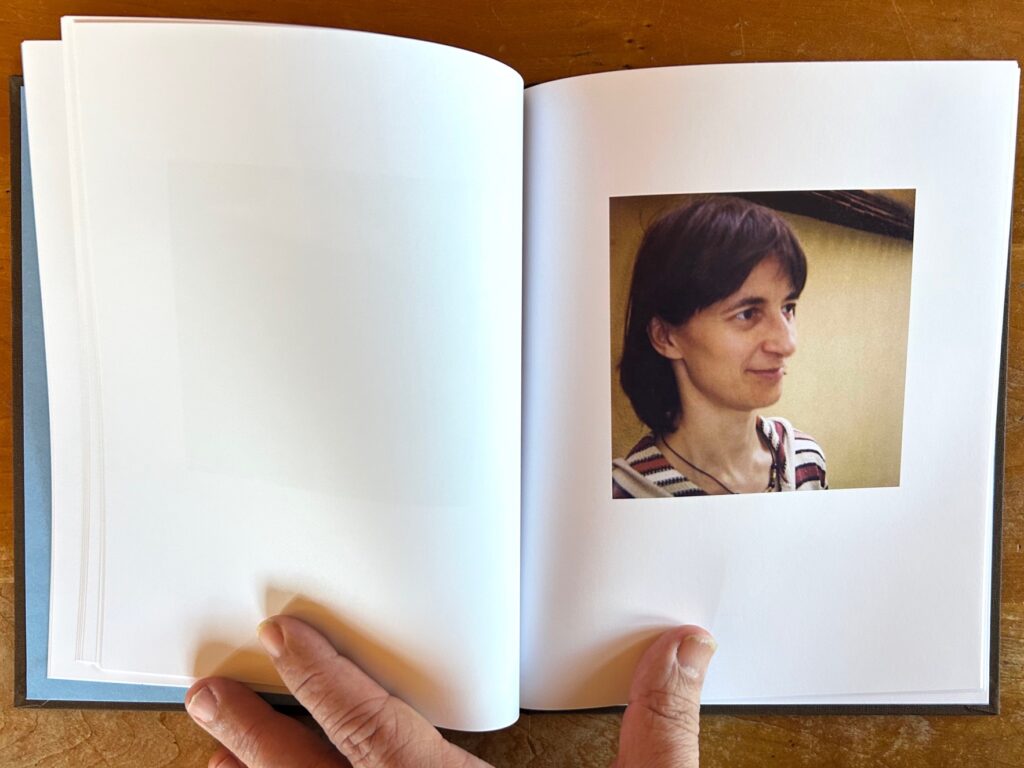
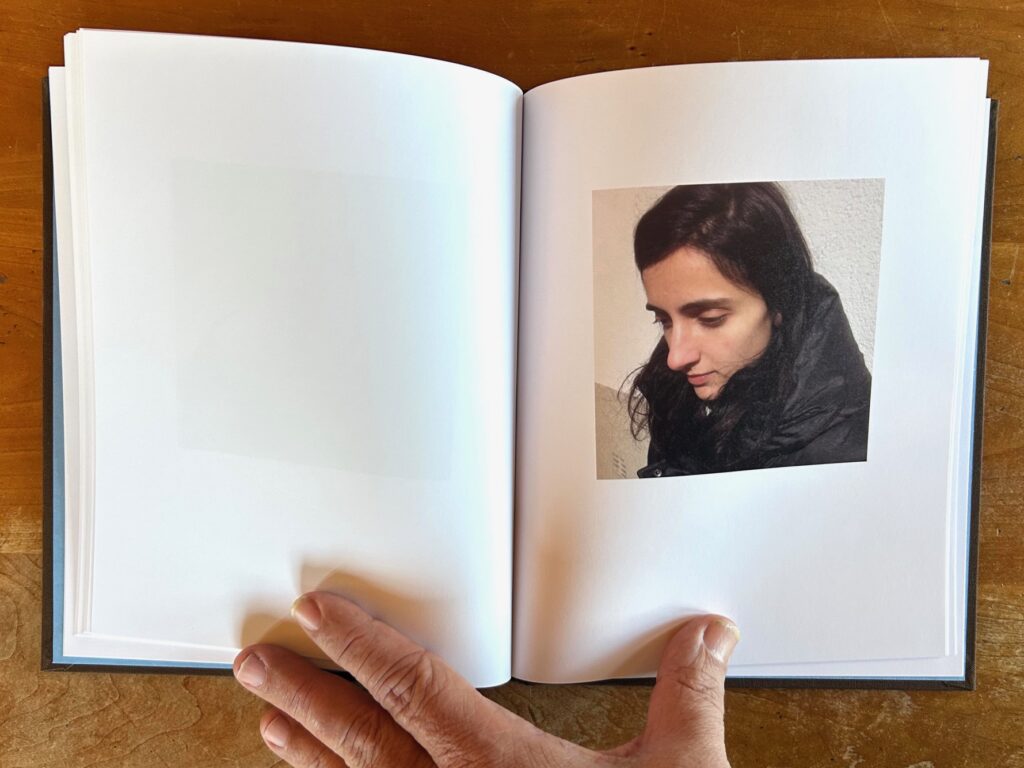
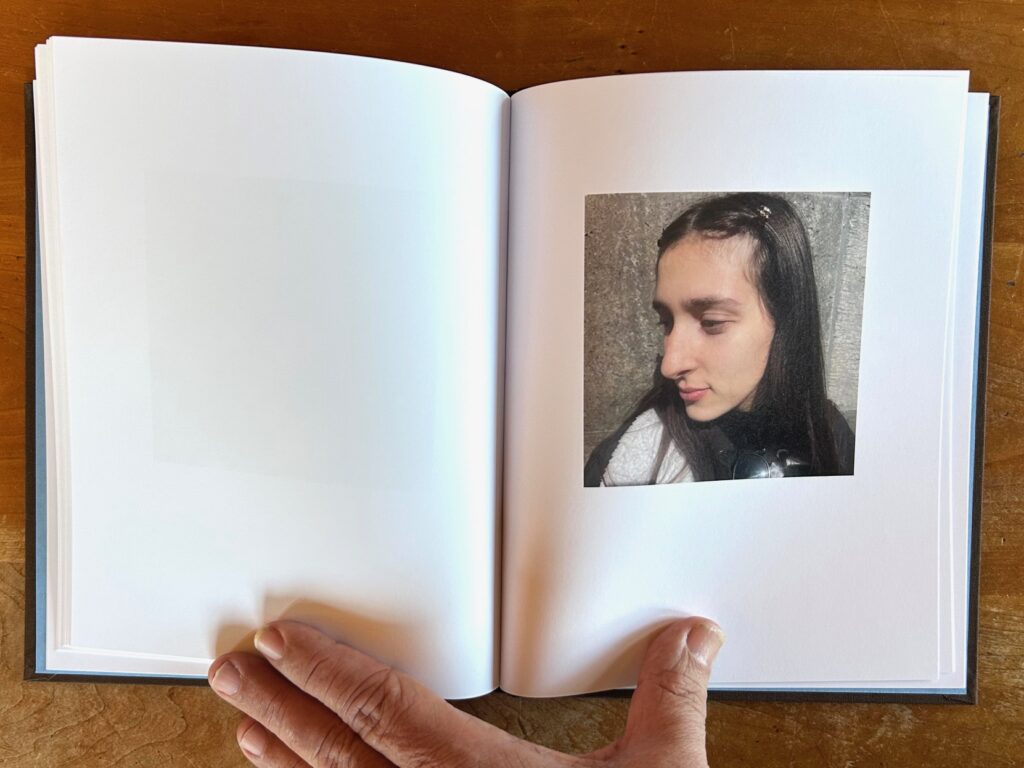
Which brings me to the German artist Miriam Yammad. Her recent monograph Self-Portrait combines elements of all the above approaches. Her “self portraits” are by turns found, staged, and reenacted. But there is one important twist. Miriam Yammad does not actually appear in any of them. Instead they feature strangers whose physical appearance resembles Yammad. They might be considered alter egos or stand ins. But they are certainly not her.
These subjects were encountered by chance and captured in passing. Where in the world did Yammad find them? That’s not clear. The locations and identities aren’t specified in the book (there are no captions). But the process seems to have involved a great deal of leg work, patience, and sifting. There are just fourteen photos in the book, shot over seventeen years beginning in 2008. That’s a glacial rate of accretion by normal photographic standards. Nevertheless some winners gradually accumulated, and the results are impressively consistent.
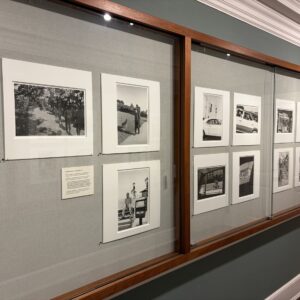
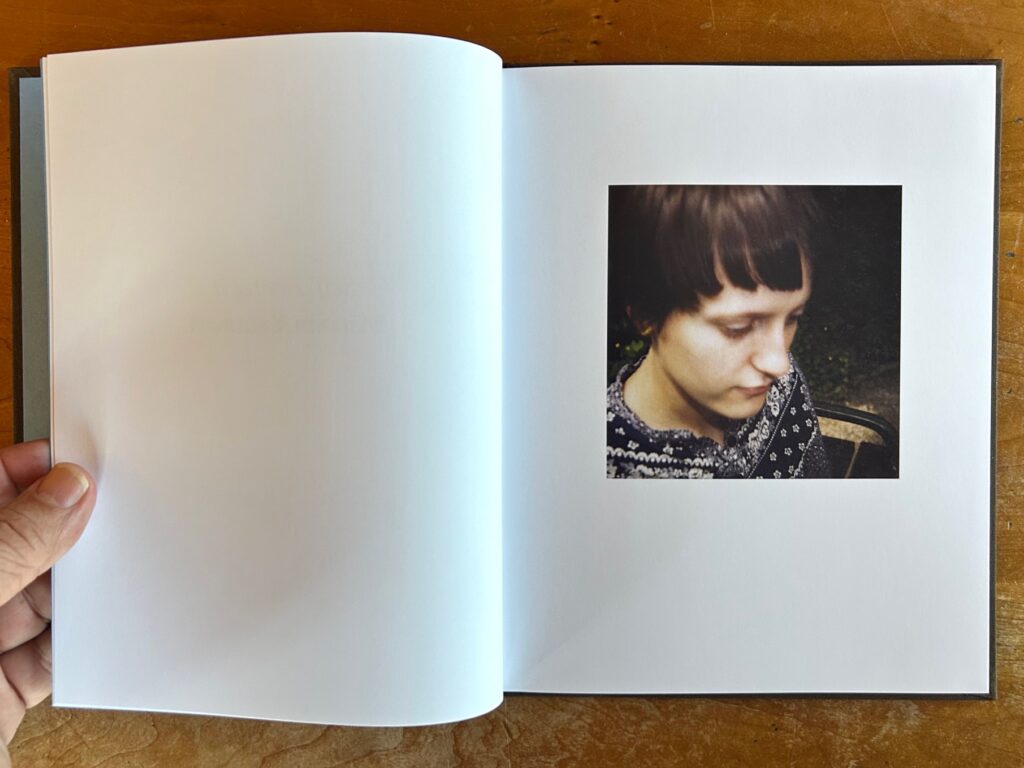
Self Portrait was published last spring in conjunction with a dual exhibition with Miriam Stoney at Gallery 5b in Glasgow. Physically speaking, it is a modest production. It is a small, thin hardback with minimal design, bound in plain brown cloth. The interior pages carry Yammad’s portraits in square format color, arranged one per spread on the right facing pages.
One could hardly imagine a more stripped down design. But the book’s simplicity belies a heavier psychic weight. Yammad’s images are cropped tightly around head and shoulders, isolating the most recognizable and meditative features of her subjects (or maybe she is the subject?). One by one, anonymous women are recorded and presented. This one has short hair, that one has glasses, another is elderly with earrings, and so on. They are shown against different backdrops, lighting situations, and fashion eras.
Incredibly, this small sample pool of strangers—with no circumstances in common— gradually sketches a mental image of Yammad. She seems to have a sharply angled face centered around a prominent nose. Her brown eyes are set below thin eyebrows, with a prim mouth balanced above a knobby chin. She likes to depict herself peering downward in a state of deep thought. Whether she is contemplating the nature of her identity or just waiting for a bus we can’t tell.
As for her own self portrait, Yammad seems to have missed the memo about the many options. It’s difficult to find a photo of her online. Her website includes no image of her, just strangers. I’ve never met her in person or seen a photograph. And yet—perhaps a risky mental assumption?—I feel I have a strong sense of her appearance. Yammad’s methodology works on me like an astronomer documenting a black hole. By definition, no light or information can be transmitted from object itself. But by measuring the surrounding gases and gravitation effects, an indirect image appears.
But let’s get back to terrestrial matters, where Yammad’s alternative selfies dovetail with everyday digital expression. In the online world, personal identity is increasingly securitized, splintered, and contested. Most of us are represented online through multiple accounts, profiles, and avatars, accessed through various passwords, personas, and devices. As artificial intelligence takes an increasingly greater stake in media content, these aspects of identity are likely to be crunched, repurposed, and commodified in unpredictable ways. What will a collective portrait of you look like in the future? What will define you to the outside world? Or to yourself? Selfhood may indeed become a precarious proposition, and Yammad is one step ahead of the curve. Self-Portrait may be rooted in traditional photography, but its philosophical underpinnings run deeper.
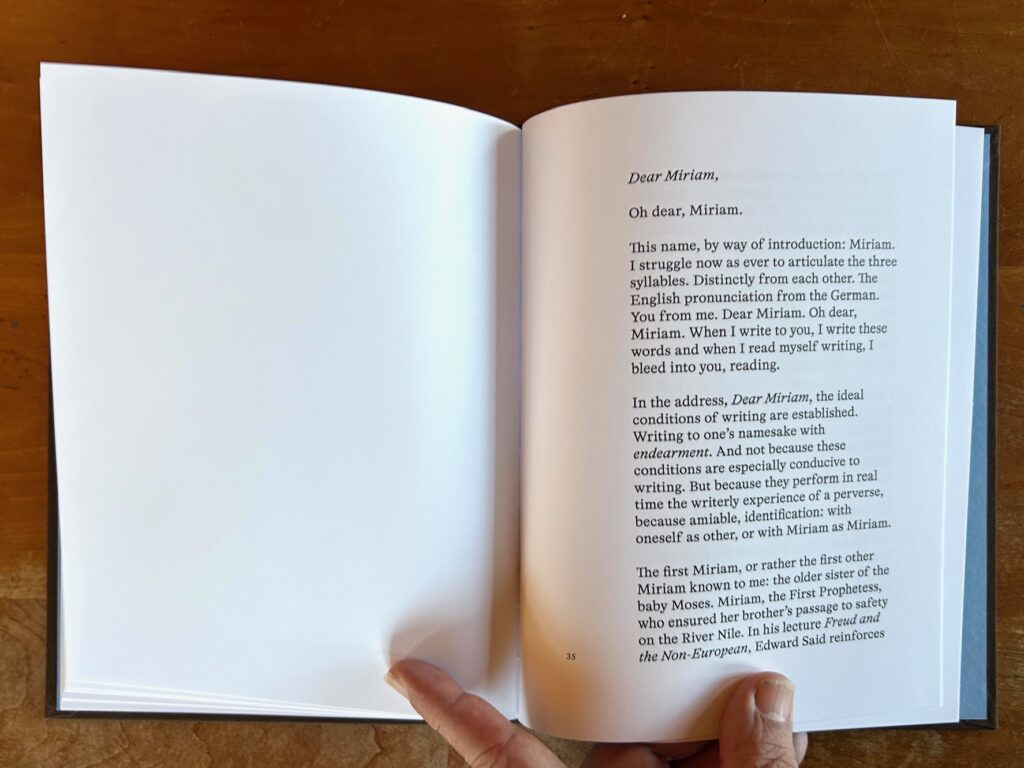
But that’s just the photographs. The book includes a provocative text too. Exhibition collaborator Miriam Stoney—her first name is no accident—joins in with her own self analysis. Her essay “Dear Miriam” delves into the history of the artists’ shared name, ruminating on other past Miriams, Jewish identity, Indian parents, difficulties with pronunciation, misguided taxi drivers and “the error of a mistaken identity.” It’s a delightful hodgepodge of ideas, and a nice accompaniment for the book’s self-probing photos. At one point Stoney addresses her collaborator directly. “And you, Miriam Yammad,” she writes, “You are said to be interested in construction of identity, though I don’t think you’re so interested in identity’s construction per se. Yours is a work of dismantling, of holding constituent parts in your hands. Your work, signed with your name, is a life of its own. Another Miriam. But not entirely.”
As the book is structured, it’s not hard to tell the two Miriams apart. Readers can get a sense of each one, and how they prefer to present themselves in public—through photos and text. Miriam Stoney’s portrait is easy to find online, and I feel I could recognize either Miriam if I met her in person. But of course, that assumption could be wrong. These various pictures and words are merely projections, potential smokescreens to throw me off the chase. Maybe another Miriam is in fact the same Miriam? But not entirely?
Collector’s POV: While Miriam Yammad does not appear to have a consistent gallery representation relationship at this time, a two-person exhibition featuring this body of work (with Miriam Stoney) was held at 20 Albert Road, Glasgow (from May 31 to June 29, 2025, here).