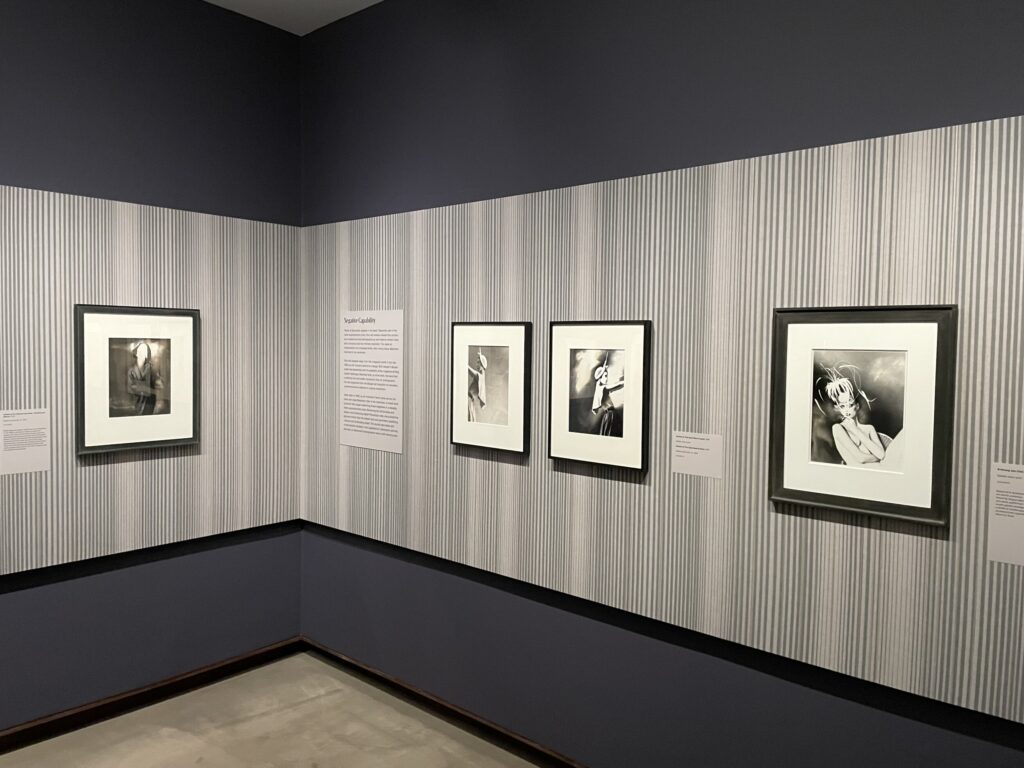
JTF (just the facts): A total of 64 photographs, magazine covers and spreads, and other supporting materials, generally framed in black and matted, and hung against dark grey walls and vertically striped linen fabric panels in a series of rooms on the second floor of the museum. Most of the works on view were part of a 2025 gift from Lizzie and Eric Himmel. The exhibit was curated by Virginia McBride. (Installation shots below.)
The following works are included in the show:
Lillian Bassman
- 1 gelatin silver print with applied media, 1950, sized roughly 13×11 inches
- 24 gelatin silver prints, 1948, 1949, 1949/c1994, 1950, c1950, 1951, 1952, 1954, 1954/c1994, 1955, 1957, 1959, c1960, 1961, 1964, 1965, 1998, sized roughly 9×13, 10×8, 10×9, 10×10, 10×11, 10×12, 11×13, 11×14, 12×9, 13×10, 13×11, 14×10, 14×11 inches
- 3 photomechanical reproductions, 1949, 1950, 1952, sized roughly 13×18 (open spread) inches
- 9 gelatin silver print with collaged elements and applied media (cover maquette), 1949, sized roughly 13×10 inches
- (vitrine) 1 photomechanical reproduction, 1948, sized roughly 12×9 (cover) inches
- (vitrine) 1 gelatin silver print contact sheet, 1951, sized 8×10 inches
- (vitrine) 1 photomechanical reproduction (tear sheet), 1951, sized roughy 13×9 inches
- (vitrine) 1 gelatin silver print with applied media, 1961, sized 12×14 inches
- (vitrine) 1 photomechanical reproduction, 1961, sized roughly 13×18 (open spread) inches
- 1 platinum print, 1959/c2007, sized 30×26 inches
Other works/collaborations
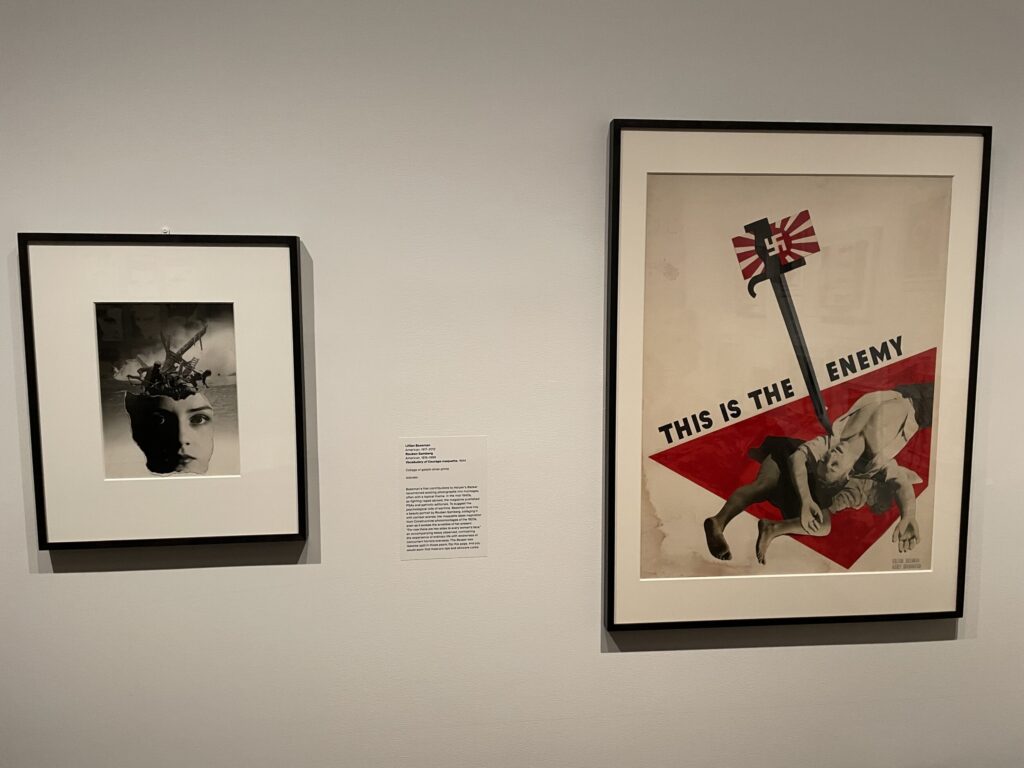
- LB/Rouben Samberg: 1 gelatin silver print, 1944, sized roughly 14×10 inches
- LB/Alexy Brodovitch: 1 collage of gelatin silver prints with applied media, 1942, sized roughly 34×25 inches
- LB/Alexy Brodovitch (photographed by Hermann Landshoff, Leslie Gill, Ernst Beadle, Richard Avedon, Martin Munkácsi): 9 photomechanical reproductions, 1945, 1946, 1947, sized roughly 12×9 (cover), 12×18 (open spread) inches
- LB/Alexy Brodovitch (photographed by Richard Avedon): (vitrine) 1 photomechanical reproduction, 1945, sized roughly 12×9 (cover) inches
- LB/Paul Himmel: (vitrine) 1 gelatin silver print with color film transparency, 1946, sized roughly 13×10 inches; 1 photomechanical reproduction, 1948, sized roughly 12×18 (open spread) inches
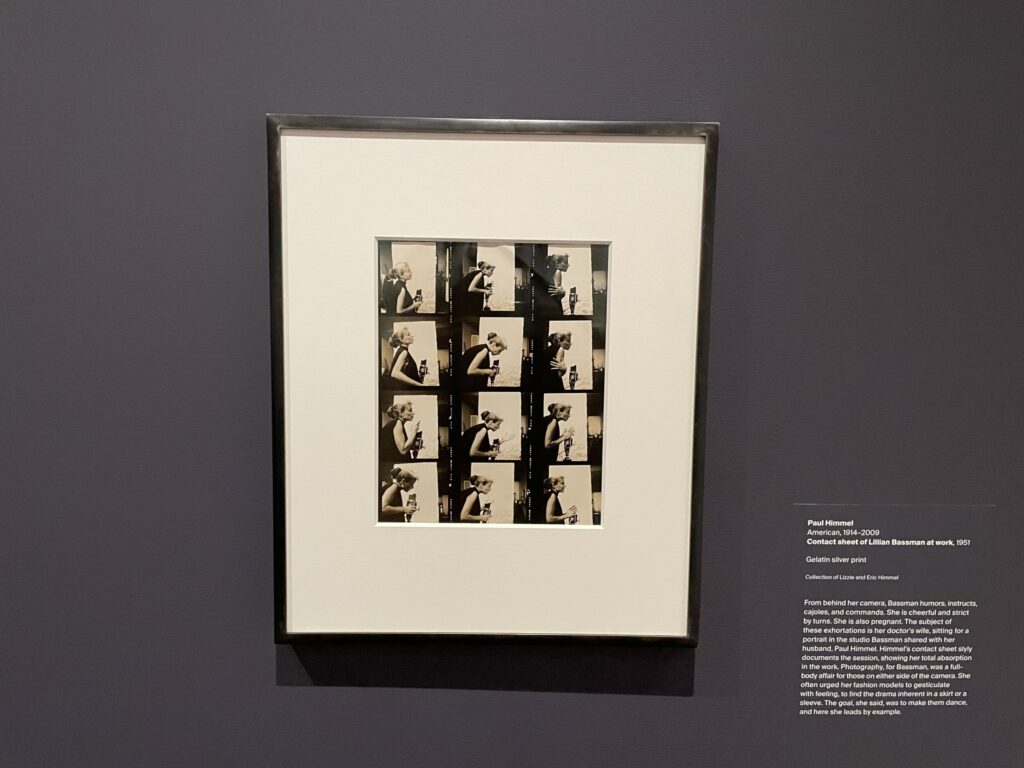
- Paul Himmel: 1 gelatin silver print contact sheet, 1951, sized 10×8 inches
- Nina Leen: (vitrine) 1 photomechanical reproduction, 1945, sized roughly 14×21 (open spread) inches
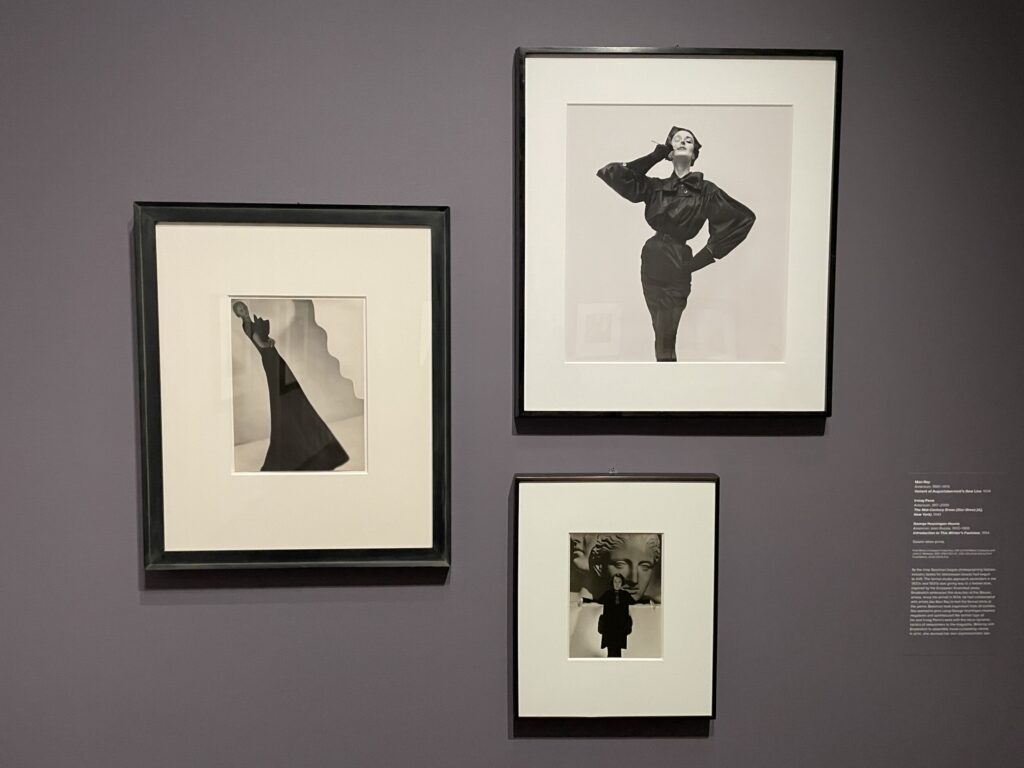
- Man Ray: 1 gelatin silver print, 1934, sized roughly 12×9 inches
- George Hoyningen-Huene: 1 gelatin silver print, 1934, sized roughly 9×7 inches
- Irving Penn: 1 gelatin silver print, 1949, sized roughly 18×15 inches
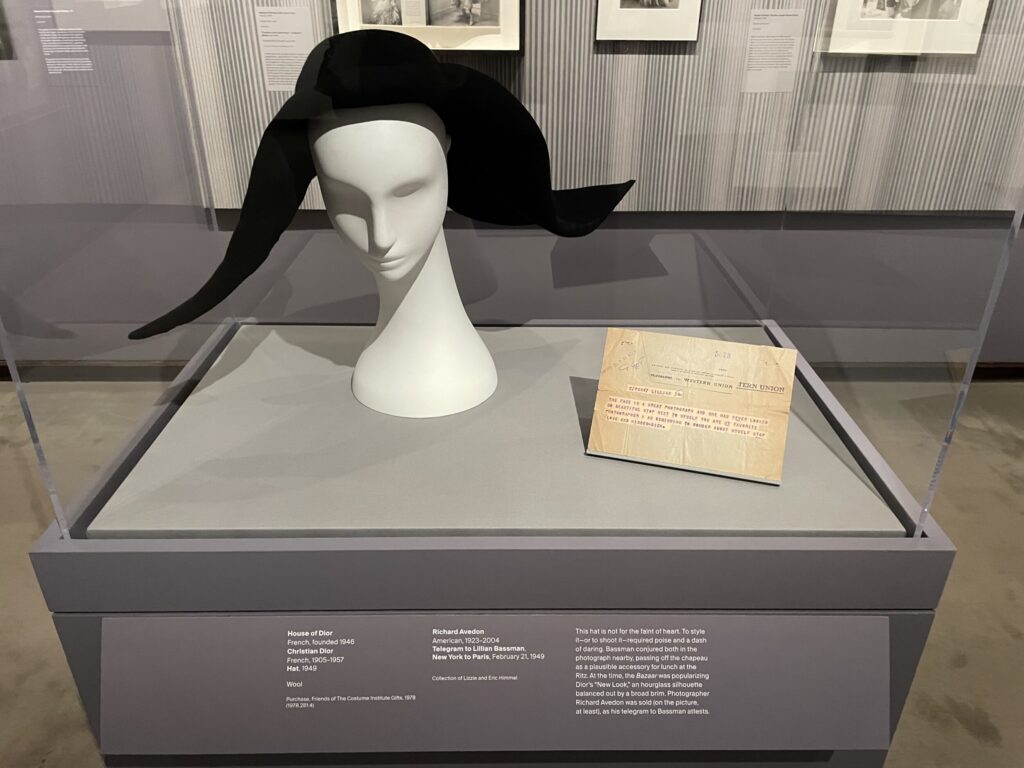
- Christian Dior: (vitrine) 1 wool hat, 1949
- Richard Avedon: (vitrine) 1 telegram to Lillian Bassman, 1949
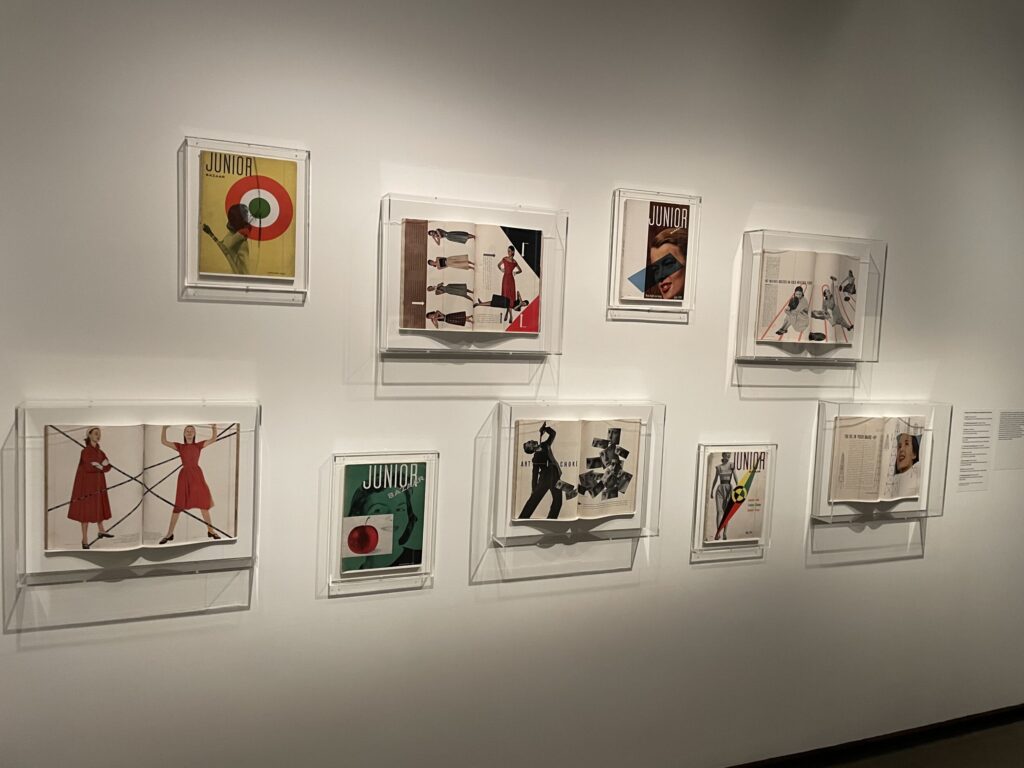
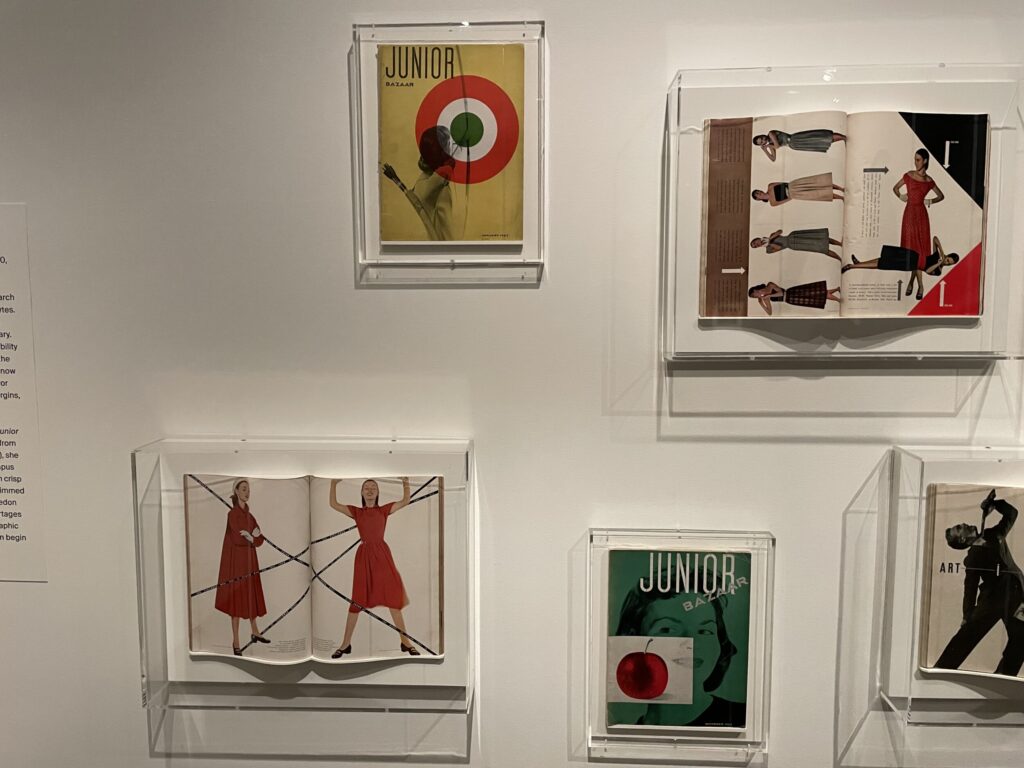
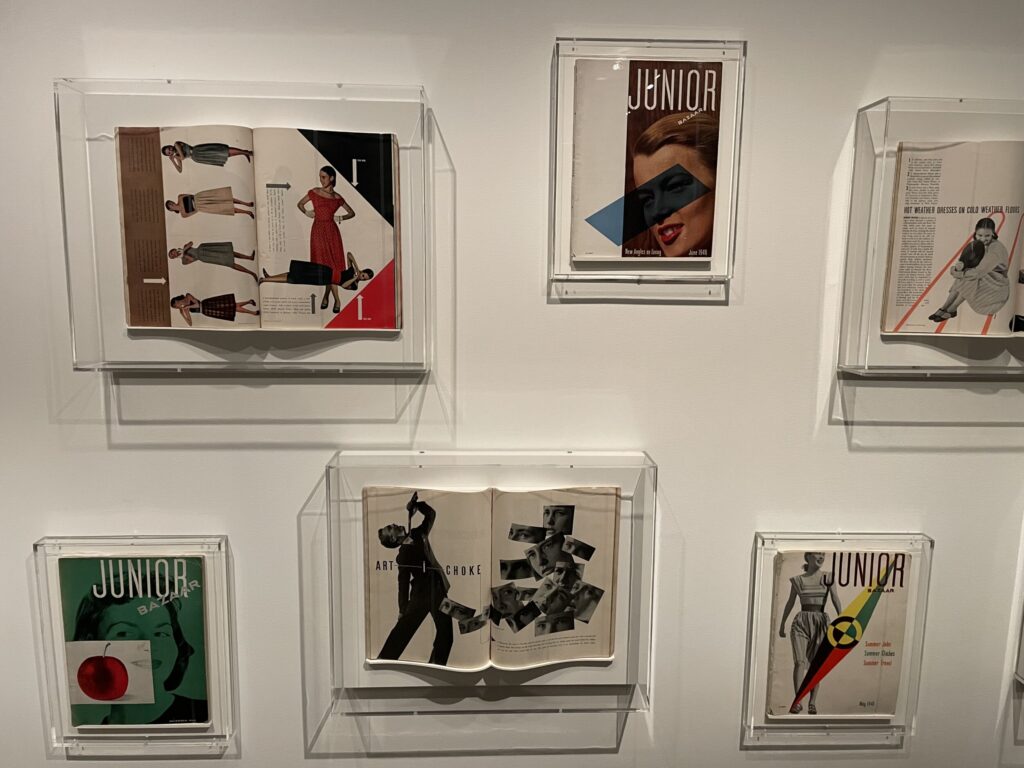
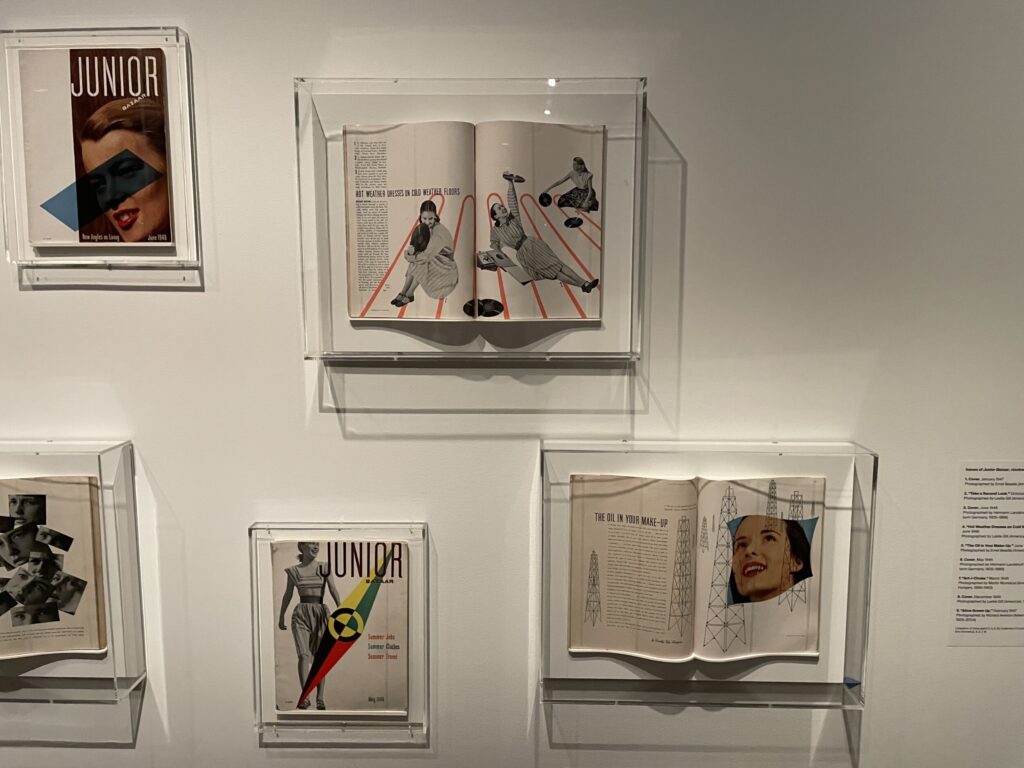
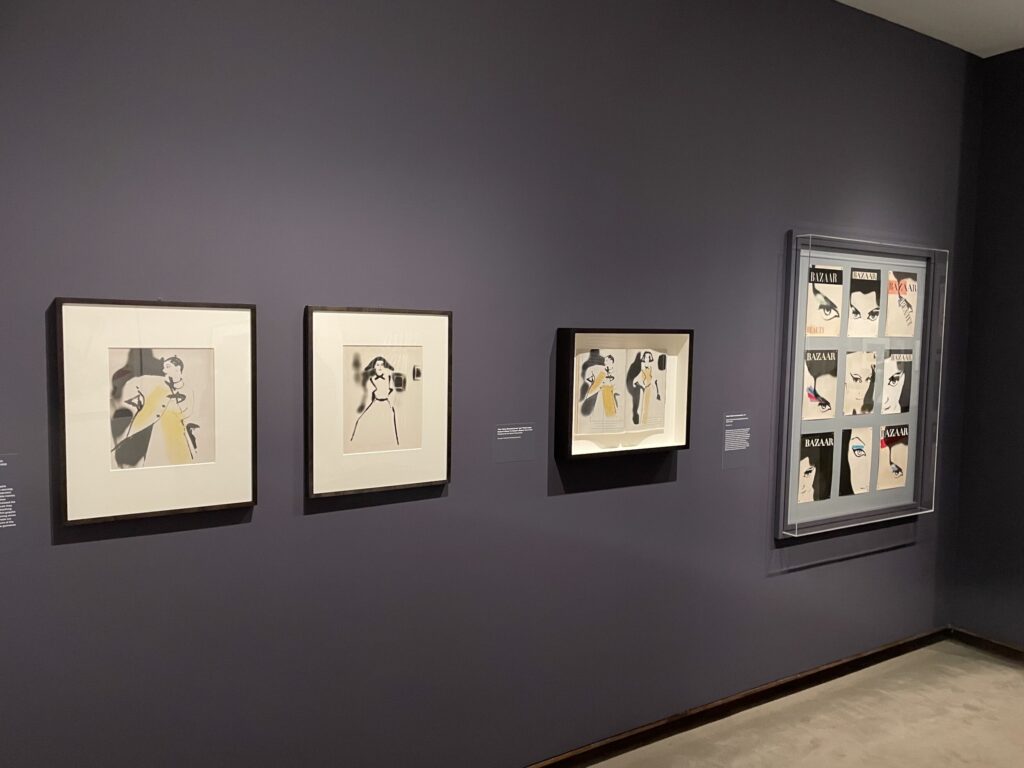
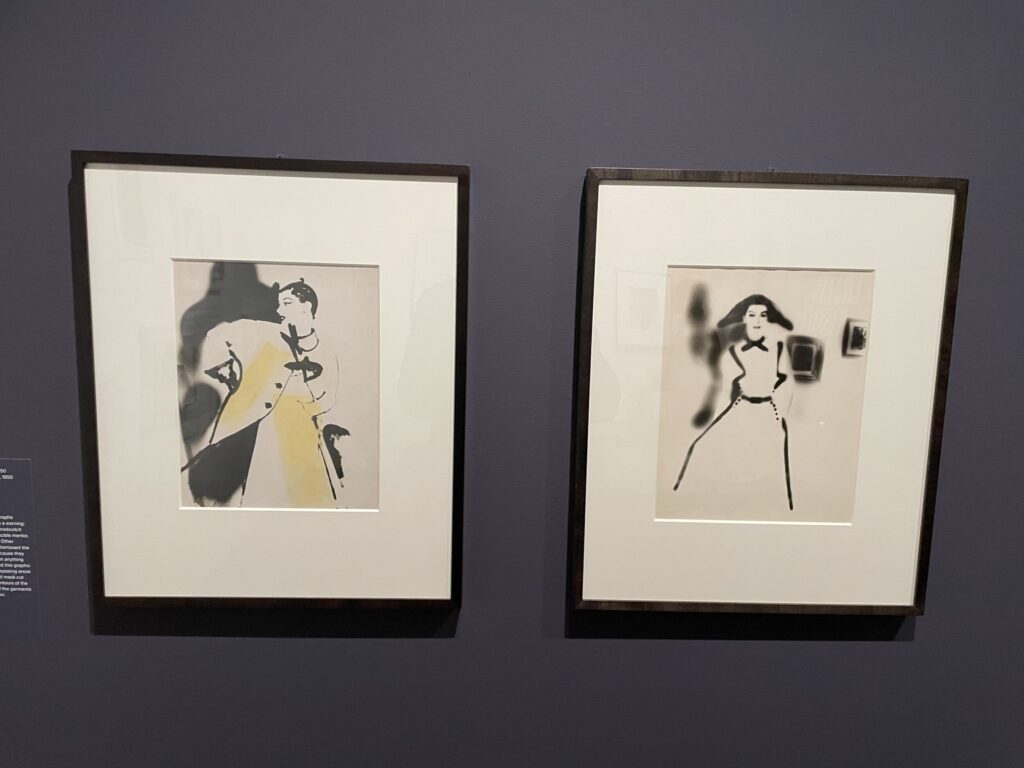
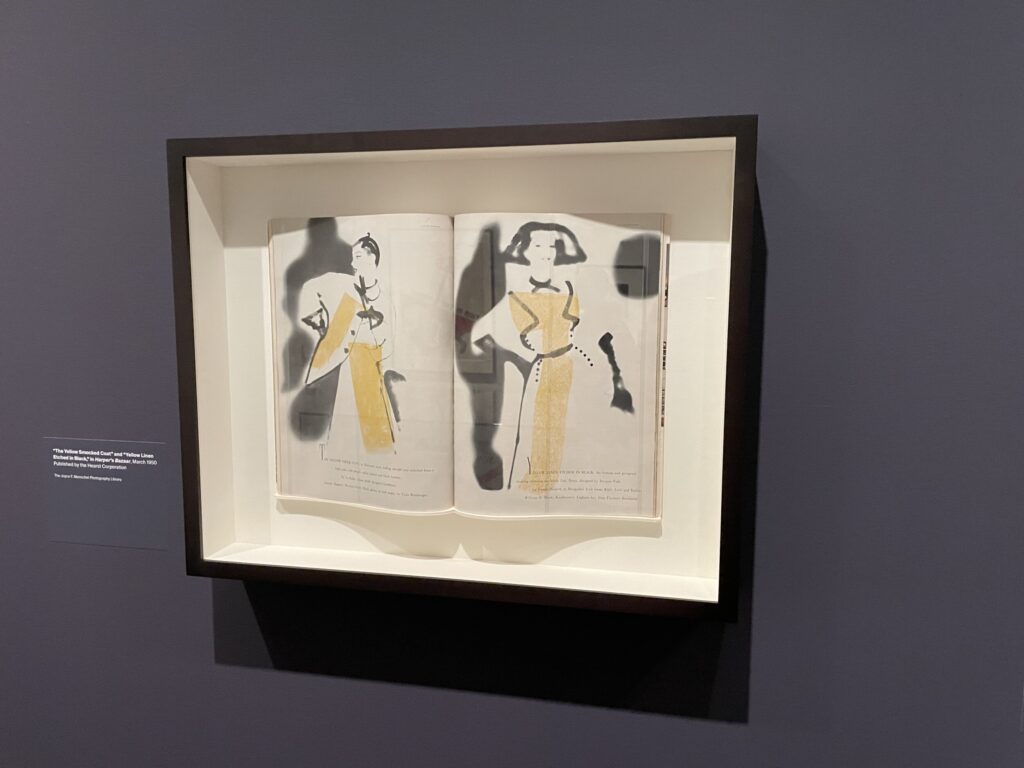
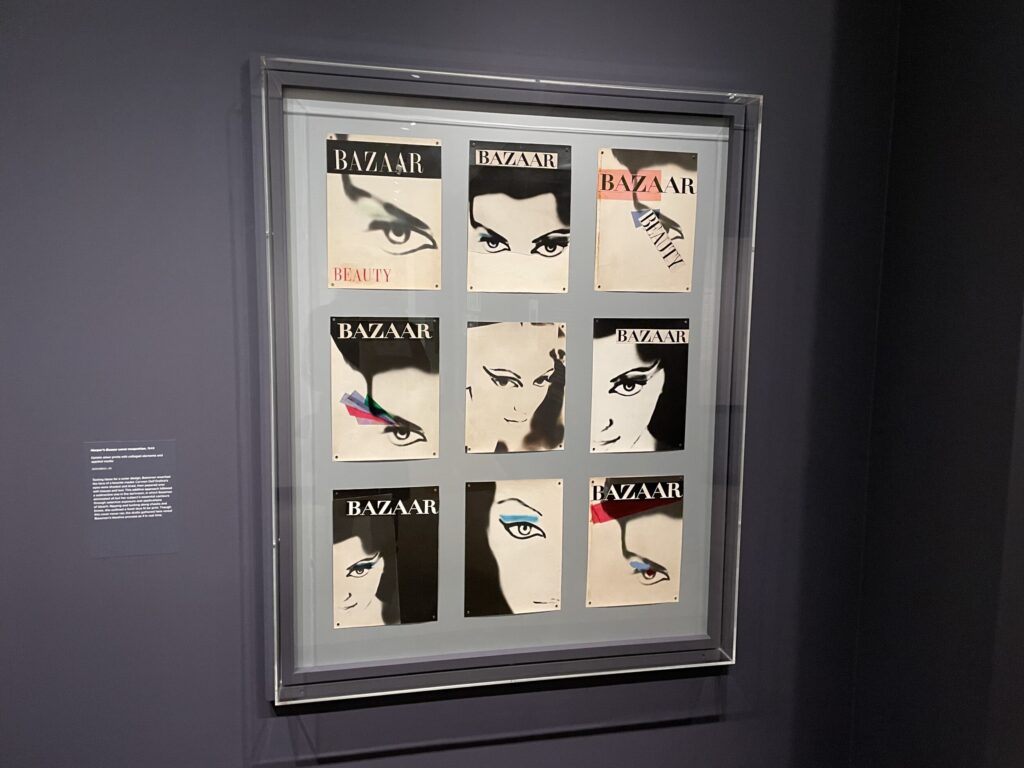
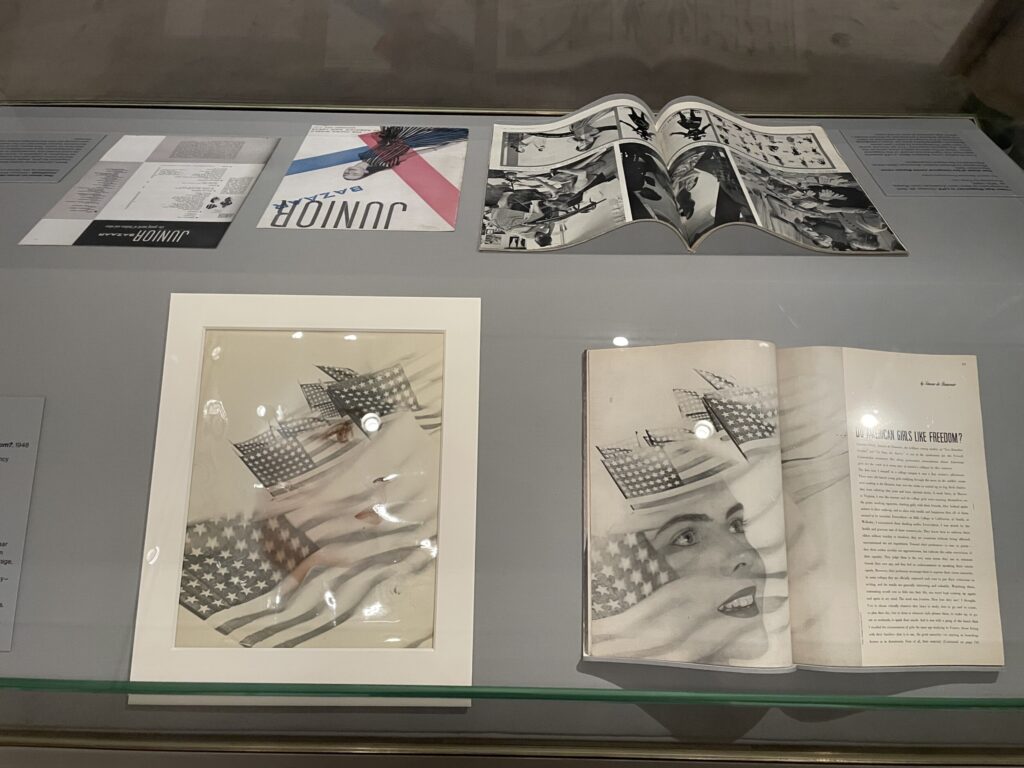
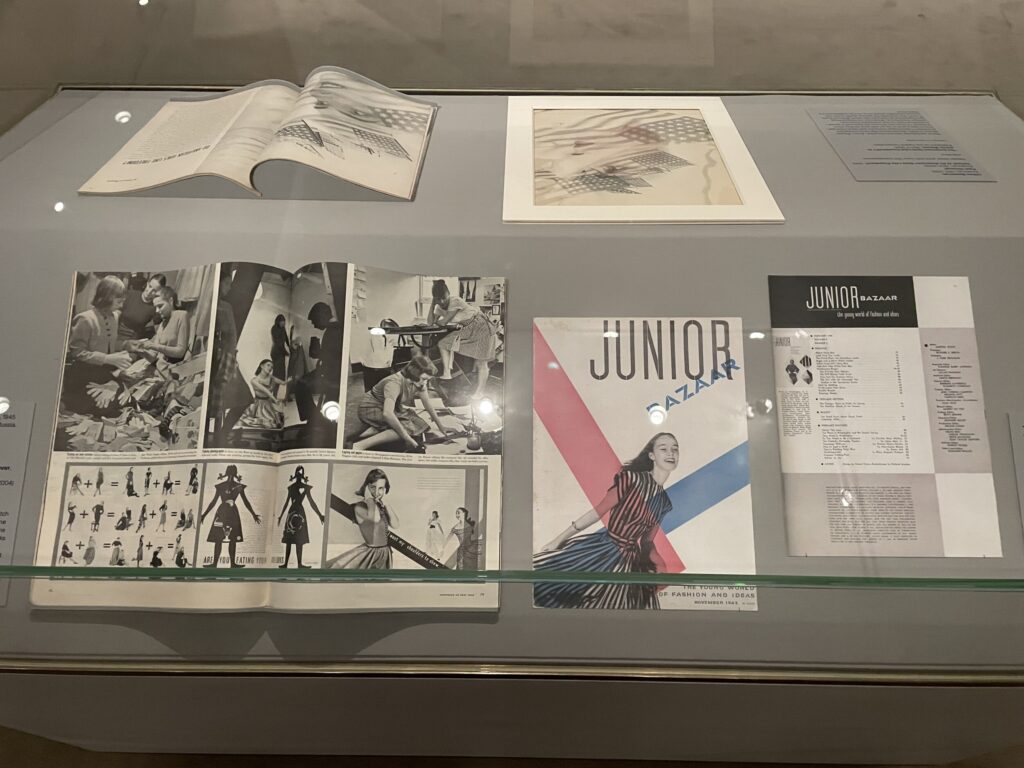
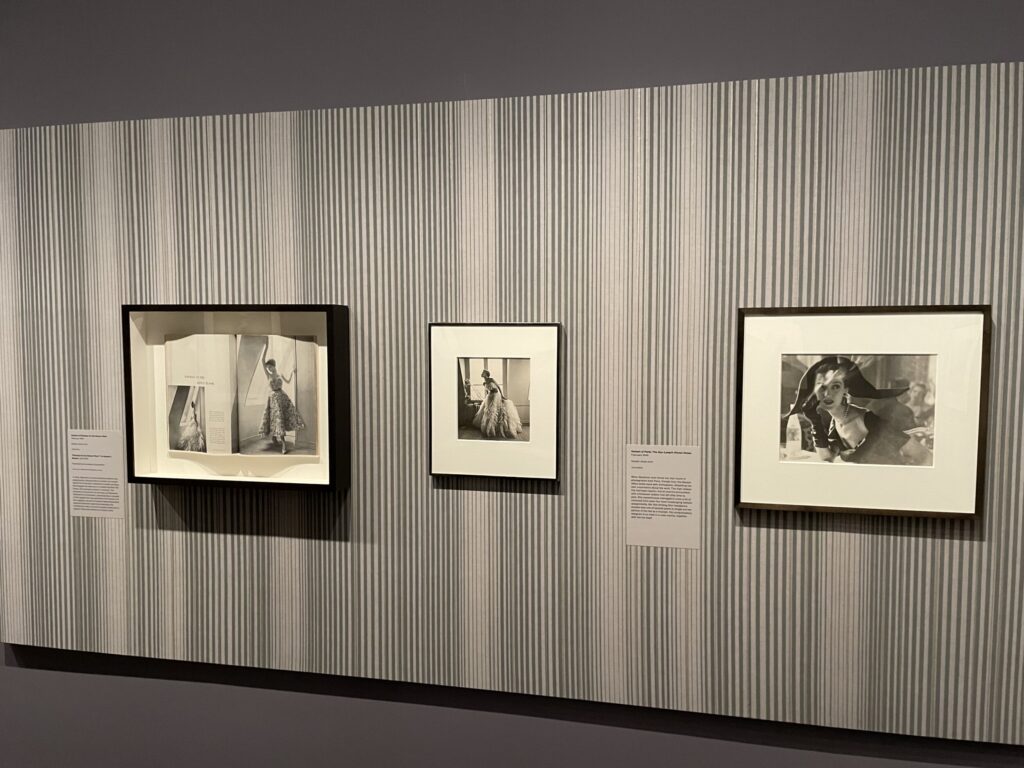
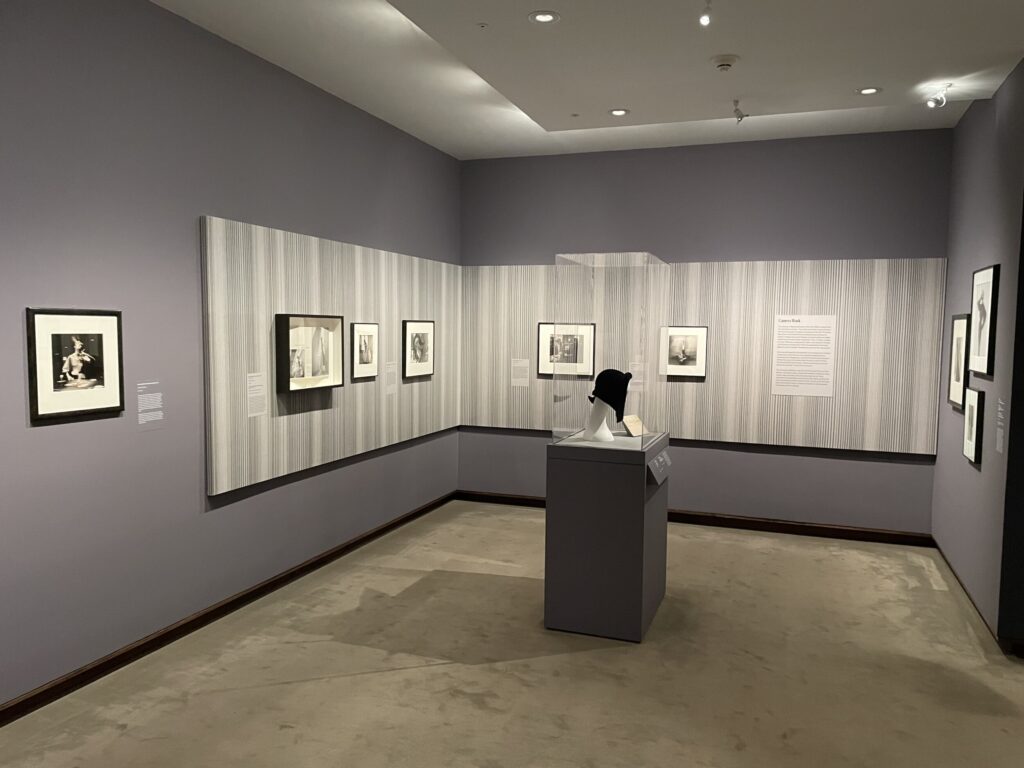
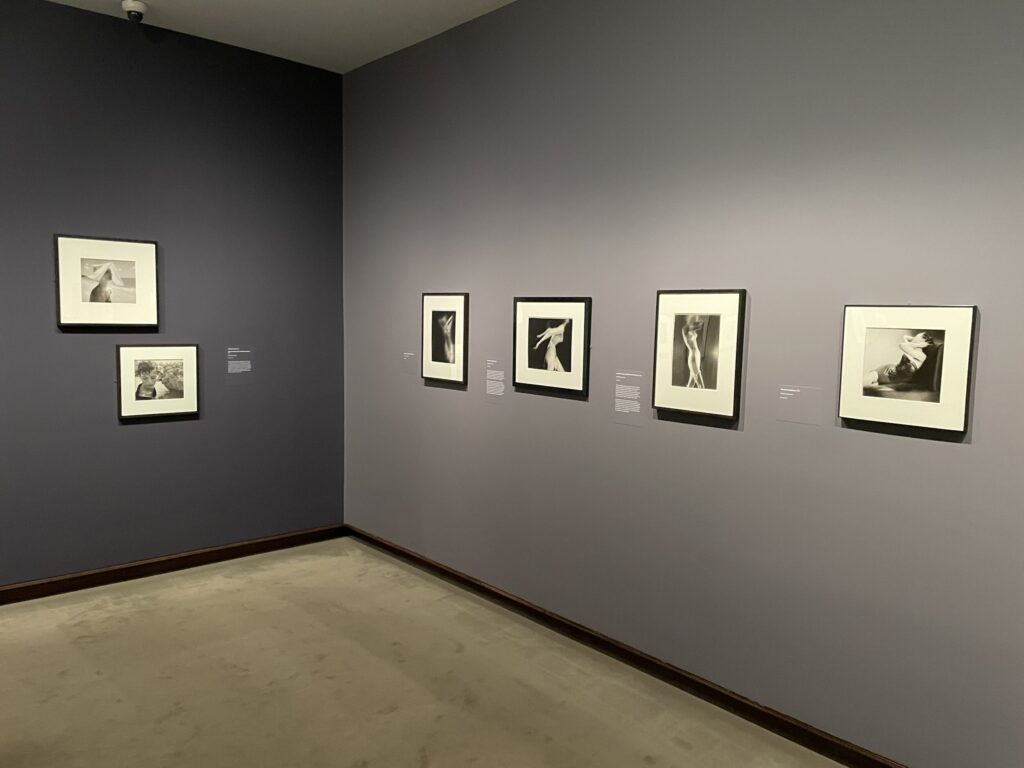
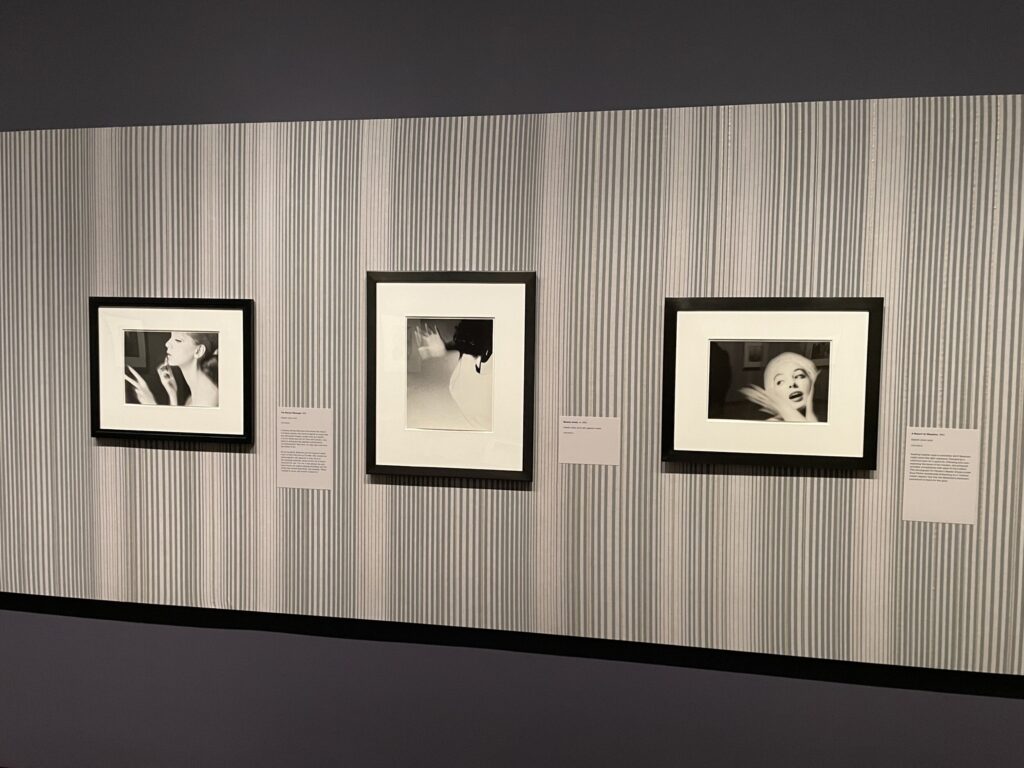
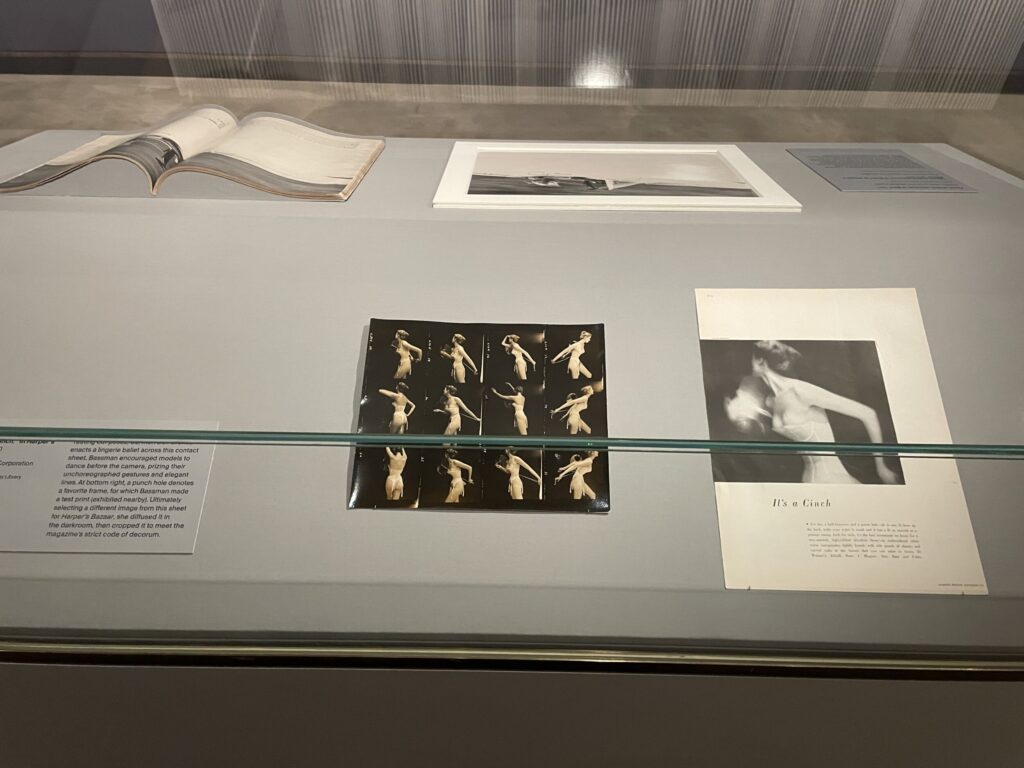
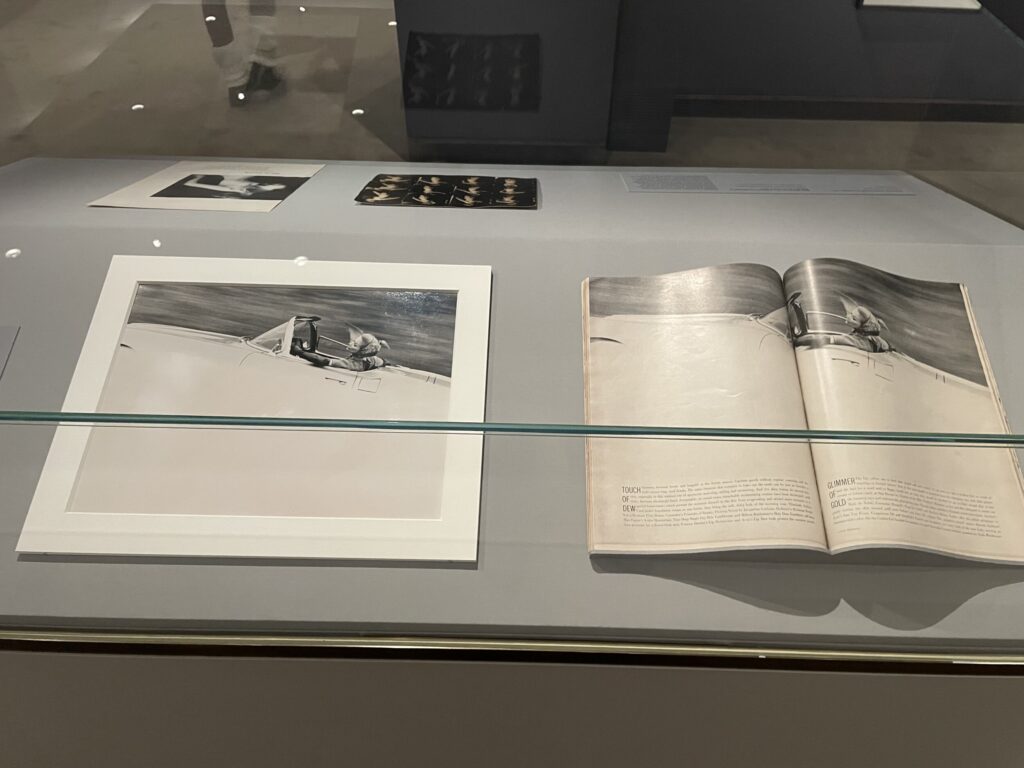
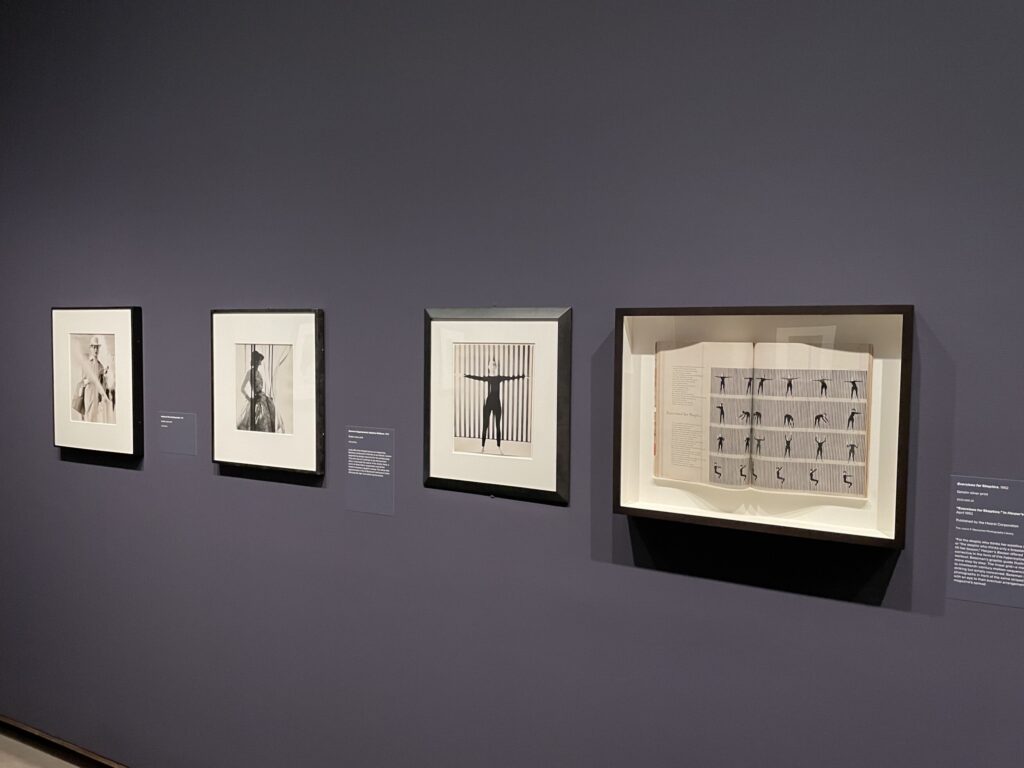
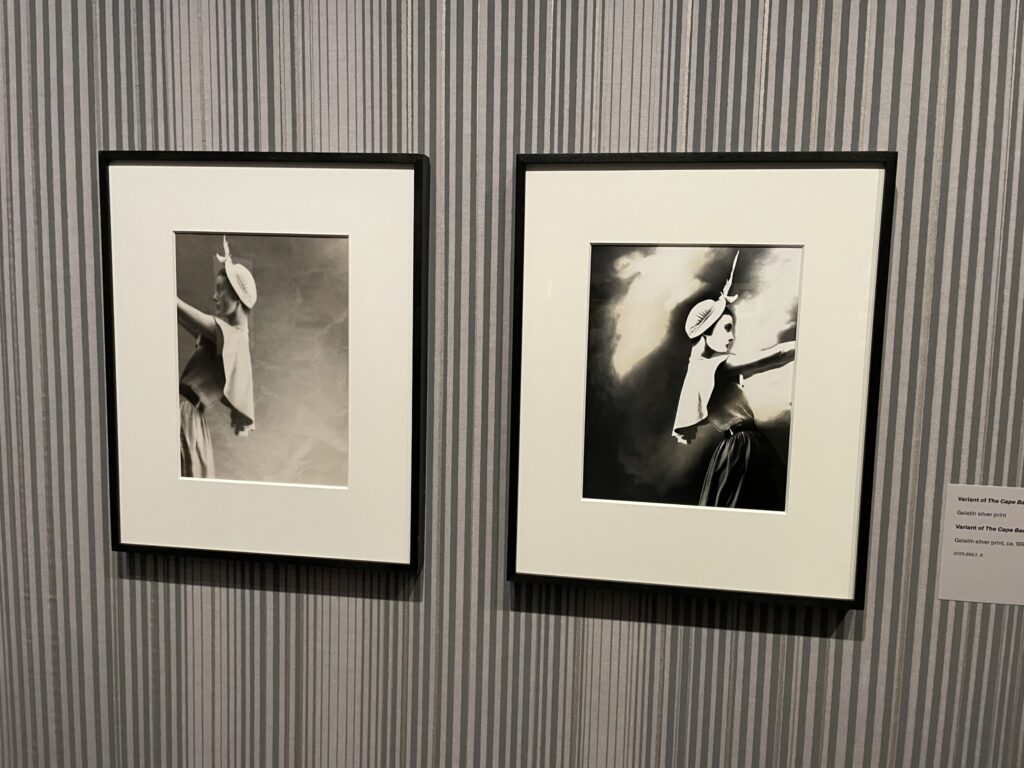
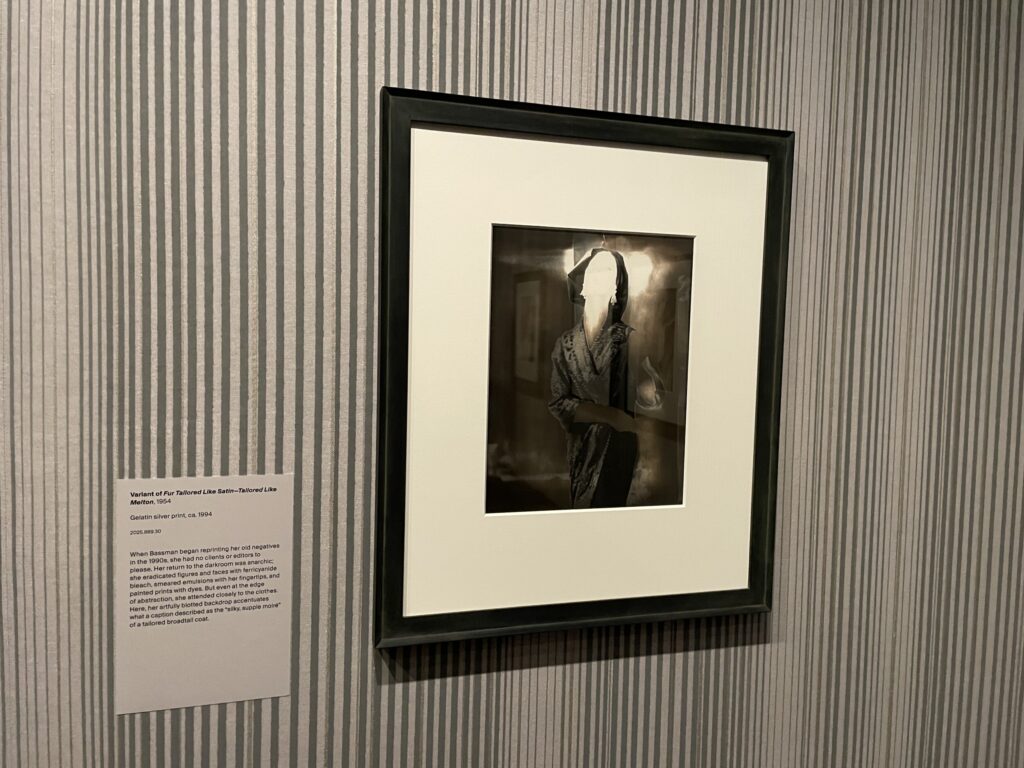
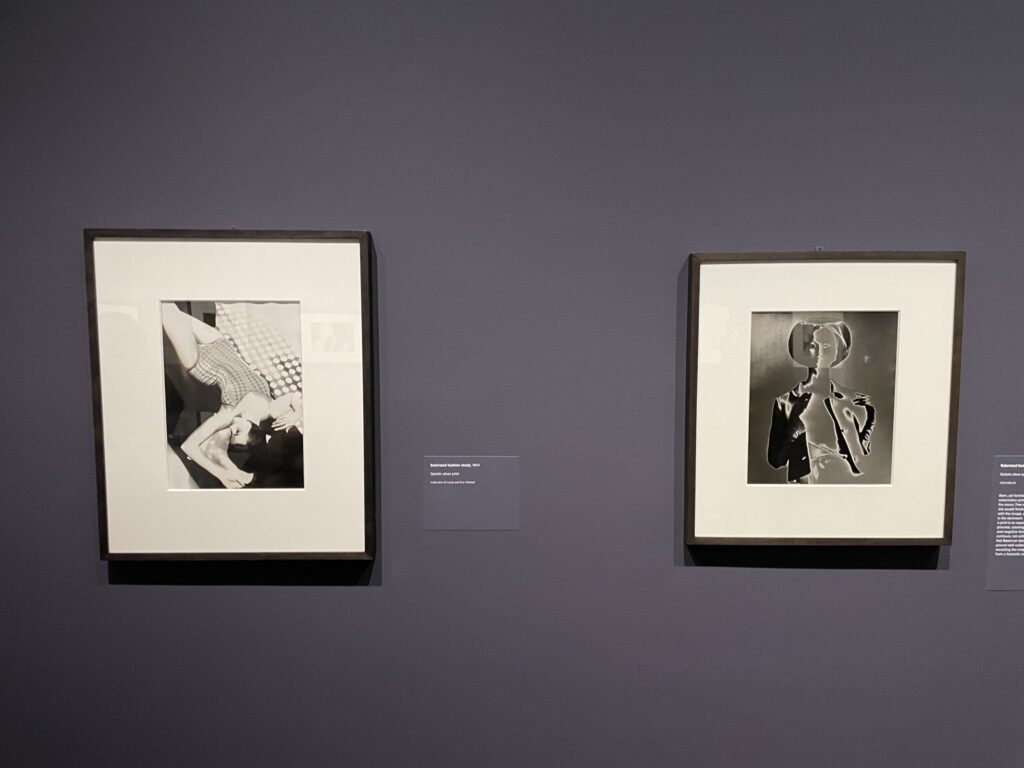
Comments/Context: If we start with the structural idea that art making can be thought of as a focused exercise in creative problem solving, an artist’s unique eye or aesthetic is then built on the kinds of problems he or she has spent time trying to solve. Consistently wrestling with landscapes might lead to a certain set of successful (and unsuccessful) approaches, while diving into abstraction might yield an entirely different range of workable techniques and domain knowledge. In Lillian Bassman’s case, before she really picked up a camera full time and made her name as a fashion photographer, she spent half a dozen years working as a magazine art director, thinking about the design and layout of pages and the constraints of covers and spreads, and as seen in this smartly edited show, it is this mindset that ultimately informed her eye as a photographer.
In 1940, in her early twenties, Bassman took a design seminar with Alexy Brodovitch, who was, at the time, the art director at Harper’s Bazaar. She leveraged that classroom experience into a job on his team of artists and editors, and over the next several years, she assisted him and helped lay out the magazine. Their reimagined design was quietly revolutionary, bringing modernism together with pieces of Bauhaus clarity, Constructivist logic, and a touch of Surrealist energy, blending bold type, graphics, and photography (particularly montage) with dynamism and verve. Bassman then went on to become the art director of Junior Bazaar (from 1945 to 1948), a spinoff publication aimed at teenagers, where she applied a similarly inventive eye to adolescent themes and campus issues. The first room of this succinct show covers this early ground, with standout examples of collage and poster collaborations, cover designs incorporating tinted geometric scrims and bold symbols, and spread designs featuring photography mixed in with graphic elements like oil derricks, arrows, and criss crossed lines of text. In each example, Bassman is starting with relatively straightforward images of women’s faces or young women wearing fashionable dresses and infusing them with pops of unconventional framing and positioning, bringing fresh stylized energy to the photographs and stories.
In the late 1940s, Bassman started to make her own photographs, and it’s clear that from the very beginning that she was actively leveraging what she knew from her experience as an art director to craft images that would function well in the context of the magazine. Many of her first images pushed fashionable female faces and bodies toward approximation and near abstraction – heightening shadows, bleaching away detail, cropping down to eyes or profiles, and streamlining photographic specificity down into resonant expressiveness. In this way, the silhouette of a dress might become a boldly emphatic line, or a frontal view might simplify down to a few gestures. Compared to contemporary fashion examples from Man Ray, Irving Penn, and George Hoyningen-Huene hung nearby, Bassman’s early photographs look altogether brash and revolutionary, liberally using darkroom techniques to transform fashion into atmosphere, mood, or essence.
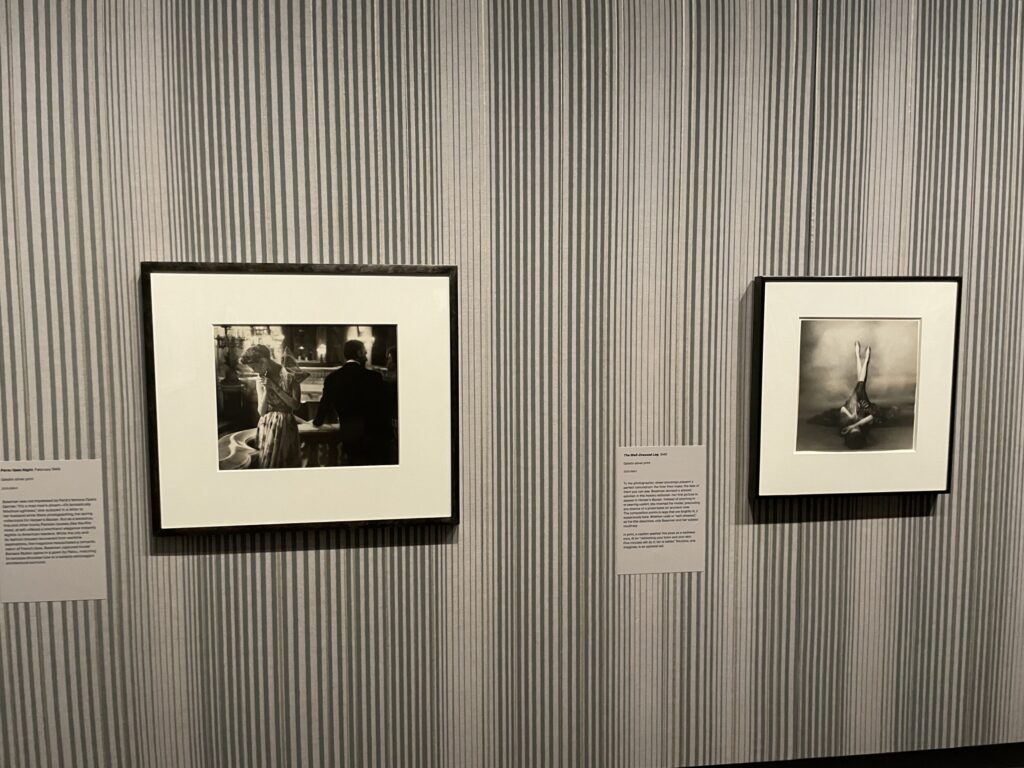
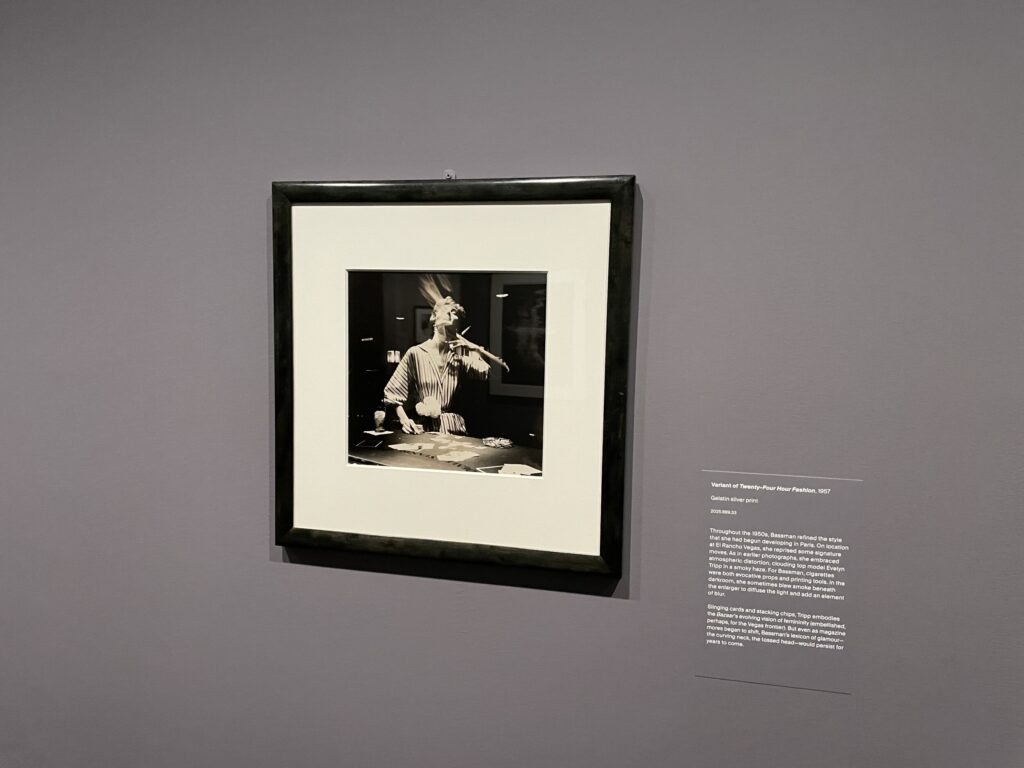
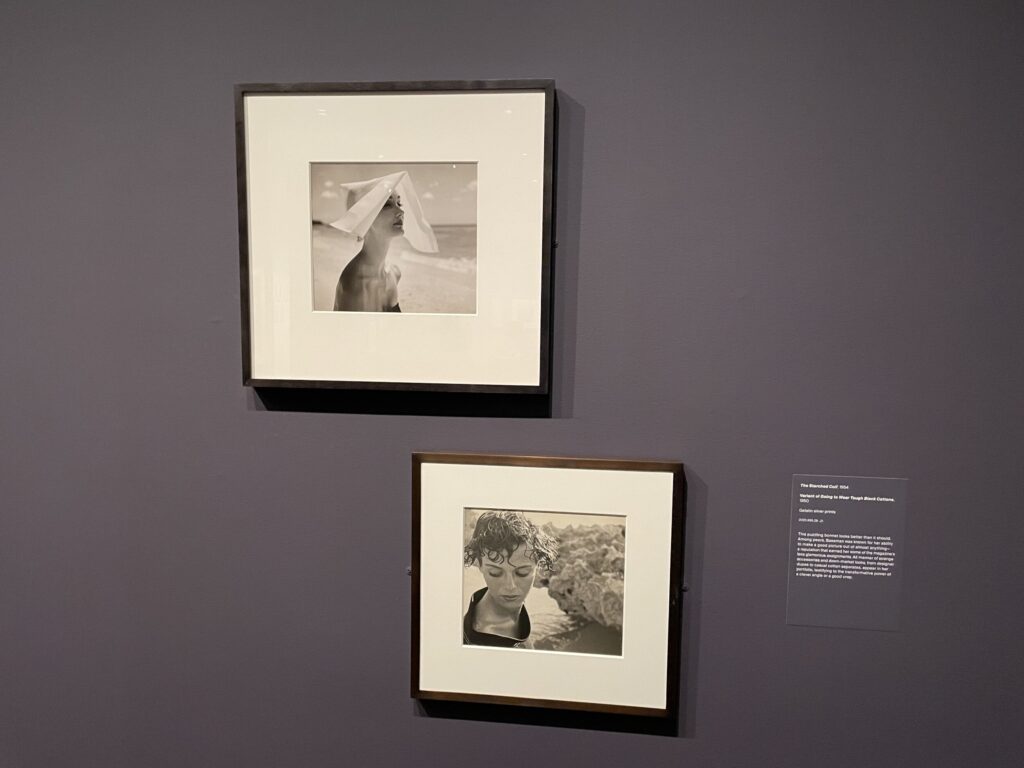
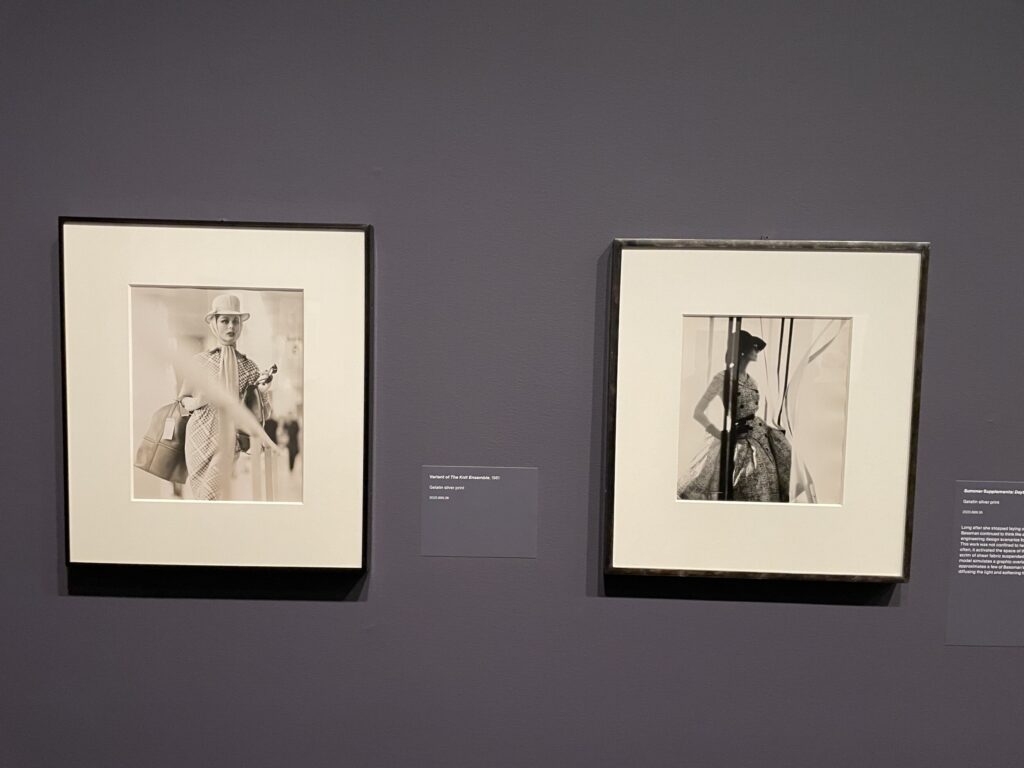
Of course, not every assignment lends itself well to such out-of-the-box thinking, and so Bassman had to find other creative ways to solve problems and reimagine tired setups. Again and again in this show, Bassman smartly upends and redirects our expectations. To show off stockinged legs, she inverts the model, placing her lying down with legs up. In featuring the elegant swoop of a Dior couture hat, she places it on a model in a cafe, with flares of light and drifts of smoke crafting a glowingly seductive daytime atmosphere. To capture the volume of an extremely frilly full length gown, she stages the model in the angled windows of a garret, using the spare architecture as a visual foil. To add misdirection to a full length setup, she allows a handrail to intrude or a hanging scrim to add diffusion. She uses distorted blurs to interrupt a striped blouse gambling setup, organizes an unbalanced windblown driving composition to fill a full spread, and styles hair with a starched towel at the beach (like a modern version of an 18th century Dutch headpiece) or wet messy ringlets similar in form to a nearby outcropping of rock. Every trope offered a visual challenge to reimagine it.
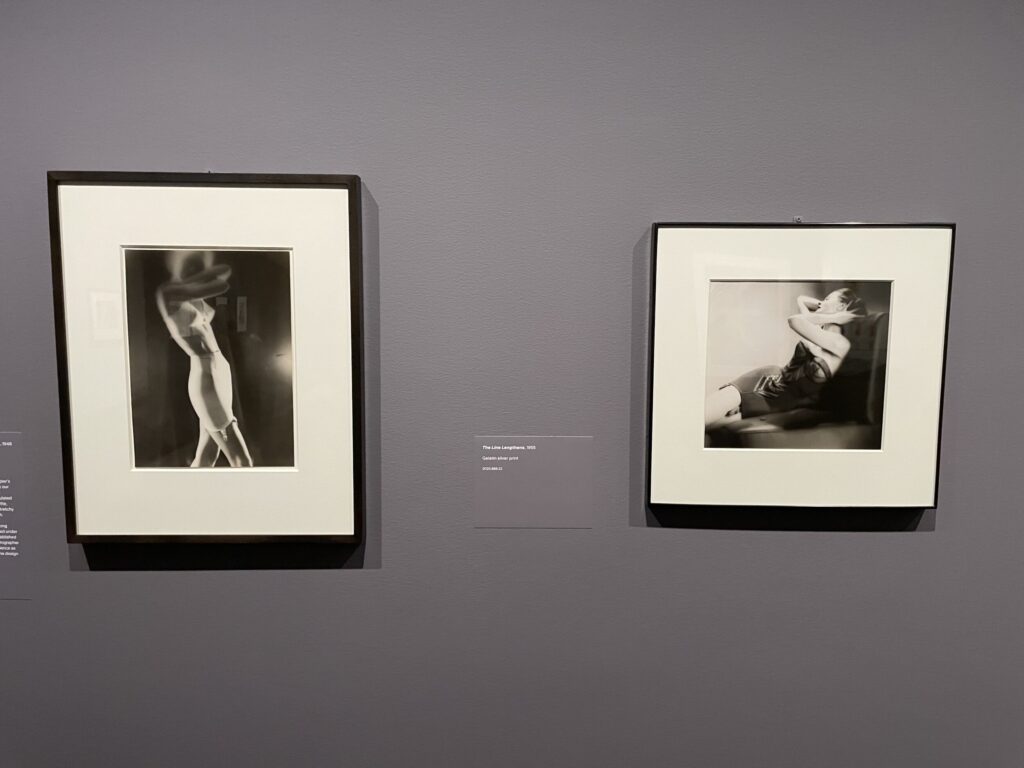
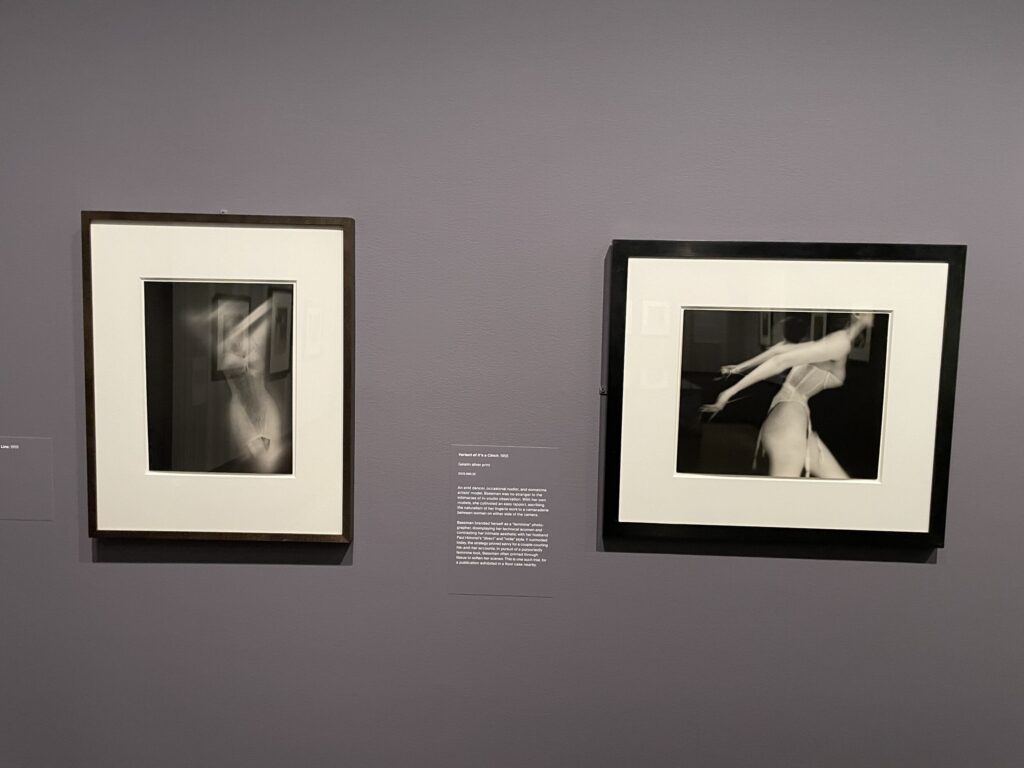
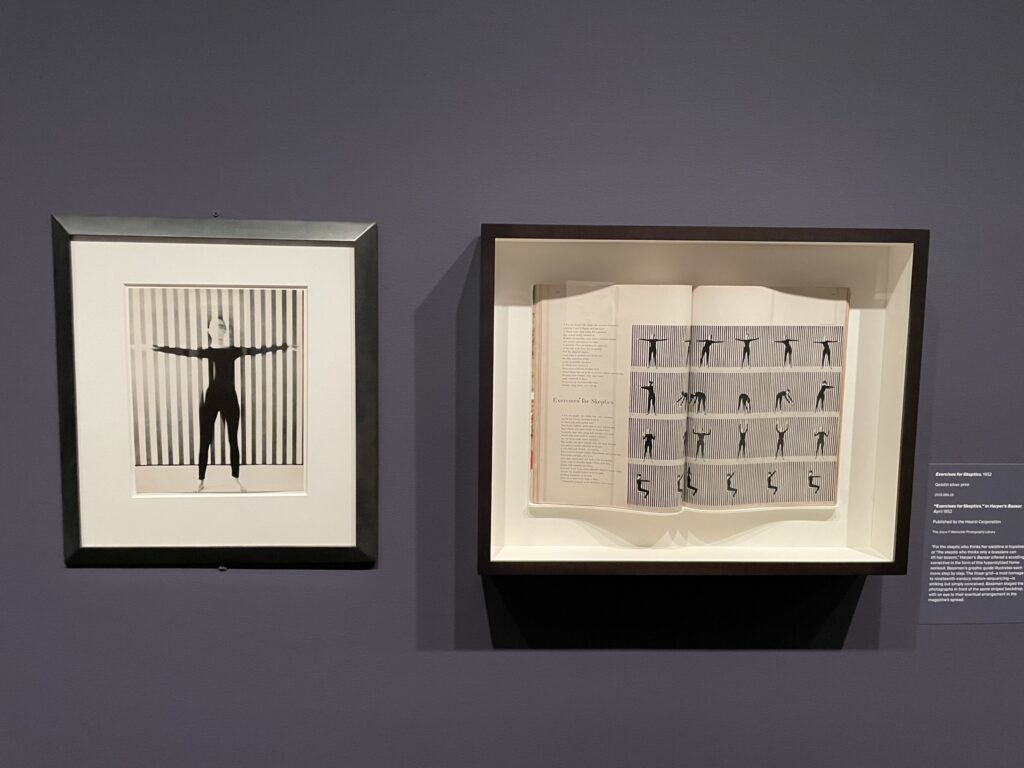
As Bassman moves into the 1950s and beyond, her confidence continued to increase and she pushed further and further toward experimental approaches. Photographs of women in lingerie were particularly tricky, and Bassman raised the bar repeatedly, with elegantly clean lines, wispy dissolving blurs, accentuated angles, and active movements used to show off different designs. She applied some of these same approaches to photographs of beauty regimes, adding improvisational poses and momentary blurs to soften the gestures of washing faces or applying lipstick. Even stay-fit athletic exercises were given this kind of synthesized visual treatment, with a black-body-suited model going through a routine against a bold vertically striped background, thereby allowing the images to be neatly arrayed in a continuous grid across the magazine spread.
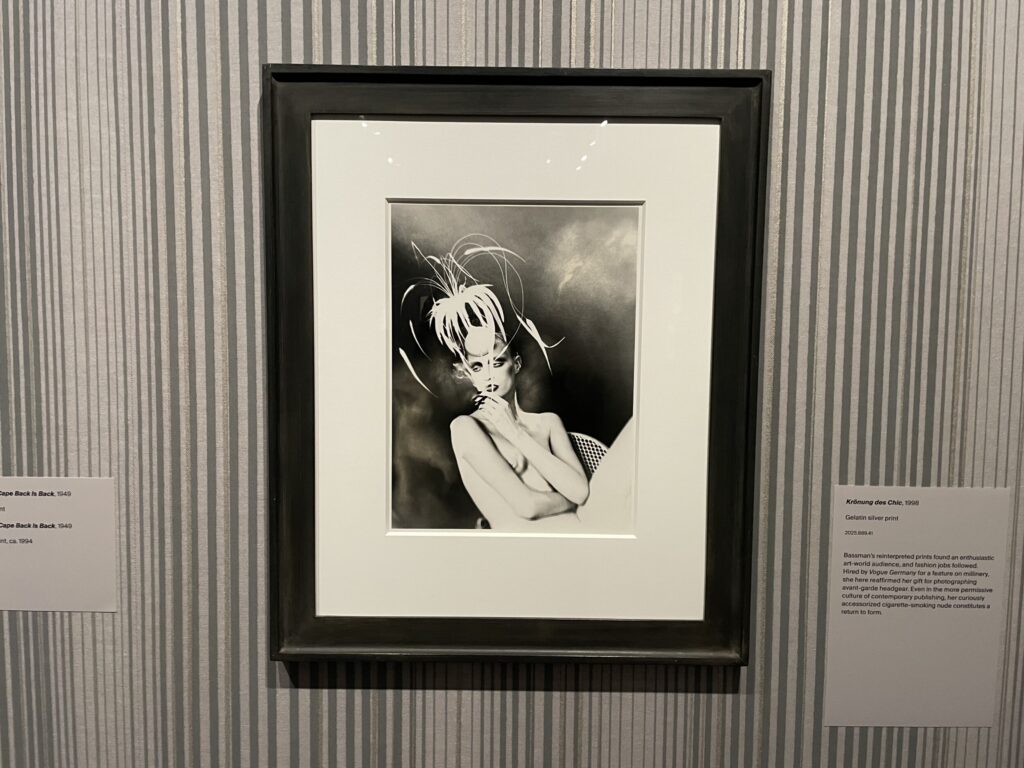
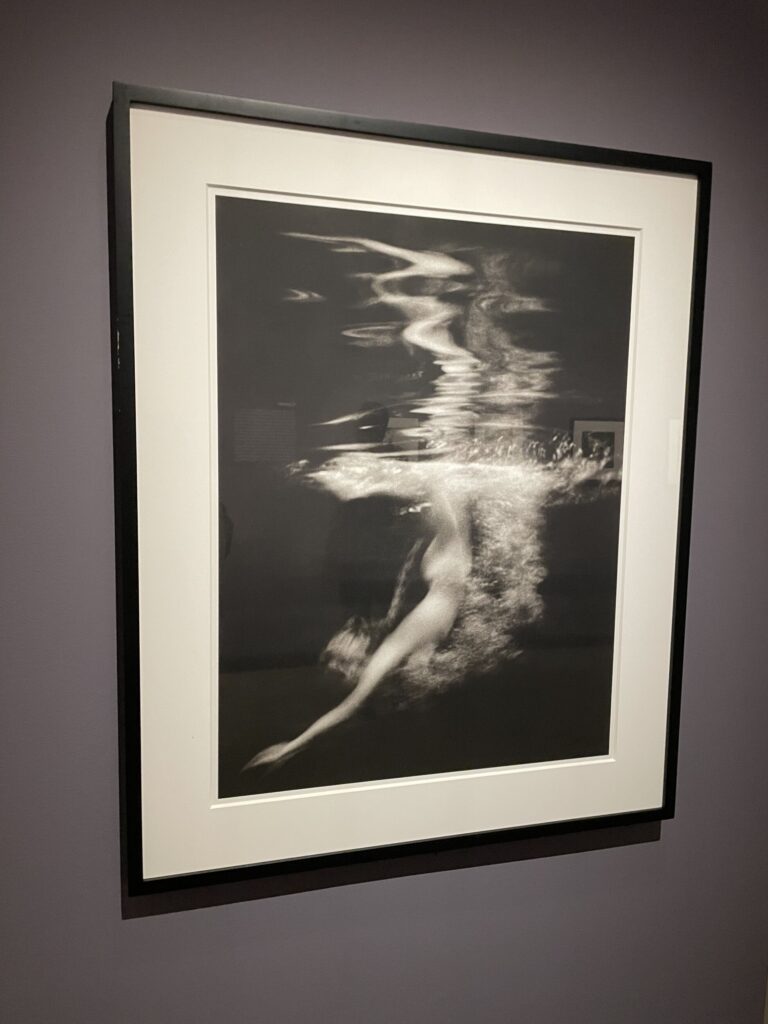
Bassman’s lasting legacy in fashion photography likely lies in the images she pushed the farthest toward the avant-garde within the context of her art director’s aesthetics, where bleaching, solarization, and other extreme darkroom techniques erased faces, amplified silhouettes, and created high contrast flares of light and dark that made the lines of a dress stand out – she took the existing visual vocabulary for fashion and brashly streamlined and personalized it, paring it back to a set of gestures that clearly communicated the redefined essentials of modern glamour. Later in the 1990s, Bassman reprinted some of her old negatives, driving them further toward abstraction with painted dyes, smeared emulsions, and relentless reduction of form, as seen in just one print in this show, an underwater view that deliberately dissolves into wavy distortion. Recent gallery shows (like those in 2016, reviewed here, 2012, reviewed here, and 2009, reviewed here) have often focused on these later re-interpretations, but this show largely aims us back at the foundational roots of those ideas, where the initial innovations first took shape.
While this show was almost certainly donation driven (in the form of a recent gift from Paul Himmel’s children), the Met curators have massaged the recently acquired works into an important story about Bassman’s rightful place in the evolution of fashion photography in the 1940s and 1950s. What’s intriguing is that it turns out to be a tale of radical transformation from within, where Bassman upends recurrent fashion motifs with a perspective that melds insider knowledge and outsider risk taking – she knew just enough about what would work (and what wouldn’t) to push on the areas where change was possible. To me, this gives her the aura of an artistic entrepreneur, who has the insight to recognize the pressure points where existing structures can be courageously torn down and discarded, thereby making the necessary space for new ideas.
Collector’s POV: Since this is a museum exhibition, there are of course no posted prices. The estate of Lillian Bassman is represented by Edwynn Houk Gallery in New York (here), Staley-Wise Gallery in New York (here), Atlas Gallery in London (here), and Peter Fetterman Gallery in Santa Monica (here), among others. Bassman’s prints have become more consistently available in the secondary markets in recent years, with prices ranging between roughly $2000 and $50000.




One of the best exhibitions in New York that no one knows about. Thank you for reviewing this Loring. Hopefully non photographic people will discover her work when the lines for the Raphael exhibition are snaking down the corridors of the Met . In saying that this is not an easy gallery to find if you are not in the know.