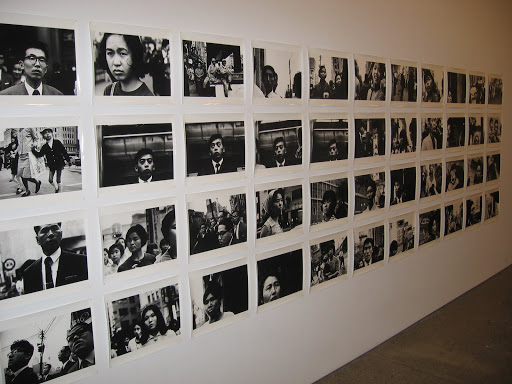
 JTF (just the facts): A total of 305 black and white prints from three different projects, displayed in the main gallery space. Ginza (1963-1972) is comprised of 212 prints, each 14×17 or reverse, pinned directly to the wall, shown in three large grids. Subway (1963-1972) includes 80 prints, each 8×10, pinned behind plexiglass but not framed, arrayed in small series and groups along one wall. Untitled (1970) is made up of 13 small prints (5 1/2×4 1/2), framed in brown and lined up on an interior wall. (Installation shots at right: Ginza, top, Subway, middle, Untitled, bottom.)
 The exhibit of Araki’s work currently on view at Anton Kern goes back to the beginning of his career and examines some of his first projects from the 1960s and 1970s, before he fully embraced his mature style. Here we find him shooting roll after roll on the streets and in the subways, testing framing techniques and camera angles. The Ginza series, taken on the streets of the fashionable shopping district, are mostly contrasty head shots and tight close ups, dark and indirect. He captures his subjects in both traditional and Western dress, with a sense of style that is reminiscent of William Klein. There are plenty of shadows, but these streets are not gritty, they are glamorous. And while not every shot is a winner on its own, as a group, the images show an evolving working style and energetic eye, telling a well rounded story of this particular place and its people.
 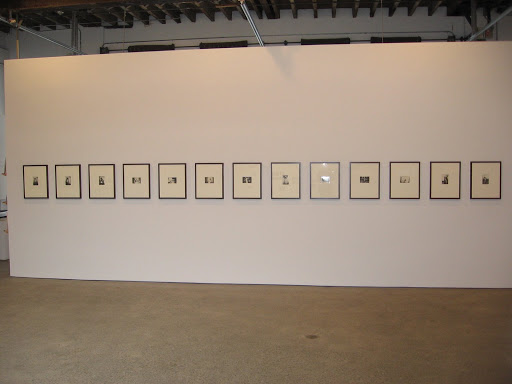 In the Subway pictures, Araki follows in the footsteps of Walker Evans, shooting multiple frames of bored travelers and commuting salary men riding the crowded trains. These pictures have more narrative to them, displayed in groups of several images, allowing the viewer to watch a scene unfold over a short time window. The Untitled images show us the beginnings of Araki’s more erotic vision. In these pictures, the same thin framed woman, with an oval face and big round eyes reminiscent of an anime character, is photographed in various nude poses, from demure to direct.
This exhibit broke many of my preconceived notions and pigeon holes for Araki’s work and made a compelling argument that his talents are much broader than generally perceived. Even if you are not a fan of Araki’s more recognizable images, this is a well constructed show that brings forth some thought provoking historical precedents for his later work.